

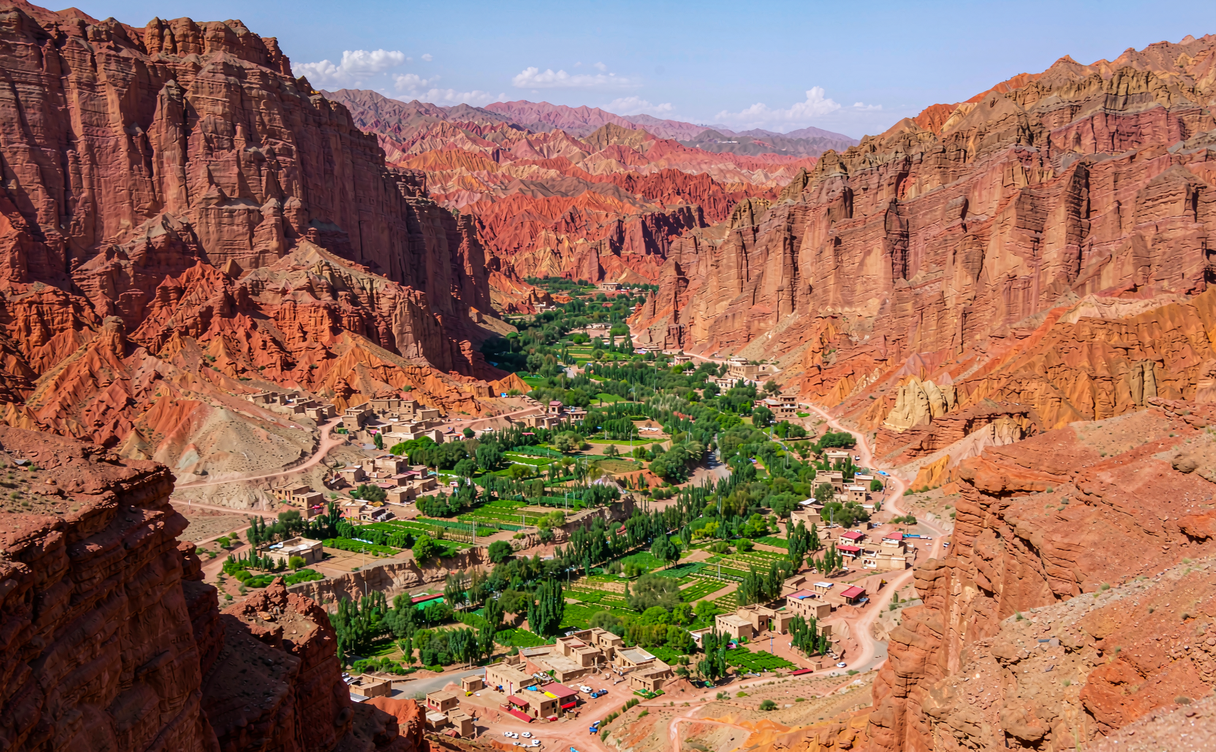
Tuyoq is the place in Turpan where the desert and the oasis argue in public. One minute you are standing in a red sandstone canyon that looks like it was painted for a sci-fi set, and the next you are drinking green grape juice in a shady courtyard full of vines. Forty kilometres east of Turpan city, in Turpan Prefecture of Xinjiang, China, Tuyoq is the canyon village we recommend to anyone who thinks the Turpan Basin is just a hot flat empty rectangle.
The official name is Tuyoq Gorge (吐峪沟), and the site covers three things that sit within a few hundred metres of each other: a narrow gorge cut through the Flaming Mountains, a working Uyghur village of flat-roofed mud houses wrapped in grape trellises, and the Tuyoq Thousand Buddha Caves, a national heritage site of painted Buddhist grottoes older than most of the stuff in the Mogao grottoes. We have been here in July when the thermometer at the Flaming Mountain weighbridge beside it read 47°C in the shade, and we have been in October when you could walk the gorge in a jacket. Both are real.
The encyclopaedia entry on the Flaming Mountains explains the red iron-oxide sandstone and the faulting that lifted it out of the basin floor. Reading it is useful. Standing in the gorge is better.
Best time to visit Tuyoq
The best time to visit Tuyoq is April to early June, and mid-September to October. Turpan is one of the hottest inhabited places on earth and the basin floor sits below sea level, so heat is not a footnote here, it is the whole weather system. May averages 20–32°C and the vines are green; October averages 12–25°C and the grapes are off the trees but the light is the best of the year.
July and August are possible but require discipline. The gorge has almost no shade, the rock holds the heat until well after sunset, and the walk-in from the car park is exposed. We now do Tuyoq in August only before 9am or after 6pm. If you insist on summer, bring two litres of water per person and stay on the shaded side of the gorge, where the seep springs run.
Winter is short and surprising: December and January in the basin can drop to −10°C, and the gorge is genuinely beautiful with frost on the red rock and nobody at all around. The village restaurants keep shorter hours. Build the rest of your year around that window and the trip stops being a heat problem.
How to get to Tuyoq
Tuyoq is east of Turpan, past the Flaming Mountains weighbridge, and the road is good. Three options:
- Taxi or ride-hail from Turpan: 40 km, 40–55 minutes, ¥100–150 each way. This is what most foreigners end up doing. Agree a wait time — the gorge car park is a 30-minute walk from the village in summer heat and you will not want to negotiate a second fare.
- Long-distance bus: Turpan’s long-distance station runs services east toward Shanshan that stop at Tuyoq. Cheap (¥10–20) and slow, and you will need the driver, or a colleague, to point you out.
- Self-drive: easy. The road is straight, well signed, and you can continue to Shanshan and the Kumtag Desert edge if you want the full day.
On-site, entry to the Tuyoq scenic area runs around ¥60–80 per person depending on the season, with a shuttle bus charge of roughly ¥20 from the parking area to the gorge mouth. Opening hours are roughly 9:00 to 19:00 in summer and 9:30 to 18:00 in shoulder season. The China high-speed train guide for foreigners helps if you are reaching Turpan by rail and want to understand the network before you start hiring cars.
Things to do at Tuyoq
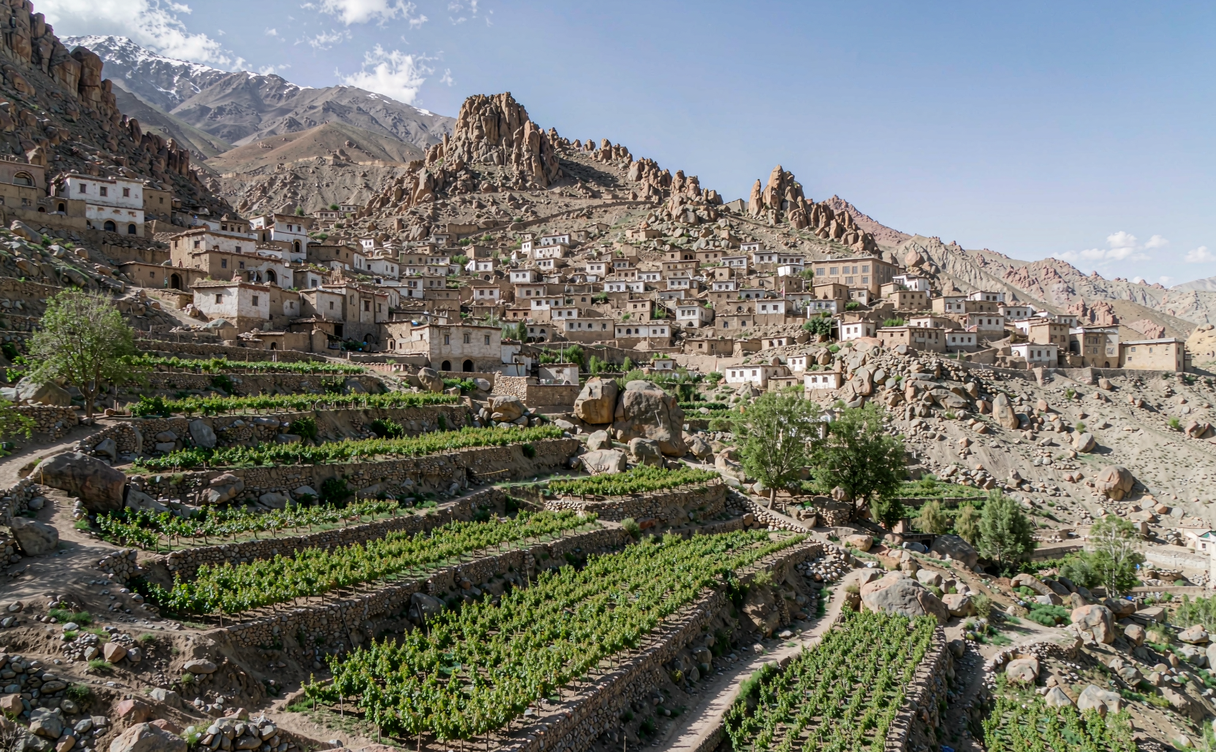
Start with the village. Tuyoq is a living Uyghur settlement, not a reconstruction, and the whole point is that people still sleep, cook and pray here. Wander the narrow lanes behind the main street. Flat roofs, pigeon towers, grape pergolas over the pavements, and the wood-fired bread ovens that line the lane to the Mosque of Tuyoq. Locals will usually wave you in for tea; a small gesture goes a long way and a photograph of someone’s kitchen without asking is not on.
Then do the gorge, which is the reason you came. The path enters between two walls of rust-red sandstone that narrow to about a metre and a half in places. It is a scramble in a few spots, fine in trainers, and it climbs. Allow 90 minutes for the out-and-back and do not attempt it in mid-July at noon.
Finally, the Tuyoq Thousand Buddha Caves (吐峪沟千佛洞). Carved into the canyon wall, these grottoes date from the 5th and 6th centuries and carry remnants of mural painting in a style that sits between Central Asian and Chinese Buddhist art. A few chambers are open with a guide; rope lines protect the surviving pigment. It is a quiet, slightly eerie place and almost always empty.
Inside the gorge
The gorge is short. From the entrance to the furthest accessible point is around 1.5 km, and the character changes three times. The first 300 metres are a broad, walkable basin with birch and willow by the stream — this is the shade end. The middle is the slot: tall vertical walls, a faint trail, and the best sound in Turpan, which is water going somewhere underground. The last stretch climbs onto a bench above the canyon with a view back down the red funnel.
We tell people to go up rather than across. The high bench is where the whole village laid out below the wall reads as one object, and it is where most of our photographs came from.
Photography note: the rock is genuinely that colour at 7am and it goes flat grey-blue by 11am. Shoot the gorge early, spend the middle of the day in the village courtyards, and go back for the canyon at 6pm when the walls go violet.
What most visitors miss
Two things. First, the Karez channels above the village — the gravity-fed underground aqueducts that make Turpan a green oasis in a below-sea-level desert. Several stone-lined channels run down the hill behind Tuyoq and you can trace them from the gorge rim. Second, the grape-drying houses on the outskirts, tall brown walls of stacked lattice where the seedless grapes of Turpan are dried into 葡萄干 by autumn.
Go at opening time, walk the gorge before 10am, and spend the late afternoon in the village lanes instead of the viewpoint — the canyon looks best early and the village makes more sense slow.
Where to eat and where to stay in Tuyoq
There is a small cluster of village restaurants on the main lane serving 拉条子 (hand-pulled noodles), 拌面 with a cooling cucumber salad, 烤包子 (oven-baked mutton buns, ¥5 each), and 缸子肉 (lamp in a small clay pot). A meal for one is ¥25–45; for two, ¥70–100. Drink the local 葡萄汁 — it is pressed from the seedless grapes and it is cheap and cold.
There are guesthouses in the village with a handful of rooms, ¥150–280 a night, and courtyards that stay cool through the evening because the walls are half a metre thick. If you want a pool and an air-conditioned lobby instead, stay in Turpan city and drive out. For the wider choice, our Turpan travel guide lists the hotels by area.
Practical tips before you go
Carry cash. Small village restaurants and the ticket gates at the far end of the gorge often cannot take a foreign card, and WeChat Pay with a foreign card is unreliable out here. Learn two phrases in Uyghur — rahmat (thank you) and yaxshi (good) — and the whole village opens up. Wear a hat and closed shoes; the gorge floor is loose gravel and the rock is hot enough to scorch the soles of thin sandals at midday.
Dress modestly: this is a working religious village. Shoulders and knees covered for both men and women, and ask before photographing anyone inside a home or around the mosque.
If you are travelling the Silk Road in this region, give Tuyoq a full morning and pair it with the Musalla and the Karez system in Turpan city on the same day — together they explain how an oasis survives below sea level.
Pairing Tuyoq with the Silk Road loop
Tuyoq fits a Turpan day better than most people realise. The town itself holds the Karez, the Idkah Mosque and the Museum of the Turpan Uyghur, all within walking distance; the Turpan Silk Road guide maps the sites in the right order. East of Tuyoq the road runs on to Shanshan and the Kumtag Desert, where the sand meets an oasis town with no transition at all.
For a longer route, our Xinjiang travel guide strings Turpan, Kashgar and the Tian Shan foothills into a workable circuit. If you are still deciding, the best things to do in China roundup ranks the Xinjiang canyon villages among the country’s most unusual. First-time visitors should read our China travel guide for first-timers before hiring a car in the basin.
Final thoughts
Tuyoq is not remote in the way people imagine. There is a road, a car park, a ticket office and a restaurant serving noodles. But the moment you step into the slot in the canyon wall the noise stops and the red goes electric. We come back every year, almost always in the last week of October, and we have never once seen a crowded afternoon there. If you only have four hours in Turpan, spend them here rather than at the Flaming Mountain sign.
Arrange the car for a nine-hour day: Tuyoq gorge at opening, the village lanes over lunch, back to the canyon rim for sunset, and Shanshan’s desert edge on the way home.