

I still remember the moment I stepped through the narrow entrance of the Lingering Garden (Liu Yuan) and the city noise of Suzhou simply vanished. One small doorway, then a whole world of whitewashed walls, grey tile roofs, and carefully placed rocks opened up. If you are planning a trip to China and want to understand why the Chinese garden is considered an art form, this is the place to start.
The Lingering Garden is one of the four great classical gardens of China, and it sits quietly in the northwest of Suzhou, just a short ride from the old city center. In 1997 it was inscribed by UNESCO as part of the Classical Gardens of Suzhou, which tells you everything about its cultural weight. For me, the magic is not in any single building but in how the whole space is choreographed: you turn a corner and a new frame appears, like a painting that keeps unfolding.
Getting There from Shanghai
Most foreign visitors arrive in the region through Shanghai, and the good news is that Suzhou is one of the easiest day trips you can make. I have done this run several times, and the high-speed train is the only sensible choice.
From Shanghai Hongqiao Railway Station, trains to Suzhou Railway Station leave roughly every ten to fifteen minutes during the day. The trip takes about 25 minutes on a G-train, and tickets are cheap by Western standards. If you are staying near People’s Square, allow 30 minutes by metro to reach Hongqiao first.
From Suzhou Railway Station, the Lingering Garden is only about 3 kilometers away. A taxi or ride-hailing car gets you there in 10 to 15 minutes depending on traffic. I usually avoid the tourist buses and just grab a cab; it is simpler and barely more expensive for two or three people. There is also a local bus, but after a long train ride I prefer the door-to-door comfort.
One practical tip: buy your train ticket in advance through the official 12306 app or a hotel concierge, because the popular morning departures fill up fast on weekends and holidays.
What to See
The garden covers around 23,000 square meters, but do not let the number intimidate you. The layout is divided into four distinct sections, and each has its own character. I like to walk them in order so the contrasts land the way the designers intended.
The eastern part is dominated by a cluster of elegant halls and courtyards. The most famous is the Hall of Cold Green (Hanshan Hall), a large open room where you can sit, look out at the garden through lattice windows, and feel the centuries of scholars who did exactly the same. The wooden screens and carved beams here are the real thing, not replicas.
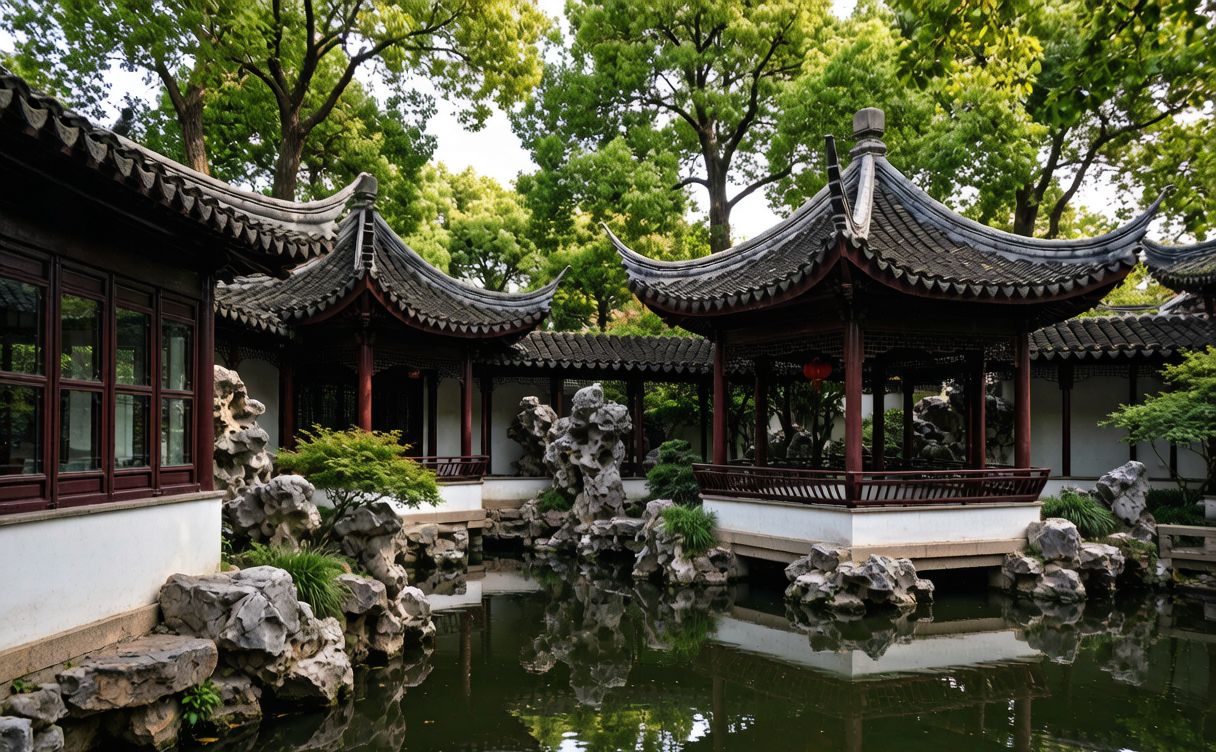
The central section is built around a calm lake, with a man-made mountain of Taihu rocks rising on one side. This is the postcard view, and it is even better in person because the reflection doubles the composition.
The northern area is more rustic, with a small bamboo grove and a kitchen-garden feel that reminded me of a countryside retreat. The western part is a rocky hill with a winding path to the top, where you get a rare elevated view over the garden’s rooftops.
Garden Highlights
If your time is short, these are the three spots I always point first-time visitors toward.
First, the Taihu rockery. Taihu stones are the signature of Suzhou garden design, prized for their holes, wrinkles, and weathered shapes. The central mountain here is a masterclass in how to fake a natural mountain inside a walled city. Stand at the water’s edge and let your eye travel up the rocks to the pavilion on top.
Second, the famous covered corridor. At more than 700 meters, it links every part of the garden and protects you from both sun and rain. I found myself slowing down here, because the corridor walls are punctuated with stone tablets and little windows that turn each step into a new vignette.
Third, the Cloud-Capped Peak (Guangyun Peak), a towering Taihu stone that is one of the largest of its kind in any Suzhou garden. It stands alone in a courtyard, and the way the light hits its perforated surface in the late afternoon is something I still think about.
These highlights are why I rank the Lingering Garden above many smaller Suzhou gardens for a first visit: it has variety. You get water, rock, architecture, and a sense of walking through a sequence rather than a single pretty scene.
Tips
I learned a few things the hard way, so here is what I tell friends before they go.
Arrive early. The garden opens around 7:30 in the morning, and the first hour is peaceful. By 10 a.m. tour groups arrive and the narrow paths get crowded. If you only have an afternoon, weekdays are noticeably calmer than weekends.
Wear comfortable shoes. The paths are flat but uneven stone, and the western rocky hill involves some steps. Nothing strenuous, but flip-flops would be a mistake.
Hire the audio guide or a licensed human guide at the gate. The garden’s meaning is in its details, and a good guide will explain why a window is shaped a certain way or what a poem on a beam refers to. I skipped the guide on my first visit and missed half the story.
Bring water and use the restrooms near the entrance before you start, because facilities inside are limited. Photography is allowed, but tripods can be awkward in crowded spots.
If you want a meal afterward, the streets just outside the north gate have solid local noodle shops. I had a bowl of Suzhou-style wonton noodles there that was far better than anything near the tourist center.
Best Time
Suzhou has four clear seasons, and each changes the garden completely. Spring, from March to May, is my favorite. The peonies and azaleas bloom, the weather is mild, and the light is soft. The garden feels alive without being sweltering.
Autumn, September through November, is the other sweet spot. The maple leaves turn red against the white walls, and the cooler air makes the long corridor walk pleasant. I visited in late October and the reflections in the central pond were unforgettable.
Summer is hot and humid, with occasional heavy rain, so mornings are essential. Winter is cold but quiet, and after a light snow the garden is stunning and nearly empty, which is a real treat if you do not mind the chill.
Avoid the week-long Chinese public holidays, especially Golden Week in early October and the Spring Festival, unless you enjoy crowds. On those days even the early hours are busy.
Good to Know
The Lingering Garden is open year-round, with a small discount in the low season. Tickets are sold at the gate and through major Chinese travel platforms; I recommend buying online to skip the queue. The site is wheelchair accessible in its main halls and corridors, though the rocky hill is not.
For the deeper cultural background, I suggest reading the official UNESCO listing before you go. The Classical Gardens of Suzhou, including the Lingering Garden, are recognized as a World Heritage site for their outstanding representation of Chinese landscape garden design. You can find the details here: UNESCO Classical Gardens of Suzhou.
If you are building a longer China itinerary, the garden also works well with a stop on Shanghai’s Nanjing Road for big-city energy, or as a calm counterpoint to the martial history of the Chengdu Wuhou Shrine. And if you want more classical garden atmosphere, our Suzhou travel guide lists the other top gardens worth your time.
I left the Lingering Garden the first time already planning my return. There is a reason scholars once wrote poems about “lingering” here instead of leaving. Spend a morning, slow your walk, and let the rocks and halls do their quiet work.