

I still remember the first time I walked through the red gates of Wuhou Shrine on a humid Chengdu afternoon. The cicadas were loud, the incense was thick, and for a moment I forgot I was in a modern Chinese city of 20 million people. This is the most famous temple in China dedicated to the heroes of the Three Kingdoms era, and it sits quietly in the south of Chengdu, right next to the bustling Jinli Street.
If you are a foreign visitor trying to understand Chinese history without drowning in textbooks, Wuhou Shrine (also called Wuhou Ci or the Zhuge Liang Temple) is the single best place to start. It honors Zhuge Liang, the brilliant strategist of the Shu-Han kingdom, and Liu Bei, the kindly founder of that short-lived state. After two weeks of exploring Sichuan, I can tell you this spot rewards slow walking far more than fast photo stops.
Getting There
Wuhou Shrine sits in the Wuhou District, south of Chengdu’s city center. I took the Chengdu Metro Line 3 to Gaoshengqiao Station and walked about ten minutes west. The shrine is hard to miss: look for the large red walls and the steady stream of tour groups.
A taxi or ride-hailing app (DiDi) from Tianfu Square costs roughly 15 to 25 yuan and takes 15 minutes in light traffic. If you are staying near the panda base in the north, give yourself 40 minutes each way. I recommend pairing the shrine with Jinli Street, which shares the same wall on one side, so you only pay for parking or a single metro trip.
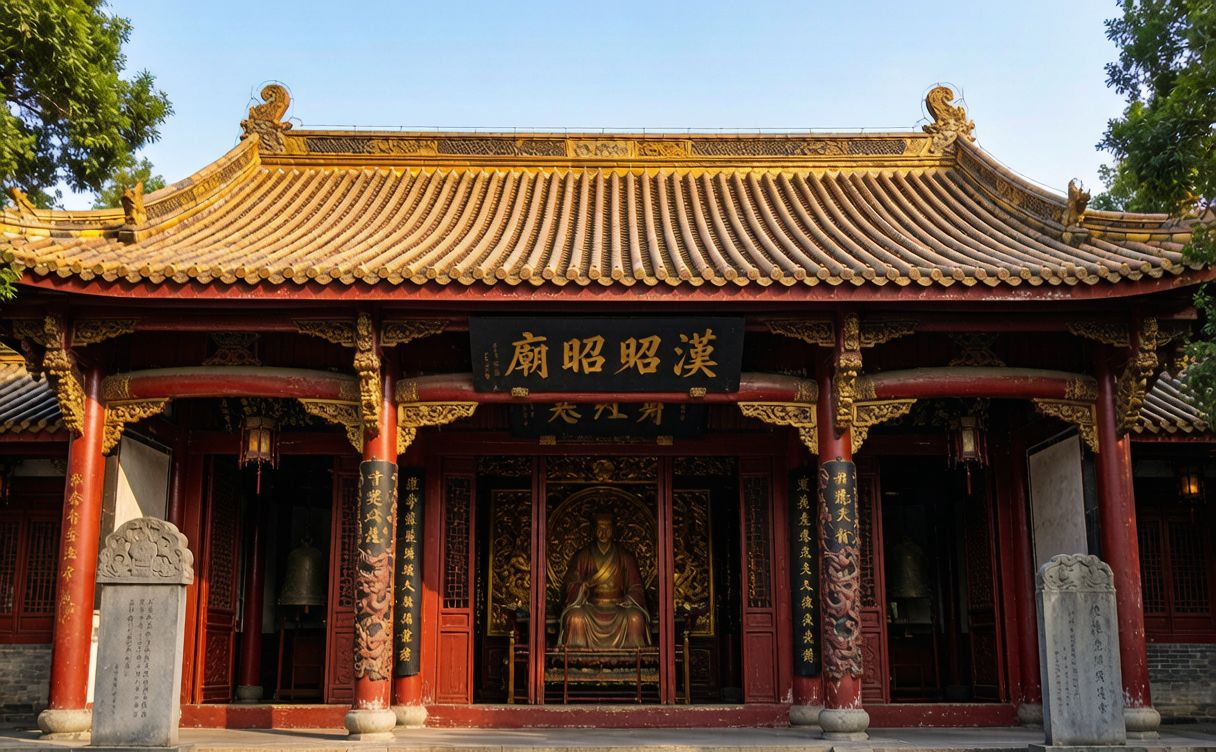
The ticket office sits just outside the first courtyard. Buy your entry ticket there, or book online through the official WeChat mini-program if your phone has a Chinese data plan. Either way, arrive before 10 a.m. if you want empty courtyards for photos.
What to See
The layout follows a classic Sichuan temple plan: a straight axis of halls, each one deeper and quieter than the last. I spent about two hours inside, and that felt right.
The first hall is the Hall of Liu Bei, where a large clay statue of the Shu-Han emperor sits surrounded by smaller figures of his generals. Walk straight and you reach the Hall of Zhuge Liang, the true heart of the shrine. Here Zhuge Liang is depicted in his flowing official robe, calm and watchful. Locals leave incense and quietly bow; I joined them once and found it oddly grounding.
Between the two halls stands a small courtyard with a 600-year-old cypress said to have been planted in Zhuge Liang’s memory. I ran my hand along its bark and noticed dozens of red wish ribbons tied by visitors. It is a simple, human moment that no guidebook mentions, and it stuck with me longer than any battle map.
Behind the halls lies the Huiling Mausoleum, the actual burial mound of Liu Bei. You cannot enter the mound, but the tree-lined path around it is the calmest corner of the whole complex. I sat there for twenty minutes with a bottle of tea and watched old men play chess.
Do not skip the stele corridor on the western side. The “Triple Treasure Stele” from the Tang dynasty carries engraved praise of Zhuge Liang written by a famous prime minister, a calligrapher, and a sculptor. For a history lover, that stone is worth the whole trip.
Zhuge Liang & Liu Bei
To enjoy Wuhou Shrine, you only need one story. After the fall of the Han dynasty, China split into three rival states. Liu Bei, a humble shoemaker turned warlord, founded Shu-Han in Chengdu and dreamed of reuniting the empire. Zhuge Liang was his chancellor, a man so loyal and clever that Chinese people still say “as wise as Zhuge Liang” 1,800 years later.
I found the human details more moving than the battles. Zhuge Liang wrote a famous letter to his son urging modesty and hard work. Liu Bei, on his deathbed, told Zhuge to replace his son if the boy proved unworthy. That level of trust is rare in any age. The shrine keeps their memory alive not as myths but as people who tried, and largely failed, to do the right thing.
Wuhou Ci literally means “Shrine of the Marquis of Wu,” Zhuge Liang’s posthumous title. Interestingly, the temple honors a subject (Zhuge) more prominently than the emperor (Liu Bei) it was built beside, which tells you how much the Chinese people admire wisdom over power.
You will also see the names of the “Five Tiger Generals” carved near the side halls. These were Liu Bei’s top warriors, and their legends fill Chinese opera, comics, and video games today. Spotting their stories inside a real temple helped me connect the fiction I had seen on screen with the history beneath it.
Tips
Here is what I wish someone had told me before my first visit:
- Go early or go late. The gates open around 8 a.m. The first hour is peaceful. By noon the courtyards fill with tour groups and the heat builds.
- Wear good shoes. The paths are stone and uneven in places. I twisted an ankle once on a wet flagstone, so watch your step after rain.
- Hire the audio guide. For about 20 yuan you get a clear English explanation at each hall. The stories make the statues matter.
- Combine with Jinli. The adjacent Jinli Street is the easiest place in Chengdu to try snacks like sanzi, iced jelly, and grilled skewers. I ate my best sugar-oil cake there.
- Respect the incense. Lighting joss sticks is welcome, but keep your voice low near the halls. This is an active place of memory, not a theme park.
Best Time
Chengdu is foggy and damp in winter, with gray skies from December to February. I prefer spring (March to May) and autumn (September to November), when the ginkgo trees inside the shrine turn gold and the air is soft. Summer is hot and crowded but the shade from the old trees helps.
Avoid the first week of October, China’s National Day holiday, when domestic tourists flood the city. I made that mistake once and spent more time standing still than walking. A regular weekday in April gave me near-empty courtyards and perfect light for photos.
If you only have one day in Chengdu, I would still make room for Wuhou Shrine even over a second panda visit. The two sites balance each other: the pandas show you Sichuan’s wild side, while the shrine shows you its soul. Bookend the day with a lazy evening on Jinli Street, and you will have seen the three faces of this city in a single, satisfying loop.
If you want to plan a fuller Sichuan trip, check my Chengdu Jinli & Kuanzhai guide for street food and old lanes, and my Chengdu pandas & city guide for the giant panda base and downtown highlights.
Good to Know
Wuhou Shrine is managed as part of Chengdu’s cultural heritage, and the official Chengdu tourism board lists opening hours, ticket prices, and seasonal events on its site. I check it before every trip because holiday schedules change. You can verify current details at the Chengdu Tourism Bureau, the city’s authoritative travel portal.
The entry fee is usually around 50 yuan for adults, with discounts for students and seniors. Photos are allowed without flash. The whole site is wheelchair accessible on the main axis, though the mausoleum path has a few steps.
If you enjoy temple history, you might also like our piece on the Nanjing Ming Xiaoling Mausoleum, another imperial tomb with a very different story.
Wuhou Shrine is not the biggest temple in China, and it is not the oldest. But for understanding how Chinese people think about loyalty, wisdom, and failure, there is no better single stop in Chengdu. I left feeling I had met two remarkable men, not just read about them. That, for me, is the mark of a great attraction.