

What Is Roujiamo, and Why Do People Call It a “Chinese Hamburger”?
The first time I ate a roujiamo, I was standing hip-to-shoulder with a hundred other people on a Xi’an back lane at ten at night, watching a man in a flour-dusted apron slam a round of dough against the wall of a barrel oven. A few seconds later he pulled it out, cracked it open with a knife, and buried the inside with a spoonful of meat he had been chopping with a rhythm that sounded like rain on a tin roof. He handed it over in a paper sleeve. It cost seven yuan. That was the best seven yuan I have ever spent, and it is the reason the nickname “Chinese hamburger” is both apt and wildly misleading.
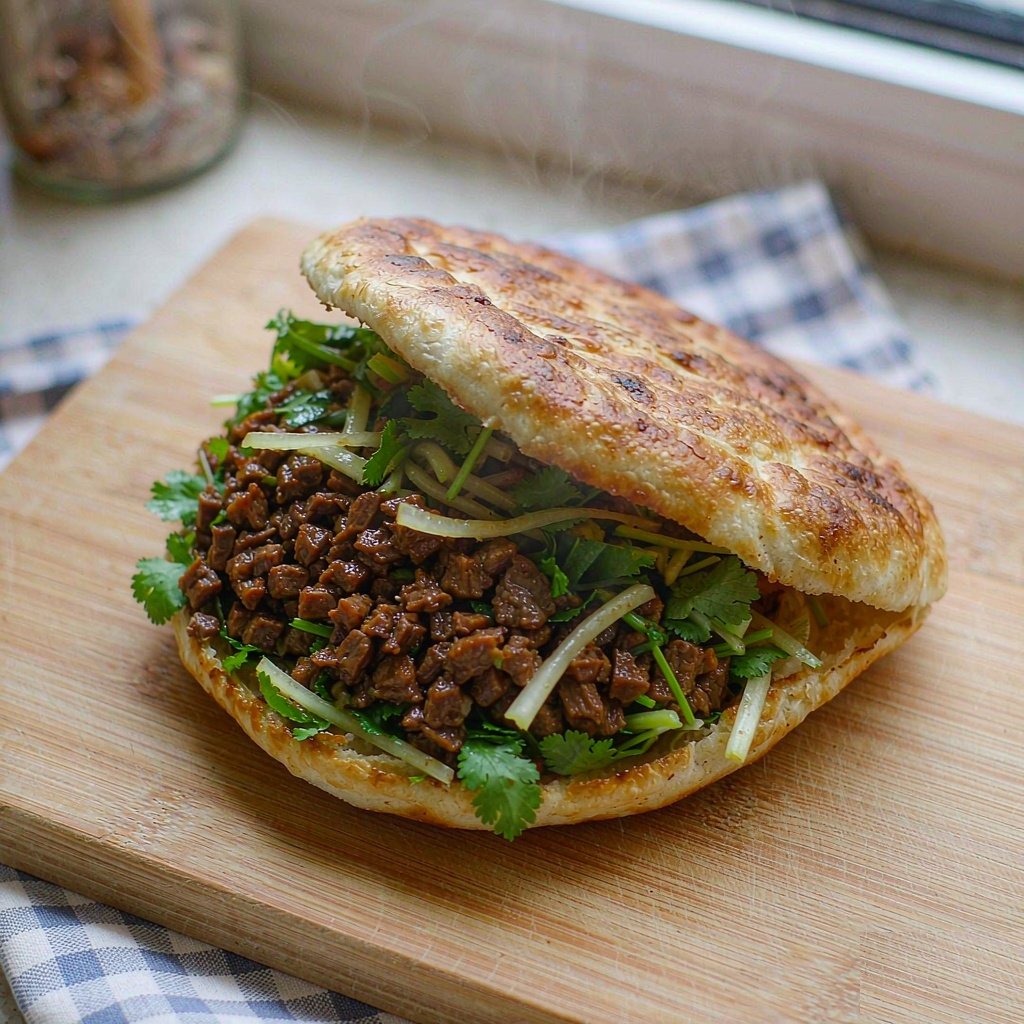
Roujiamo is a street food from Shaanxi province, built from two halves: a flat, layered wheat bread called baijimo, and a filling of pork that has been slow-braised in soy, spices and stock until it collapses at the touch of a blade. The cook chops the meat fine, often with a little of its cooking liquor and some fresh coriander and green chili, then stuffs it into the split bread. You eat it with your hands, warm, in three or four bites if you are polite and two if you are hungry. If you want to understand the wider world of Shaanxi cuisine, this sandwich is the front door.
The “hamburger” comparison sticks because the format is familiar: a round bread, a savoury filling, eaten on the move. But the resemblance ends there. There is no ground beef, no grill, no ketchup, no bun that was ever soft. Calling it a hamburger is like calling a croissant a dinner roll. Useful for the first thirty seconds, then actively unhelpful.
What Does Roujiamo Taste Like? The Bread-and-Pork Balance
Two textures do most of the work. The baijimo is the quiet hero: toasted on the outside until it is blistered and faintly smoky, with a crumb that shatters into dozens of thin leaves rather than one fluffy mass. Bite through the crust and you get a tender, faintly chewy inside that soaks up the meat juices without turning to paste.
The pork is the loud half. Because it is braised rather than fried or roasted, it carries a deep, rounded savouriness — soy and a warm spice note from cassia, star anise and clove — with just enough fat to make the whole thing feel indulgent. In the classic Xi’an version the meat is chopped with fresh coriander and a few rings of green chili, so every bite carries a bright, almost herbal lift against the richness. A well-made roujiamo is salty, meaty, a little spicy, and finished by the bread’s gentle toasted bitterness.
The Baijimo: A Bread With a Thousand Layers
Authentic baijimo is made from a stiff dough that is rolled, folded and rolled again, coaxing the gluten into thin alternating sheets. When it hits the hot wall of the oven, steam trapped between those sheets puffs them apart, and you end up with a bread that is crisp outside and leafy inside. At home most people approximate this with a dry pan and a covered lid, and you can get close — close enough that the sandwich still makes sense.
The Lu Rou: Slow-Braised Pork, Not Grilled Patties
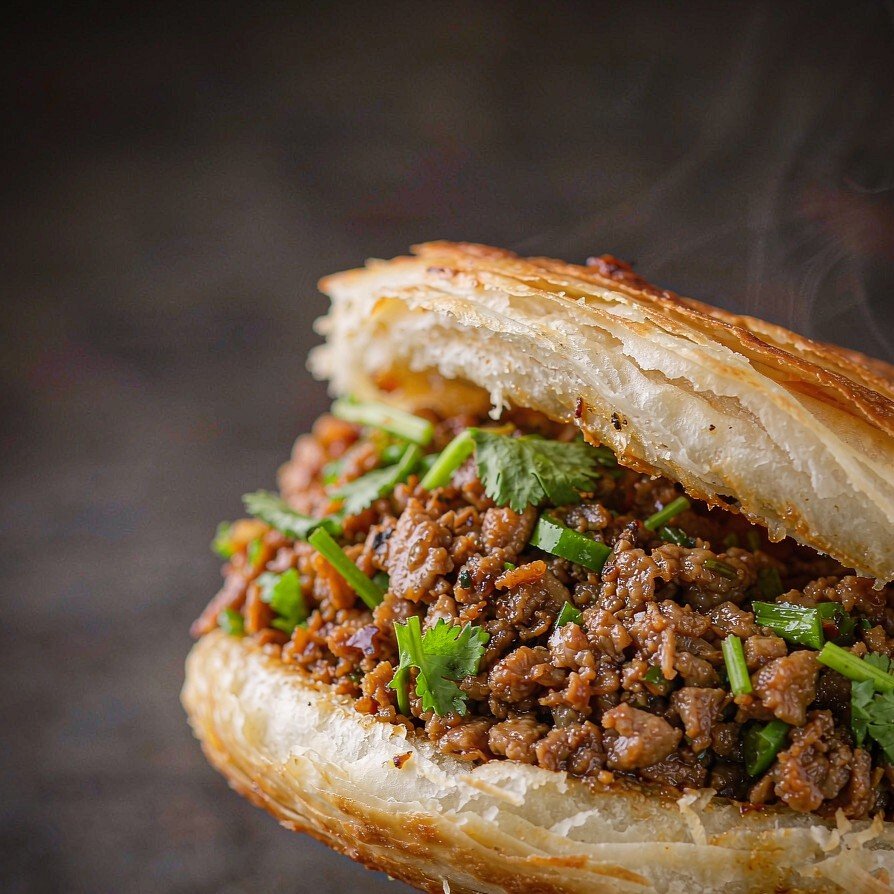
The filling, lu rou, is the same family of braise you find across northern China: pork simmered for a couple of hours in a master sauce of soy, cooking wine, ginger, and the spice packet above. The meat should be fall-apart tender but still holding shape until the knife finds it. Some shops use lean shoulder; the better ones use a cut with fat and skin, because that is what gives the filling its gloss.
Roujiamo Ingredients (and How Much of Each)
This scales for four sandwiches. Treat the amounts as a guide, not a contract.
- For the braised pork: 500 g pork shoulder, cut in two-inch chunks; 2 tbsp light soy sauce; 1 tbsp dark soy sauce; 1 tbsp Shaoxing wine; 1 slice ginger (about 10 g); 1 star anise; one 3-cm piece of cassia bark; 2 cloves; ½ tsp Sichuan peppercorn; 600 ml water or plain stock; 1 tsp sugar.
- For the bread: 300 g plain flour; 180 ml warm water; ½ tsp salt; 1 tsp cooking oil.
- To finish each sandwich: a small handful of chopped fresh coriander; 1–2 green chillies, sliced; a spoonful of the braising liquor.
If you want to keep it halal, pork is obviously out — in Muslim quarters of Xi’an the filling is typically beef, braised the same way, and it is excellent. That version is worth knowing about if you are browsing halal food options across China, because the beef roujiamo is one of the most satisfying halal street eats in the country.
Who Should Eat Roujiamo — and Who Should Pace Themselves
Roujiamo is for anyone who likes a savoury, handheld meal and is not afraid of a little fat and chilli. It is a brilliant breakfast, a perfect late-night snack, and a sane lunch when you are walking a city all day. Children usually love it once the chili is left out.
People who should go easy: anyone tracking saturated fat or sodium will find a shop-bought roujiamo richer than it looks, because the braise is unapologetically fatty and salty. The bread is wheat, so it is out for the gluten-free. And if you cannot handle fresh green chili, say so clearly when you order — in Xi’an the default includes it. None of this makes it a “bad” food; it makes it a treat, which is what street food is supposed to be.
How to Make Roujiamo at Home: Step by Step
You do not need a barrel oven or a street cart. You need a pot, a pan, and a couple of hours where you are not in a hurry.
Step 1 — Braise the pork (lu rou)
Blanch the pork chunks in boiling water for two minutes, then rinse. Put them in a pot with all the braising ingredients, bring to a boil, then lower to a bare simmer. Cover and cook for about 90 minutes, until a chopstick slides through with no resistance. Leave the meat in the liquor; it keeps better that way. This is the step that cannot be rushed, and it is the difference between roujiamo and a sad pork sandwich.
Step 2 — Bake or pan-toast the baijimo
Mix the flour, salt, oil and water into a stiff dough, knead for eight minutes, and rest it, covered, for 30 minutes. Divide into four balls, roll each thin, fold it over itself two or three times, then roll out again into a flat disc. Cook on a dry, medium-hot pan until both sides are speckled brown and the inside is cooked through — about three minutes a side. For a closer-to-Xi’an crust, finish them directly on the bars of a gas flame for a few seconds per side, watching carefully.
Step 3 — Chop and stuff
Crack a warm baijimo open with a knife, leaving a hinge. Pull out a generous piece of pork, chop it fine on a board with the coriander, chili and a splash of braising liquor, then spoon the mixture into the bread. Eat immediately, while the bread is still crisp and the meat is hot enough to steam.
Roujiamo in Xi’an: Where to Eat It and What to Expect
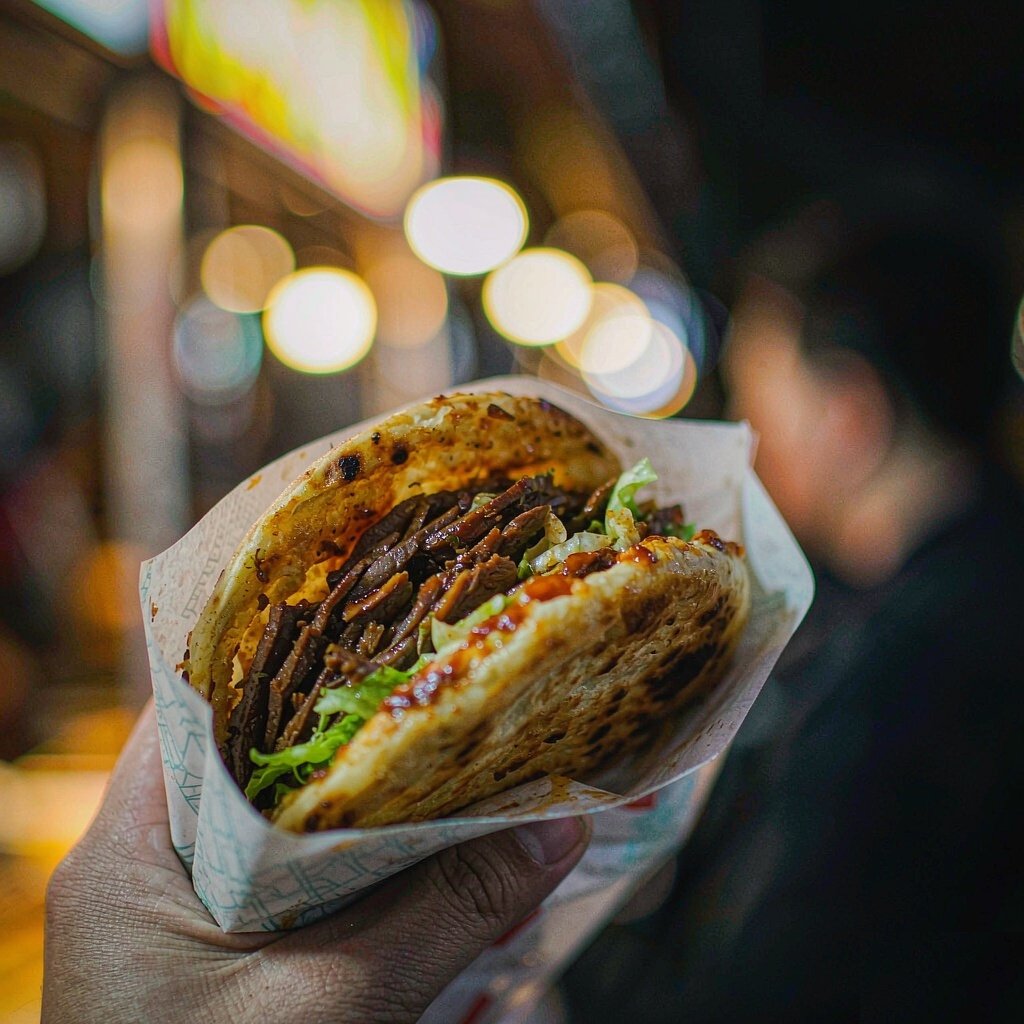
If you are in the city, the Muslim Quarter and the lanes around the Bell Tower are the obvious hunting ground, but the better sandwiches often come from unmarked shops in residential neighbourhoods where a single family has been doing nothing else for twenty years. A good roujiamo in Xi’an runs from about six to twelve yuan depending on the meat and the fame of the shop. Watch for the chop: if the cook chops to order rather than scooping pre-chopped meat from a tray, you are in the right place.
For a fuller picture of the city’s eating culture, our Xi’an food guide maps the dishes worth building a day around, and the Xi’an street food and biangbiang noodles guide pairs naturally with a roujiamo crawl, since both come from the same wheat-and-chilli heart of the local table.
Regional Twists: From Tongguan to Lajiamo
Not every roujiamo looks like the Xi’an standard. The Tongguan style, from a county east of the city, uses a flat, disc-shaped bread with an almost pastry-like layered crust, and the meat is often simmered with more spice. In many shops you will see lajiamo — the same sandwich but with the added option of a hot chili sauce swabbed into the bread, for people who want the heat turned up a notch. Beef versions dominate in Muslim areas; pork versions are everywhere else. Travelling across the province, you learn that the bread changes more than the filling, and that the bread is where local pride lives.
Roujiamo vs a Hamburger — the Honest Comparison
They share a shape and a handheld convenience, and that is the entire overlap. A hamburger is a grilled or fried patty, soft bun, often cold lettuce and a sweet sauce. Roujiamo is braised meat with the texture of a confit, a bread engineered to shatter, and fresh herbs and chili built into the bite rather than laid on top. A hamburger is a meal you sit down to; roujiamo is a meal you walk with. If you like one, you will probably like the other, but they scratch different itches, and the roujiamo itch is the one you feel at midnight on a cold northern street.
Frequently Asked Questions
Is roujiamo halal?
It depends entirely on the shop. In Xi’an’s Muslim Quarter and across Hui neighbourhoods, roujiamo is made with halal beef or lamb and is fully halal. In other parts of China the standard filling is pork and it is not. Always check, and when in doubt look for beef (niurou) or lamb (yangrou) on the sign rather than the default pork (zhurou).
How many calories are in a roujiamo?
A typical shop roujiamo with pork runs roughly 350 to 500 calories, most of it from the bread and the braising fat. The beef version is similar. It is a filling snack rather than a light one, which is exactly why it works as a meal replacement.
Can I make roujiamo without a tandoor oven?
Yes. A heavy dry pan on the stove reproduces most of the texture, and a few seconds over a gas flame adds the blistered crust. You will not match a barrel oven exactly, but the sandwich is forgiving, and the braise does most of the flavour work anyway.
What’s the difference between roujiamo and jianbing?
Completely different foods that happen to both be famous northern street eats. Jianbing is a thin egg crepe rolled around crispy crackers and sauce — soft, savoury and breakfast-oriented. Roujiamo is bread stuffed with braised meat — hearty, handheld and good any time. If you like one, the other is worth trying on the same trip.
How long does the braised pork keep?
Stored in its liquor in the fridge, the lu rou keeps for three to four days and actually tastes better on day two as the spices settle. Reheat gently with a splash of water. You can also freeze it for a month, which means a roujiamo is never more than a fresh baijimo away.
Where can I find roujiamo outside China?
In most large cities with a Chinese community you will find it in northern-style restaurants and at night markets, though quality varies wildly. The giveaway of a good one abroad is the same as at home: meat chopped to order, bread toasted on the spot, and fresh coriander in the mix. If the bread is a soft burger bun, you have been misled.