

The Qin dynasty (221 to 206 BC) lasted only fifteen years, yet it reshaped the course of Chinese history more than almost any other era. As China’s first unified imperial dynasty, it transformed a land of warring regional states into a single, centrally governed empire. For travelers today, the legacy of the Qin is surprisingly tangible: the silent terracotta army guarding an emperor’s tomb, the earliest foundations of the Great Wall, and a standardized script that still underpins written Chinese. This qin dynasty guide traces that remarkable story and shows you where to stand in the very places where it all began.
The Rise of Qin Shi Huang
Long before he became emperor, Ying Zheng ruled the state of Qin in the west, a tough, militarized realm that had spent centuries refining its armies and administration. Through a series of brilliant campaigns between 230 and 221 BC, the Qin state conquered the six rival kingdoms of Han, Zhao, Wei, Chu, Yan, and Qi. When the dust settled, Ying Zheng declared himself Qin Shi Huang, meaning “First Emperor of Qin,” and claimed a mandate that stretched across the known Chinese world.
What set the First Emperor apart was not just his conquests but his ambition to erase the old order. He abolished the feudal system in which local lords held hereditary power, replacing it with a hierarchy of appointed officials who answered directly to the throne. For the first time, the vast territory was governed by a single legal code, a single currency, and a single authority. Travelers exploring this history will find that many later imperial institutions, from the bureaucracy to the very idea of a unified “China,” trace directly back to his reign. If you are planning your first visit, our China travel guide for first-timers offers practical context on the cities where this story lives on.
The Terracotta Army of Xi’an
No symbol of the Qin dynasty speaks more powerfully than the Terracotta Army, discovered by farmers in 1974 just outside Xi’an. Built to protect Qin Shi Huang in the afterlife, the underground army contains thousands of life-sized clay soldiers, each with distinct facial features, hairstyles, and armor. Chariots, horses, and weapons fill the pits, a staggering portrait of a real ancient army frozen in clay.
Standing in the viewing hall, it is easy to feel the scale of the emperor’s vision. The figures were once brightly painted, and traces of pigment still survive. Archaeologists estimate that more than eight thousand soldiers were originally placed here, along with officials, acrobats, and birds in separate pits. The site sits near the emperor’s mounded tomb, which remains largely unexcavated and is said to hold rivers of mercury and models of palaces. Visitors to the region should also consider the Shaanxi History Museum in Xi’an, where artifacts from the Qin and later dynasties bring the broader timeline into focus.
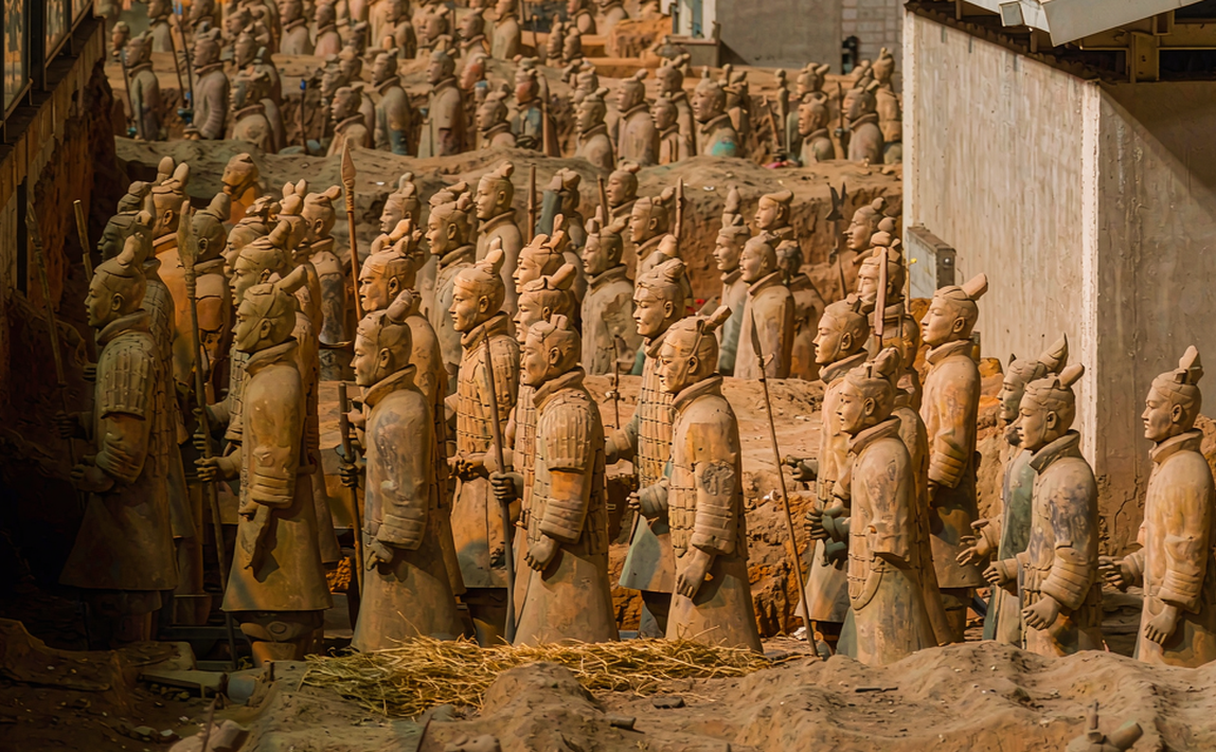
The Terracotta Army is more than a tomb guard; it is evidence of the enormous labor and organization the Qin state could command. Building it required sculptors, bronze workers, and administrators working under strict imperial direction. That same capacity for mobilization would soon be turned toward walls, roads, and a unified culture.
A Unified Writing System, Weights, and Measures
Perhaps the Qin dynasty’s most lasting achievement was cultural standardization. Before unification, the different states used their own scripts, coins, axle widths, and units of measurement, which made trade and communication slow and confusing. Qin Shi Huang ordered a single standard script, based on the Qin form of writing, to be used across the empire. This “small seal script” allowed officials in distant provinces to read the same edicts and records.
The reforms went further. The emperor mandated uniform weights and measures, a single currency shaped like a round coin with a square hole, and even consistent axle widths so carts could share the same rutted roads. These changes may sound technical, but they were revolutionary: for the first time, a merchant, a scholar, or a traveler could move across the empire without relearning local systems at every border. The unified script in particular became the bridge that connected Chinese civilization across two thousand years, surviving dynastic change long after the Qin itself had fallen.
The Early Great Wall
The Great Wall as most travelers picture it belongs largely to the Ming dynasty, but its origins lie with the Qin. Facing raids from nomadic groups to the north, Qin Shi Huang connected and extended existing defensive walls built by earlier states, linking them into a continuous barrier meant to protect the new empire’s heartland. Hundreds of thousands of conscripted workers, soldiers, and prisoners labored on these fortifications, many never returning home.
While little of the original Qin wall remains visible today, its purpose echoes in every later section. The wall was part of a broader frontier strategy that also included roads radiating from the capital and a network of signal beacons. For those who want to walk the better-preserved stretches and understand how the wall evolved over centuries, our Great Wall of China guide maps out the best places to visit and what each era contributed.
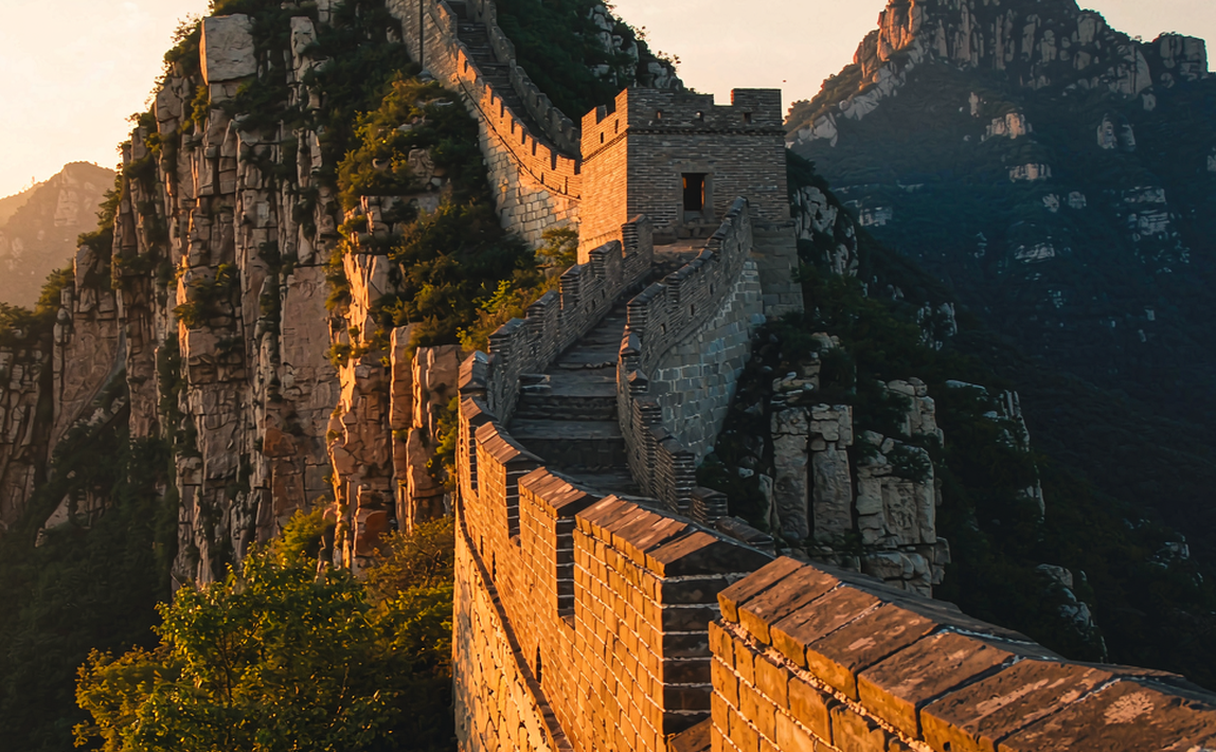
The wall reminds us that unification came at a human cost. The same centralized power that built wonders also demanded enormous sacrifice from ordinary people, a tension that runs through the entire Qin story.
A Short Reign and a Lasting Legacy
The Qin dynasty burned brightly and then collapsed. Qin Shi Huang died in 210 BC during a tour of the empire, and within a few years weak leadership, heavy taxes, and widespread unrest ignited rebellion. By 206 BC the dynasty was overthrown, giving way to the Han, which would rule for four centuries and cement many Qin institutions.
Yet the Qin’s influence outlived its brief reign. The Han kept the unified script, the central bureaucracy, and the idea of a single Chinese empire. The very name “China” is widely thought to derive from “Qin.” Roads, canals, and standardized systems built under the First Emperor became the backbone of later imperial administration. In a real sense, every subsequent dynasty governed a country that the Qin had first imagined into being. For readers who want a carefully researched scholarly summary of this transition, the Britannica entry on the Qin dynasty is an excellent external reference.
Planning Your Qin Dynasty Journey
Traveling the Qin story means following a rough arc from the capital region to the heart of the empire in the west. Xi’an, the modern city near the ancient Qin capital of Xianyang, is the essential stop, home to the Terracotta Army and rich museums of the period. From there, the wall sites and the broader cultural landscape of Shaanxi province fill in the picture. A well-planned route lets you move from the emperor’s tomb to the frontiers he defended, connecting the history on the page with the ground beneath your feet.
The qin dynasty may have been short, but its shadow is long. To stand before the terracotta soldiers or trace the line of an early wall is to meet the moment when China first became one. Slow travel through these sites rewards curiosity far more than a rushed checklist ever could.