

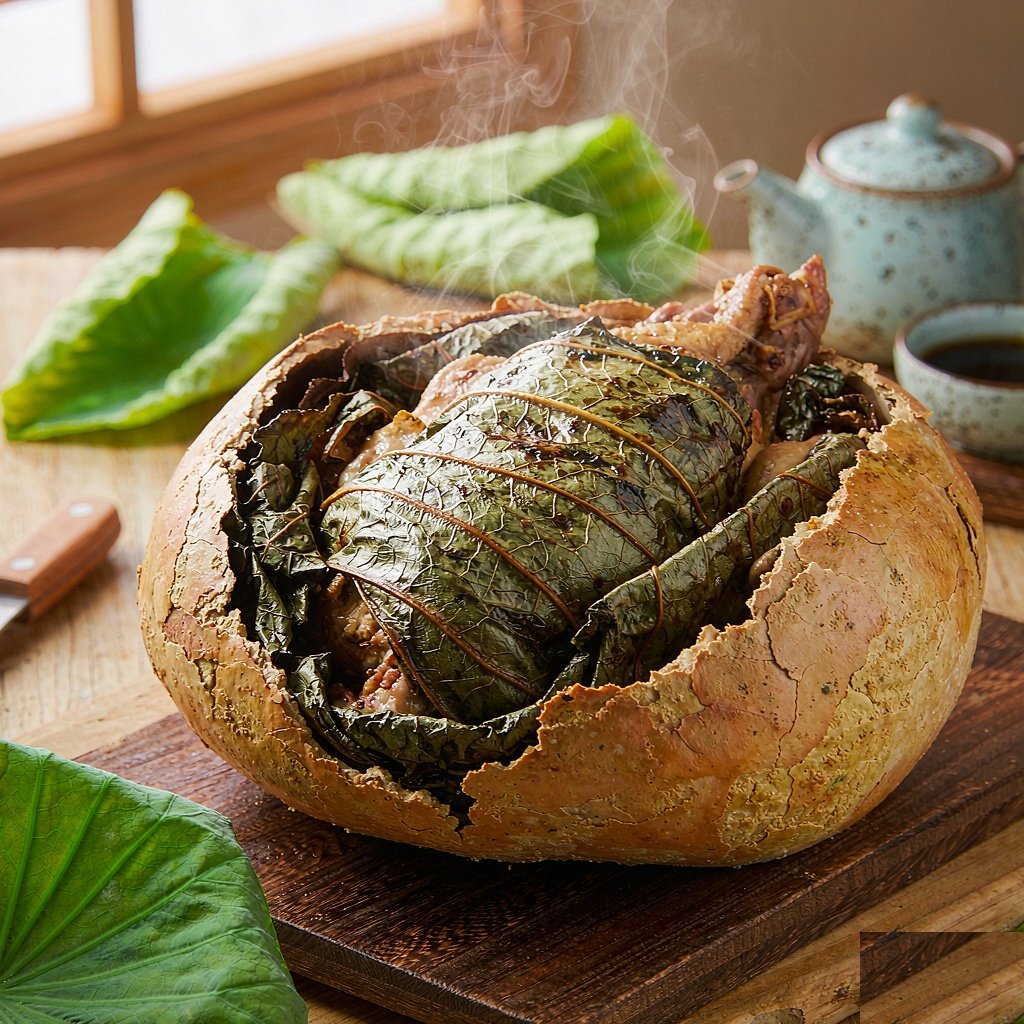
The first thing that arrives at the table is not food but a lump of baked clay, dull grey and roughly the size of a football. A waiter sets a small mallet beside it, cracks the shell along a pre-scored line, and peels back pieces of what looks like dried earth. Underneath is a dark green package of lotus leaves. When those are unfolded, steam rolls out carrying a smell I still associate with Jiangsu: wine, toasted spice and something grassy and faintly sweet. This is beggar’s chicken, or jiao hua ji, and the theatrical unwrap is half the reason it has survived on Chinese banquet tables for generations.
What Beggar’s Chicken Actually Is (and Why the Name Is a Joke)
At its core, this is a whole chicken marinated in soy sauce and Shaoxing rice wine, wrapped tightly in lotus leaves, sealed inside a shell of clay (or, in home kitchens, salt dough or foil), and baked slowly until the meat is spoon-tender. The clay is discarded. The lotus leaves are discarded too. What you eat is the bird that cooked in its own trapped steam, perfumed by the leaves rather than glazed or browned the way a Western roast would be.
The name is deliberately self-deprecating. One legend tells of a beggar who stole a chicken, had no pot to cook it in, and buried it in a fire wrapped in mud and lotus leaves scavenged from a pond. A passing official — in some versions the Qianlong Emperor — smelled the aroma, asked what it was, and the recipe supposedly entered polite society. Historians treat that as folklore, and the dish’s documented roots are more mundane: it comes from the Changshu and Suzhou area of southern Jiangsu, a region of canals and lotus ponds where using leaves as a cooking wrapper was practical long before it was fashionable. Calling it “beggar’s chicken” was a bit of local humour that stuck, and today the same dish appears on serious restaurant menus as a showcase of Jiangsu technique.
What Does Beggar’s Chicken Taste Like?
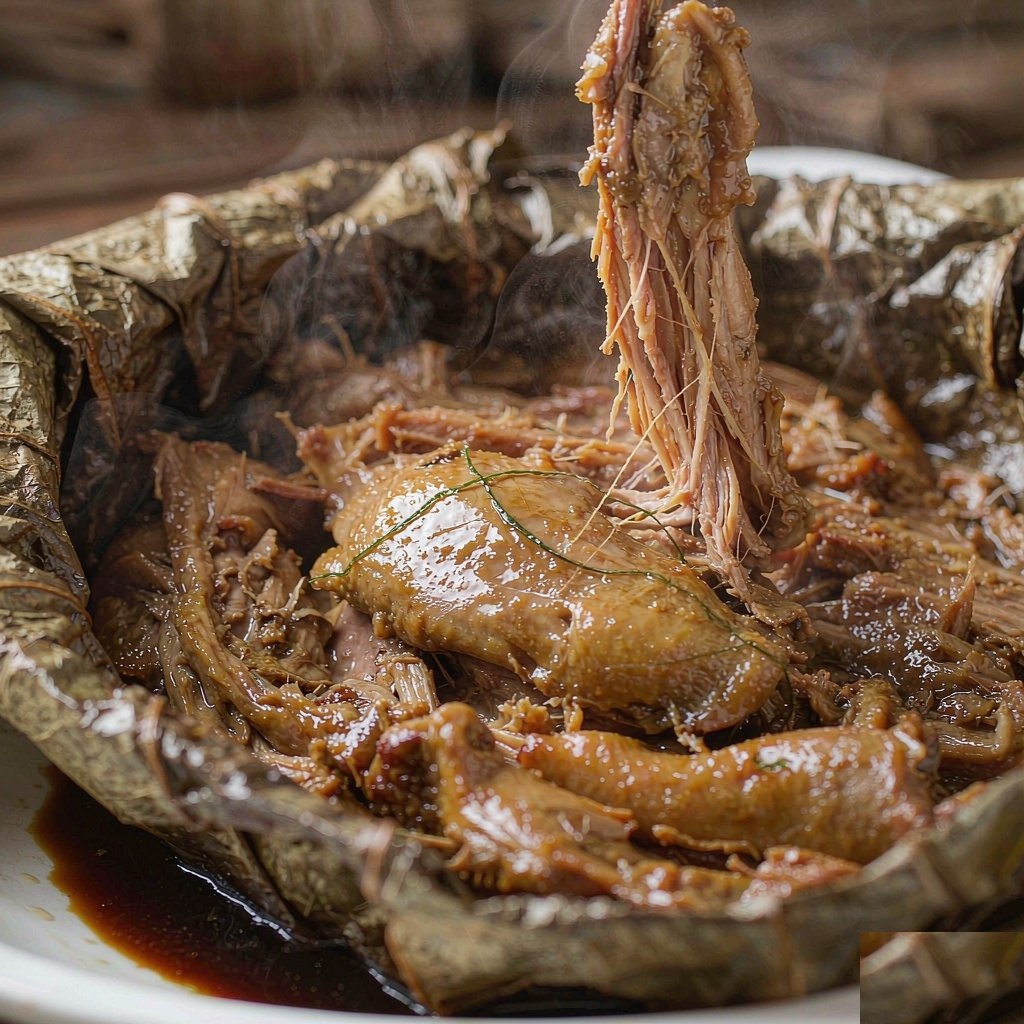
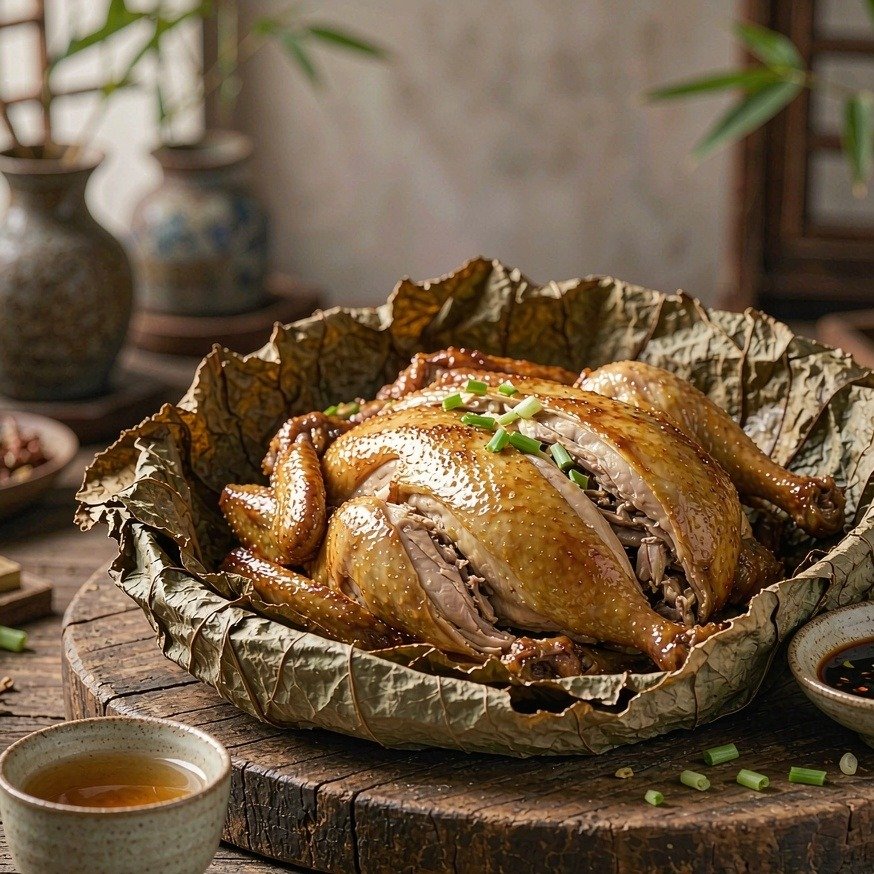
If you are expecting crisp skin, this will surprise you. The skin is soft, slightly gelatinous and deeply savoury, clinging to meat that pulls away in moist shreds rather than slicing cleanly. The dominant note is Shaoxing wine and light soy, rounded out by star anise, ginger and a whisper of five-spice. What sets it apart from an ordinary braise is the lotus leaf: it gives the bird a clean, hay-like perfume that you notice most in the first two bites, before the richer spice takes over. The juices collected in the leaf parcel are the best part, and in a good restaurant the waiter will spoon them back over the carved meat.
Think of it as the textural opposite of Cantonese roast chicken. Where that dish prizes taut skin and a clear roasting aroma, beggar’s chicken is about surrender — meat so soft it collapses under a chopstick, with none of the dryness that can afflict a breast cooked in an open oven. It is closer in spirit to a slow braise, but lighter, because the lotus leaf keeps the fat from feeling heavy.
Beggar’s Chicken Ingredients (Amounts for a 2 kg Bird)
The ingredient list is short enough that quality matters more than quantity. For one whole chicken of about 2 kg, you will need:
- 1 whole chicken (about 2 kg), preferably a free-range bird with some fat under the skin; a very lean bird will finish dry.
- 3 tbsp Shaoxing rice wine plus 1 tbsp for the final basting.
- 3 tbsp light soy sauce and 1 tbsp dark soy sauce for colour.
- 1 tbsp finely chopped ginger and 3 spring onions, cut into short lengths.
- 2 whole star anise, 1 tsp five-spice powder and ½ tsp white pepper.
- 1 tbsp sugar and 1½ tsp salt, adjusted to taste.
- 6–8 large dried lotus leaves, available at Asian grocers; soak them in warm water for at least 30 minutes until pliable.
- For the seal: either 2 kg of coarse salt mixed with two egg whites and a little water, or three layers of heavy-duty foil. Traditional clay is used in restaurants but is impractical at home.
Optional additions — a handful of glutinous rice, a few dried shiitake mushrooms or a slice of Chinese sausage tucked into the cavity — turn it into a more substantial one-pot meal. Purists leave the bird unstuffed so the chicken flavour stays clean.
Who It Suits — and Who Should Skip It
This is a dish for people who value tenderness over crispness, and for anyone who enjoys the ritual of a shared centrepiece. It feeds four to six people generously and is at its best on a cold evening, when the steam and the warm wine aroma make sense. Travellers with an interest in regional cooking will find it a useful entry point to the softer, more refined end of the cuisine; our Huaiyang cuisine guide explains the wider style it belongs to.
On the other hand, beggar’s chicken calories are worth knowing about if you are watching intake. A generous serving with skin runs roughly 550–700 calories, most of it from fat, and the soy-based marinade pushes the sodium high. Anyone on a low-salt diet should ask for a lighter marinade or eat a smaller portion. The dish contains soy and wheat (in the soy sauce), so it is not suitable for a gluten-free diet unless you swap in tamari. If you are managing a food allergy while travelling, the China food allergy guide covers how to ask about ingredients clearly. The lotus leaves are inedible, and the small bones in the bird need attention, so it is not an ideal dish for very young children.
How to Make Beggar’s Chicken at Home, Step by Step
You do not need a clay oven to make a convincing version. A salt crust or a tight foil parcel traps the same steam. Here is the method I use, based on the Suzhou approach.
- Step 1 — Marinate. Pat the chicken dry. Rub it inside and out with salt, sugar, white pepper and five-spice, then pour over the wine and both soy sauces. Add the ginger and spring onion to the cavity. Massage for two minutes, cover, and refrigerate for at least four hours or, better, overnight.
- Step 2 — Soften the leaves. Soak the dried lotus leaves in warm water for 30 minutes, changing the water once. They should be flexible, not crisp, or they will tear when you fold them.
- Step 3 — Wrap. Drain the leaves and lay them overlapping on a clean surface, shiny side down. Put the chicken in the centre, fold the leaves up around it, and tie the parcel with kitchen string. If using stuffing, add it to the cavity before wrapping.
- Step 4 — Seal. For a salt crust, spread a 2 cm layer of the salt-and-egg-white mixture over a baking tray, set the parcel on it, and cover completely, pressing firmly so there are no cracks. For the easier foil version, wrap the leaf parcel in three tight layers of heavy-duty foil, folding the edges over twice.
- Step 5 — Bake. Place in a preheated oven at 180°C / 350°F. A salt-crust bird needs about 3 hours; a foil-wrapped one, 2½ hours. The internal temperature at the thickest part of the thigh should reach 85°C / 185°F.
- Step 6 — Rest and crack. Let the bird rest for 15 minutes. Crack the salt or foil with the back of a knife, unwrap the leaves, carve, and spoon the collected juices over the meat.
Practical Tips and the Mistakes That Ruin It
The single most common failure is a torn wrapper. If the lotus leaves are not soaked long enough, they split during folding and the steam escapes, leaving you with a bird that is roasted rather than cocooned. The second mistake is under-seasoning the inside of the bird: the marinade seasons the surface, but the cavity needs its own rub or the breast meat tastes flat. Third, resist the urge to raise the oven temperature. High heat hardens the salt crust unevenly and dries the meat; the whole point is gentle, steady heat over a long period. If you want a genuinely easy beggar’s chicken recipe, use the foil method and a thermometer rather than guessing.
One more tip from experience: save a little of the hot wine-and-soy basting liquid and brush it over the carved meat just before serving. It wakes up the flavour after the long rest, and it makes the difference between a good bird and one that tastes merely moist.
Regional Variations and How It Compares
Within Jiangsu, the Changshu version is generally considered the reference point — lightly spiced, heavy on the lotus aroma, and unstuffed. Around Suzhou you will sometimes find a version with glutinous rice and sausage in the cavity, which absorbs the juices and turns the dish into a meal in itself. Further north, cooks use less wine and more star anise, and some household recipes substitute bamboo leaves for lotus when that is what the local pond provides.
So how does beggar’s chicken vs roast chicken stack up for a first-time cook? A standard roast is faster, gives you crisp skin and predictable slices, and suits a Sunday lunch. This dish takes longer, demands a wrapping step, and rewards you with softer meat and a more complex aroma. It is also far more forgiving of an overcooked bird, because the leaf parcel holds moisture that an open oven would drive off. Among Chinese classics it sits closer to the eight great regional cuisines tradition of slow, patient preparation than to the quick stir-fries most visitors expect.
Where to Eat Beggar’s Chicken in Suzhou
If you would rather watch a master do it, head to Suzhou, where old restaurants in the historic district still bring the clay shell to the table and crack it in front of you. Ordering one bird for a group of four is the sensible approach; portions are large, and the menu usually offers little else that matches the drama. Many places ask for an hour’s notice because the bird needs to bake from raw. This is one of the best beggar’s chicken experiences you can have, and it pairs naturally with a walk through the canals afterwards — the Suzhou food guide lists complementary local dishes worth adding to the meal.
If Suzhou is not on your route, the dish appears on Jiangsu-restaurant menus in Shanghai and Nanjing, though the unwrap is often less elaborate. For a broader itinerary built around regional specialties, the China food tour guide suggests how to fit a Jiangsu stop into a longer trip.
Beggar’s Chicken FAQs
How to make beggar’s chicken at home without clay?
Use either a salt crust or three layers of heavy-duty foil. Both trap steam effectively. The foil version is quicker to assemble and is the option most home cooks settle on after the first attempt.
How long to cook beggar’s chicken?
Allow 2½ hours for a foil-wrapped 2 kg bird and about 3 hours for a salt crust, at 180°C / 350°F. Check the thigh with a thermometer; it should read 85°C / 185°F.
What does beggar’s chicken taste like compared with other Chinese chicken dishes?
It is softer and more aromatic than roast or braised chicken, with a distinct lotus-leaf perfume and a strong wine-and-soy backbone. The skin is tender rather than crisp, which surprises some first-timers.
Is beggar’s chicken healthy?
It is a good source of protein, but the skin and soy marinade make it relatively high in fat and sodium. A moderate portion, with the skin removed, fits comfortably into most diets.
Can you eat the lotus leaves and the clay shell?
No. Both are cooking wrappers and are discarded. Only the chicken and any stuffing are eaten; be careful to pick out small bones as you carve.
Where to eat beggar’s chicken outside Jiangsu?
Look for Jiangsu or Shanghainese restaurants in major cities, where it is often a special-order item. Calling ahead gives the kitchen time to bake the bird properly, and it is worth asking whether the shell is cracked at the table.
There is a reason this dish has outlasted fashier ones. It asks for patience rather than skill with a wok, and it repays that patience with meat that falls apart at the touch of a chopstick and a smell that arrives before the plate does. Whether you make it in a home oven or watch a waiter break open the clay in a Suzhou dining room, beggar’s chicken is a reminder that some of the best cooking comes from the simplest idea: wrap something good, keep the steam in, and leave it alone long enough.