

Penglai Pavilion is the reason the small coastal town of Penglai, in Yantai on the northern shore of Shandong Peninsula, has been famous for more than a thousand years. A Penglai Pavilion guide has to tell two stories at once: the real one of a handsome timber tower perched on a red sea cliff, and the legendary one of a floating island of immortals that Chinese emperors sailed north to find. For foreign visitors exploring Shandong, it is a quieter, more atmospheric counterpart to the province’s beaches and beer cities, and a place where mythology and masonry sit side by side.
Why Penglai Pavilion matters
Penglai is one of China’s three great ancient pavilions, alongside Yueyang Tower and the Yellow Crane Tower, and it has anchored the Chinese imagination of the blessed islands since at least the Han dynasty. Emperors came here hoping to glimpse the immortal realms across the strait, and the town grew around the lookout. Today the pavilion complex gathers temples, gates, and gardens on a headland above the Bohai Strait, with the sea haze softening the horizon in a way that still feels otherworldly.
Penglai is also the stage for the legend of the Eight Immortals, the band of Taoist sages who, according to folklore, set out from this very shore to cross the sea using only their magical powers. Statues and reliefs of the Eight Immortals appear throughout the town, and the story is woven into local identity as firmly as the mirages are. Whether or not you know the tales, the repeated imagery gives the visit a storybook quality that children especially enjoy.
How to get to Penglai from Yantai
The practical question most travelers ask is how to get to Penglai from Yantai. The two are about seventy kilometers apart, and the trip is easy. Frequent long-distance buses run from Yantai’s bus stations to Penglai in around ninety minutes, and a taxi or private car takes a similar time on the expressway. There is no train station right at the pavilion, so the bus or car is the realistic choice. Leave Yantai in the morning, and you can comfortably see the pavilion, the water fortress, and the old town in a single day before returning.
Penglai Pavilion tickets
Budgeting is simple once you know the Penglai Pavilion tickets arrangement. Admission is sold as a combined ticket covering the pavilion complex and the adjacent Penglai Water City, rather than as separate entries, which is good value because the two sights sit next to each other. Prices are a little higher on public holidays and lower in the quiet winter months, and the ticket includes access to the cliff-top gardens and the small museums inside the walls. Buy at the official gate, carry your passport in case identification is checked, and arrive early, because the viewing terraces get busy by midday.
The Penglai mirage legend
The most romantic thread of any visit is the Penglai mirage legend. For centuries, locals reported seeing castles, streets, and crowds appear in the air above the sea, a phenomenon the Chinese called “haishi,” and these shimmering images were taken as proof of the immortal islands. What they were seeing was a real atmospheric mirage, but to the emperors and poets who wrote about it, the boundary between optics and magic hardly mattered. The pavilion’s halls are full of inscriptions and paintings celebrating these visions, and on a hazy day you can understand exactly why people once believed.
Mirages here are a genuine optical effect, caused when layers of air at different temperatures bend light over the cool sea, and they are most likely in the shift between spring and summer. Locals still gather when one is reported, and while modern visitors are more skeptical, the thrill of seeing a phantom city flicker above the water has not entirely faded. Even without a mirage, the pavilion’s upper terrace is the best place to watch the strait and imagine the emperors who once stared out from the same spot.
The Penglai water fortress
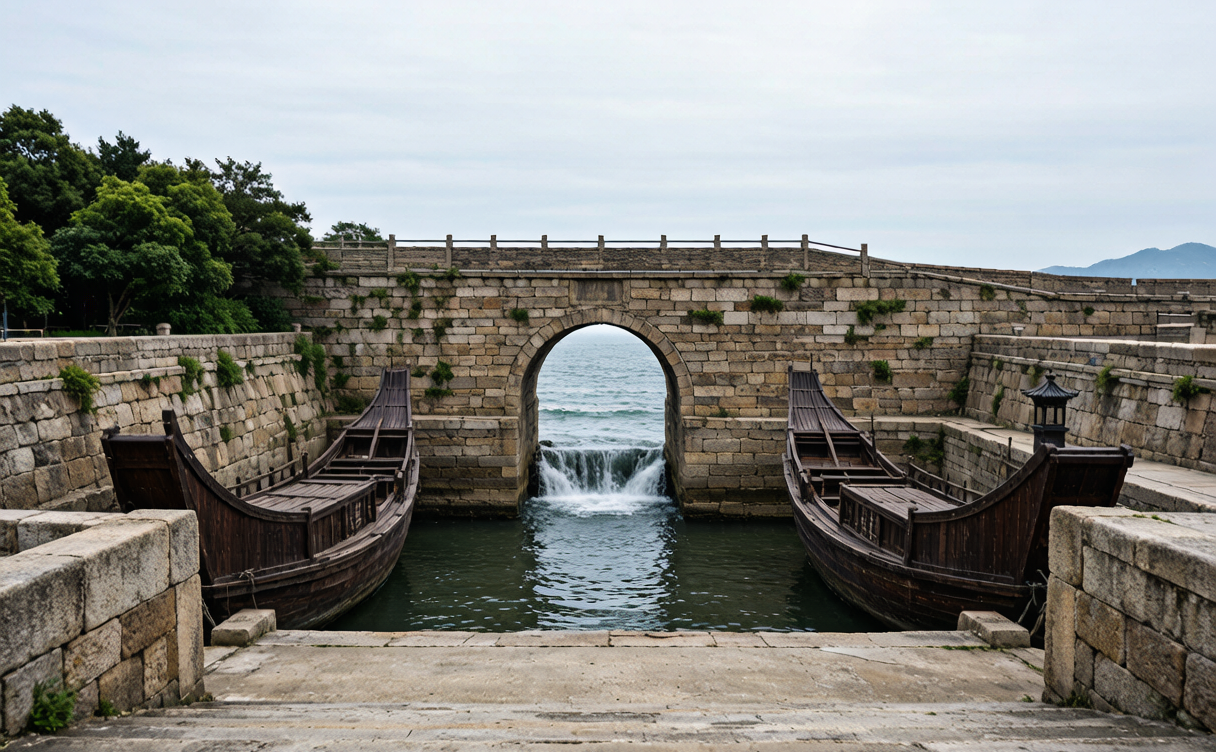
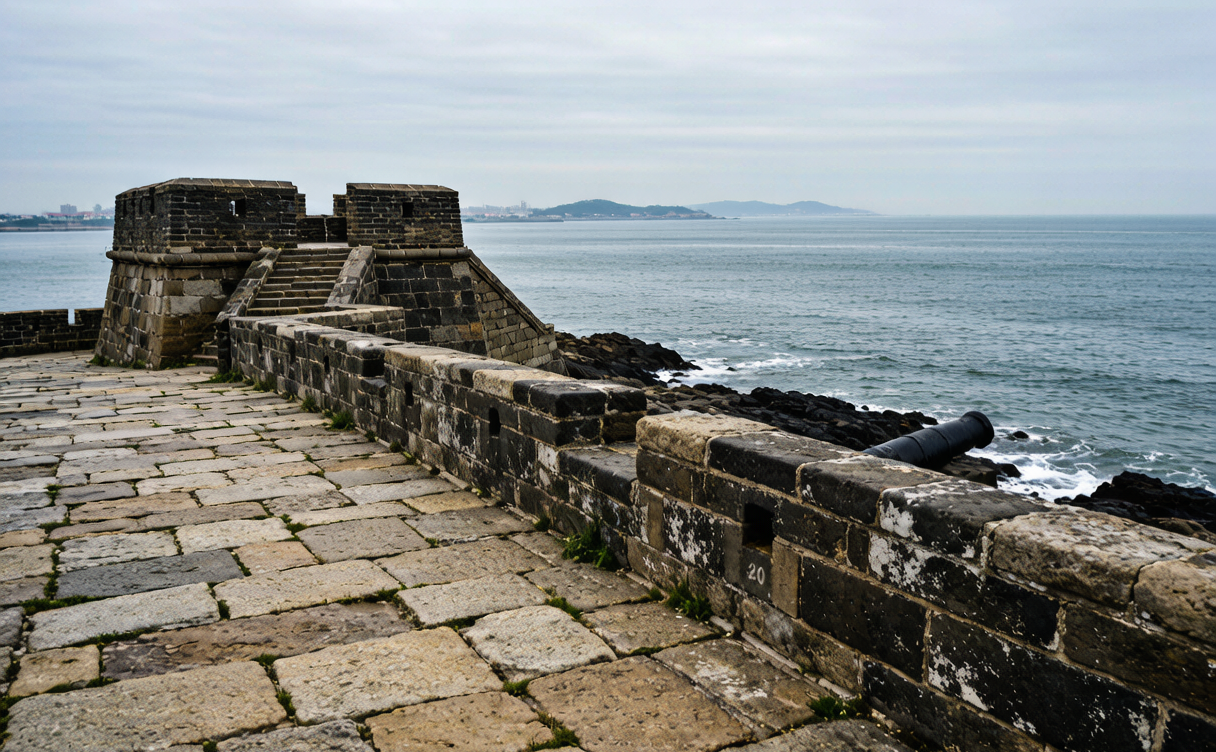
Below the pavilion lies the Penglai water fortress, a remarkably complete Ming dynasty naval base built to defend against raiders from the sea. Thick stone walls enclose a sheltered basin with an arched water gate opening straight to the ocean, where replica wooden junks are moored. Walk the battlements and you get both a lesson in Ming military engineering and a fine view back up at the pavilion on its cliff. For travelers interested in China’s maritime history rather than only its legends, this is the most satisfying part of the site.
Best time to visit Penglai
Timing affects the mood. The best time to visit Penglai is late spring and autumn, when the skies are clearer and the humidity lower, giving the best chance of seeing the strait and, if you are very lucky, a faint mirage. Summer is warm and busy with domestic tourists, while winter is cold, quiet, and sometimes grey, though the empty pavilion in winter light has its own appeal. As always in China, avoid the golden-week holidays if you want the cliffs to yourself.
Beyond the walls, the town of Penglai is calm and easy to walk. A short stroll south of the entrance brings you to a small seafront with humble seafood restaurants where you can eat the morning’s catch for a fraction of city prices. The town is also a sensible base if you want to slow down after the fast pace of Yantai or Qingdao, with a few modest hotels and a relaxed northern-Shandong rhythm that bigger resorts have lost.
Combining Penglai with Shandong
Penglai sits at the far north of Shandong, which makes it a natural capstone to a peninsula trip. Start from the provincial capital with our Jinan travel guide, which covers the city of springs, then move east through Yantai, Penglai’s own gateway city, before deciding how far down the coast to go. If you want a bigger city finish, Qingdao offers the familiar mix of sea, beer, and architecture a few hours south.
Practical tips
Wear comfortable shoes, because the pavilion grounds involve stairs and uneven stone paths. The sea breeze on the cliff is cooler than inland, so bring a layer even in summer. English signage is limited, so a translation app helps, and a guide at the water fortress can bring the Ming naval story to life. Allow at least half a day for the whole complex, and keep your camera ready, because the pavilion against the strait is one of Shandong’s most photogenic frames. If you plan to return to Yantai by late bus, check the last departure time before you enter, since the site can swallow an afternoon without you noticing.
Sources: Official visitor information for Penglai and Yantai is published by China National Tourism Administration at https://www.travelchina.gov.cn/.