

In 1905 a retired imperial examination champion named Zhang Jian opened a museum in his home town. It was the first public museum in China founded by a Chinese person, and it was not in Beijing or Shanghai — it was here, on a silty stretch of the Yangtze’s north bank. Zhang went on to build cotton mills, schools and a park system, turning a provincial county into what planners still call “China’s first modern city.” This Nantong travel guide covers what survives of that experiment, plus a moat that has held its shape for a thousand years and a Buddhist hill above the widest river mouth in the country.
Content Preview
- Where Nantong sits and why the estuary made it
- Best time to visit, season by season
- Trains and the bridge from Shanghai and Suzhou
- The Haohe moat, Langshan hill and the Zhang Jian museums
- Blue calico, whistling kites and Yuantuojiao, where the river ends
- Where to stay, what to eat, a two-day plan and practical tips
Where Nantong Sits and Why It Matters
Nantong is the last major city on the north bank of the Yangtze before the river becomes the sea. For most of its history that made it a backwater — the river was a wall, and Shanghai was visible in economic terms but unreachable in practical ones. Two bridges changed that: the Sutong Bridge in 2008, and the Hutong Yangtze River Bridge, a road-and-rail cable-stayed structure with a main span of around 1,092 metres, in July 2020. A three-hour ferry-and-bus slog became about seventy minutes by train from central Shanghai. Some 7.7 million people live in the prefecture, but the core is compact, green and almost free of foreign visitors.
Best Time to Visit
Late March to mid-May. The best stretch. Typically 14–25°C, willows out along the moat, enough clear days for real views from Langshan.
June to mid-July. Plum rains: two to three weeks of drizzle and heavy humidity. Museums are fine, hill walking is not.
Late July and August. Hot and sticky, around 30–36°C, with occasional typhoon tails up the coast. Sea breezes make Qidong more bearable than the city.
September to November. The other good season, and arguably the best time to visit Nantong: dry, 15–26°C, clear light over the water, hairy crab from late October. Avoid 1–7 October.
December to February. Cold and damp, 2–9°C, no central heating. Rates drop by a third. Pack more layers than the numbers suggest.
How to Get There
Nantong West handles most high-speed services over the Hutong bridge; Nantong Station is closer to the centre. Nantong Xingdong Airport (NTG) flies domestic routes only, so almost every foreign visitor arrives by rail. If you are working out how to get to Nantong from Shanghai, the train is the answer — our guide to booking China’s high-speed trains as a foreigner covers passport-name ticketing and station entry.
| From | Mode | Duration | Typical cost |
|—|—|—|—|
| Shanghai Hongqiao → Nantong West | High-speed rail | 1 hr 10 min | ¥120 (US$17) |
| Suzhou North → Nantong West | High-speed rail | 50 min | ¥85 (US$12) |
| Nanjing South → Nantong | High-speed rail | 2 hr | ¥180 (US$25) |
| Nantong Station → Langshan | Bus or Didi | 25 min | ¥2 / ¥30 (US$4) |
| Nantong → Qidong Yuantuojiao | Coach + taxi, or car | 1 hr 40 min | ¥45 + ¥60 (US$15) |
City buses cost ¥2 and Didi rides inside the ring road rarely top ¥25. A car and driver for a full day out to Qidong runs ¥500–700 (US$70–98).
Nantong Travel Guide to the Sights That Matter
The Haohe moat ring
The Haohe (濠河) is why the old city still makes sense on foot. Dug when the town was walled in 958, it survives as a continuous ring of water roughly 10 kilometres around, landscaped into a linear park with willows, stone bridges, dawn tai chi groups and small museums on the banks. The walls are gone; the water is the monument. Walk a section, or take a tour boat from near the Nantong Museum — a full loop runs about 50 minutes and ¥60–80 (US$8–11). Evening departures, when the bridges are lit, are the better ride.
Langshan Scenic Area
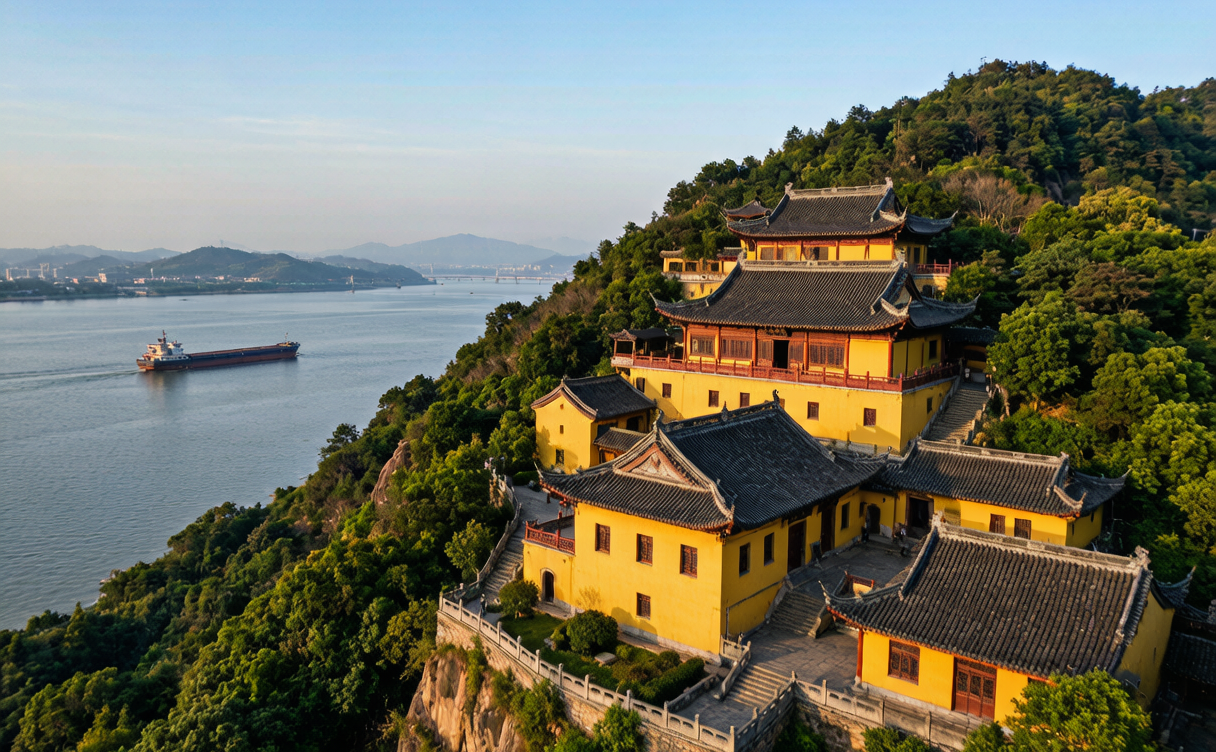
Langshan (狼山), “Wolf Hill,” is the tallest of five small hills on the riverbank southwest of the centre. At roughly 107 metres it is no mountain, but it is the only high ground for a hundred kilometres, and the view is of the Yangtze going out to meet the sea with the Sutong Bridge strung across it.
The summit holds Guangjiao Temple (广教寺), a Buddhist complex counted among China’s smaller famous Buddhist hills and dedicated to Dashizhi: yellow walls, an old pagoda, monks used to nobody speaking English. The stone stairway takes around 25 minutes at a slow pace. The park at the base is free and the temple typically charges around ¥20 (US$3). Go late afternoon and stay for the light on the water.
Nantong Museum and the Zhang Jian trail
The Nantong Museum (南通博物苑) is the point of the city. Founded in 1905 in a garden Zhang Jian laid out himself, it combines original pavilions with a modern wing and covers natural history, local archaeology and the industrial story. Entry is free with passport registration, it closes on Mondays, and English labelling is partial at best.
Within a short walk you can add the Zhang Jian Memorial Hall and the Nantong Textile Museum, and north of the centre the restored Tangzha mill district, where the red-brick Dasheng cotton works of 1895 still stand — together the most coherent surviving record of early Chinese industrialisation in the country. The Wikipedia entry for Nantong summarises the wider history.
Blue calico and whistling kites
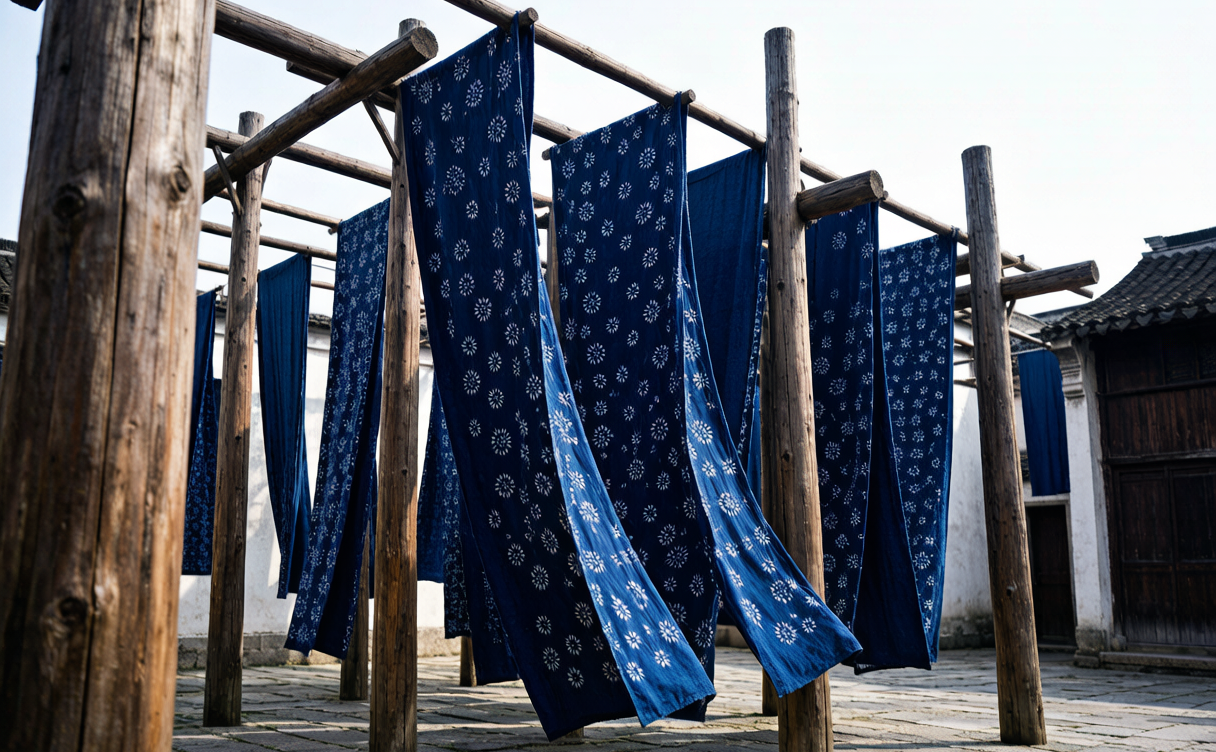
Two crafts are genuinely local. Blue calico (蓝印花布) is indigo-dyed cotton, resist-printed with paper stencils and hung on tall drying racks; the private museum on Haodong Road sells cloth by the metre and runs stencil workshops. Banyao kites (板鹞) are flat, boxy and strung with rows of carved gourd whistles that hum in the wind — national intangible heritage, and an awkward but rewarding thing to carry home.
Yuantuojiao: the end of the river
Out at Qidong (启东), 90 minutes east, Yuantuojiao (圆陀角) is where the Yangtze’s fresh water meets the yellow-brown East China Sea. It is not conventionally beautiful — a low headland, a lighthouse, mudflats, wind turbines — but standing at the mouth of a river you may have travelled a thousand kilometres upstream on is worth the drive. For that upstream half, see our Yangtze River cruise guide.
Where to Stay
Budget — ¥140–260 (US$20–37). Chain hotels around Nantong Station and Renmin Road. Clean, reliable, no English at reception.
Mid-range — ¥300–600 (US$42–84). The Chongchuan district blocks inside the Haohe ring are where I would stay: walk to the museum, the moat and the food streets, ¥20–30 by taxi to either station.
Splurge — ¥800–1,600 (US$112–225). A few international-brand towers near the CBD and one or two resorts by Langshan with river-facing rooms. Weekends fill with Shanghai families. If you are deciding where to stay in Nantong for a single night before an early train, pick Nantong West over the old centre.
What to Eat
Nantong cooking sits between Huaiyang refinement and coastal plainness, and it is not spicy.
- Wenge (文蛤) — Qidong hard clams, steamed or in soup, long marketed as “the freshest thing under heaven.” ¥60–120.
- Tiaomian (跳面) — springy noodles kneaded under a bamboo pole, in clear broth with shrimp roe. ¥12–20.
- Gangpian (缸爿) — sesame flatbread baked on a jar-oven wall, eaten at breakfast with soy milk. ¥3.
Sample Itinerary
A two-day Nantong itinerary for foreign tourists, assuming a Shanghai start.
Day 1 — the city
- 09:30 arrive Nantong West, drop bags, taxi to the Nantong Museum
- 10:00 museum and garden, then the Zhang Jian Memorial Hall
- 12:30 tiaomian noodles near Renmin Road
- 14:00 blue calico museum and a stencil workshop
- 16:30 Langshan: climb, temple, golden hour over the river
- 19:00 evening boat on the Haohe
Day 2 — the estuary
- 08:00 car east to Qidong; 09:45 Yuantuojiao headland and lighthouse
- 12:00 clam lunch on the coast
- 14:00 back via the Tangzha mill district
- 17:30 train to Suzhou or Shanghai
A third day buys Rugao’s old streets or a slow walk of the full moat ring.
Practical Tips
- Tickets are passport-named. Carry the physical passport and use the manned gate, not the ID scanner.
- Reserve museums online. Free state museums, the Nantong Museum included, usually need a day-before booking through a WeChat mini-program. Ask your hotel if you cannot read the form.
- Payment. WeChat Pay and Alipay accept foreign cards, but link them before you arrive. Carry ¥200–300 cash for stalls and donations.
- English is rare. Expect essentially none outside top-tier hotels. Save addresses in Chinese characters and screenshot them.
- Didi works well and has an English interface; drivers will phone you, so add “I don’t speak Chinese” in the note field. The estuary is exposed year-round, so bring a windproof layer even in May.
FAQ
Is Nantong worth visiting?
If you want a working Chinese city with real history and no tour groups, yes. It is not a substitute for Suzhou — there are no classical gardens of that rank — but the museum complex, the moat and Langshan make a satisfying two days, and it is the easiest way to see the Yangtze estuary.
How many days do I need?
Two. One day covers the city core if you are efficient; the second buys Qidong or the Rugao side trip.
What are the best things to do in Nantong on a short stop?
The Nantong Museum, a boat ride on the Haohe, and Langshan at sunset — that trio fits into six hours between trains. Scenic areas may ask for online reservation at weekends and holidays; your passport is the ID these systems accept.
Can I do Nantong as a day trip from Shanghai?
Yes, and many people do. Take an early train from Hongqiao, see the museum and Langshan, and be back by 21:00. You will not have time for Qidong.
Written by Karl · Updated August 6, 2026