

If you visit only one Buddhist site in China, make it the White Horse Temple (白马寺, Baima Si) on the eastern edge of Luoyang. Tradition holds that it is the first Buddhist temple established on Chinese soil, founded in 68 CE when the Eastern Han emperor sent envoys west, returned with scripture and two white horses, and built a monastery in their honor. We have taken both devout pilgrims and casual travelers here, and the combination of deep antiquity and unexpected international flavor always lands. This White Horse Temple Luoyang guide covers the history, the ticket, the transport, and the small details that make a visit memorable.
Why it earns the “first temple” title
The story, recorded in later texts, goes that Emperor Ming of Han (r. 57–75 CE) dreamed of a golden figure and dispatched a mission toward the west. The envoys met two monks, Kashyapa Matanga and Dharmaratna, who brought Buddhist sutras and images back to the Han capital of Luoyang on white horses. The emperor ordered a temple built to house them, and because the horses carried the load, it was named the White Horse Temple. Whether every detail is literal history or founding legend, the site has been continuously venerated for nearly two thousand years, which is what gives it such weight. For a wider heritage frame, our China UNESCO World Heritage guide places it alongside the nearby Longmen Grottoes.
White Horse Temple Luoyang tickets and visiting basics
Entry is inexpensive: the standard ticket is about 35 RMB, with modest discounts in the low season and free or reduced entry for children and seniors meeting the usual height and age rules. The temple opens early, roughly 07:40 to 18:00 in summer and 08:00 to 17:00 in winter, and we strongly suggest arriving near opening to enjoy the courtyards before tour buses arrive around 09:30. Tickets are sold at the entrance and through major Chinese platforms; advance purchase is rarely necessary except on holiday peaks. We once arranged a private dawn walk for a meditation practitioner, and the empty main hall with incense smoke drifting in the first light was, by his description, the calmest hour he spent in China.
How to get to Luoyang and the temple
Luoyang is a major stop on the high-speed network. Luoyang Longmen Station (洛阳龙门站) sits on the line linking Xi’an and Zhengzhou; from Xi’an it is about one and a half to two hours, and from Zhengzhou roughly 40 minutes to an hour, with second-class fares in the 60–110 RMB range. From the station to the temple, which lies about 12 kilometers east of the old city, a taxi takes 30–45 minutes and costs roughly 40–65 RMB. Public buses also run but involve transfers, so for most visitors a taxi or a pre-booked car is simpler. If you are building a Henan loop, our Zhengzhou travel guide explains the hub you will likely use, and our Kaifeng travel guide adds the Song-dynasty park to the east. We once arranged a client to train from Xi’an to Luoyang, visit the temple that afternoon, and still reach the Longmen Grottoes the next morning; the geography makes that easy.
What to see in the temple grounds
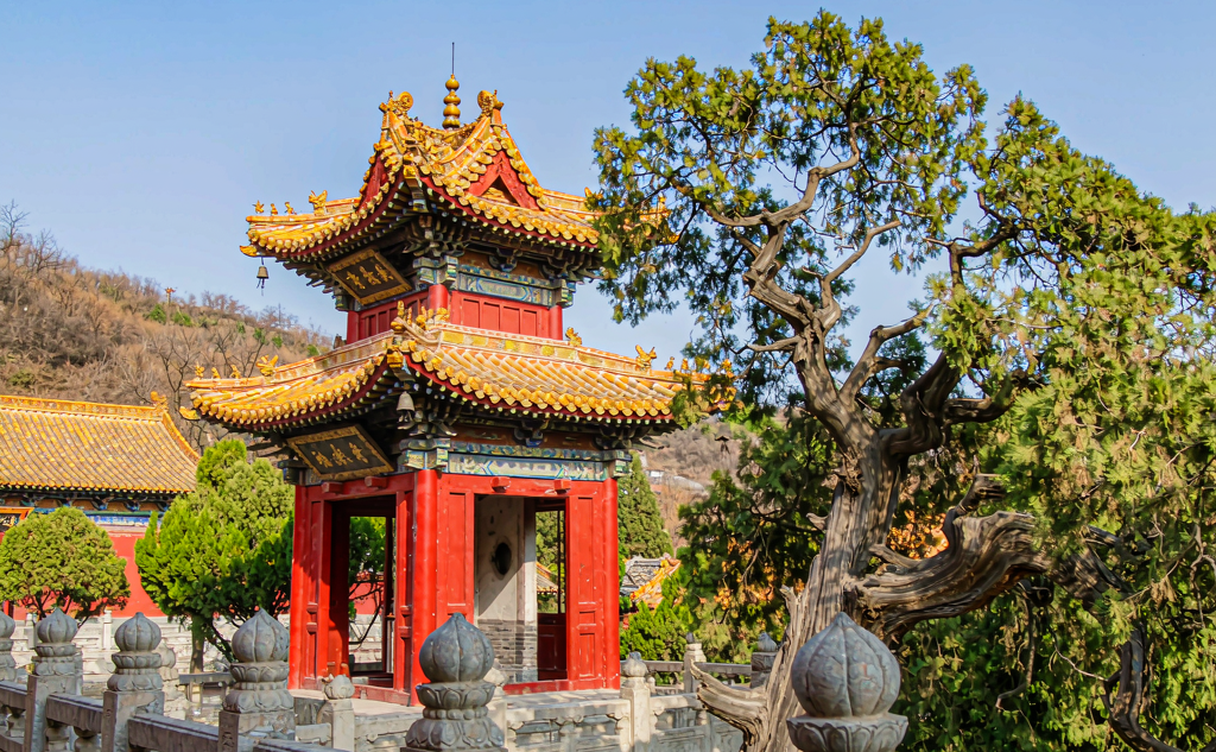
The core is a typical axial layout: a front hall, the Hall of Heavenly Kings, the Great Buddha Hall (大雄宝殿), the Hall of Mahavira, and finally the Hall of Reception (接引殿), with a tall Qiyun Pagoda (齐云塔) in a separate rear garden. The two stone white horses at the gate are the photo everyone takes. What surprises first-timers is the international zone: behind the traditional Chinese compound sits a Thai-style temple donated by Thailand, a Burmese (Myanmar) hall, and an Indian-style stupa and garden built with Indian government support, plus a Sri Lankan pavilion. Together they make the point that Buddhism returned here from many directions. We always tell clients to leave an extra 40 minutes for the international area, because the contrast between the solemn Chinese halls and the golden Thai spire is one of the most photogenic juxtapositions in Henan.
Best time to visit Luoyang
The best time to visit Luoyang is spring, especially mid-April, when the city’s famous peonies (牡丹) bloom and the temples sit in mild weather. Autumn (September to October) is the other sweet spot, with clear skies and comfortable temperatures. Summer is hot, and the temple’s open courts offer little shade, so go early. Winter is cold but wonderfully quiet. If you can, avoid the National Day holiday. For broader seasonal planning, our China travel guide for first-timers helps you sequence Luoyang with other stops.
Things to do in Luoyang beyond the temple
A White Horse Temple visit is usually paired with the Luoyang Longmen Grottoes guide, the UNESCO cliff-carved Buddhas just south of the city, which we consider the single best half-day in Henan. Back in town, the Luoyang Museum gives context on the Tang and Han periods, and Guanlin (关林) marks the tomb-shrine of the revered general Guan Yu. The old city’s night market is the place for Luoyang’s signature beef soups (洛阳汤) and the elaborate “water banquet” (水席), a sequence of soupy dishes that once graced Tang-dynasty tables. We once arranged a water-banquet dinner for a client who thought they disliked Chinese food; the gentle, sour, broth-based courses won them over for under 120 RMB per person.
Food near the temple
The temple itself has a vegetarian canteen where monks and visitors eat simple noodles and buns for a few RMB, and we recommend it for the atmosphere as much as the food. Just outside the gate, small restaurants serve 牛肉汤 (beef soup with flatbread) for about 15–25 RMB, a Luoyang breakfast staple. If you want the full water banquet, head into the city center, where set meals start around 60 RMB per person. We often tell clients to eat the temple’s plain vegetarian lunch, then save the richer city food for dinner.
A practical Luoyang itinerary
We suggest a half day for White Horse Temple and a half day for Longmen, which together fill a relaxed day with an overnight in the city. Morning: temple at opening, with the international garden before it crowds. Lunch near the gate or back in town. Afternoon: Longmen Grottoes until close. Evening: old-city night market. If you have a second day, add the museum and Guanlin, or time a spring visit around the peony festival in Wangcheng Park. This Luoyang itinerary also works as a stop between Xi’an and Zhengzhou. For the full city picture, our Luoyang travel guide covers hotels, the peony season, and transport passes in detail.
Background to read first
To understand the founding legend and the temple’s place in the spread of Buddhism across East Asia, the Wikipedia entry on White Horse Temple is a clear, sourced starting point. We send it to clients the week before they fly so the stone horses and the old halls carry more meaning on arrival.
Practical tips
Dress modestly and speak quietly; this remains an active monastery. Remove hats in the main halls. Wear shoes you can slip off easily if you enter side shrines. Carry water in summer, as shade is limited. A licensed guide at the gate costs about 80–120 RMB for a small group and is worth it for the founding story alone. We once arranged a visit that ended with the resident monk’s blessing ceremony; such moments cannot be guaranteed, but arriving early and showing respect improves the odds.
Final thoughts
The White Horse Temple is small compared with the great mountain monasteries of the south, but its claim as the cradle of Chinese Buddhism gives it an importance that size cannot measure. Spend a calm morning, wander the international gardens, and you will leave with a real sense of how a faith traveled the Silk Road and took root. We hope this White Horse Temple Luoyang guide gives you the detail to visit it well and the curiosity to explore the rest of the city while you are there.