

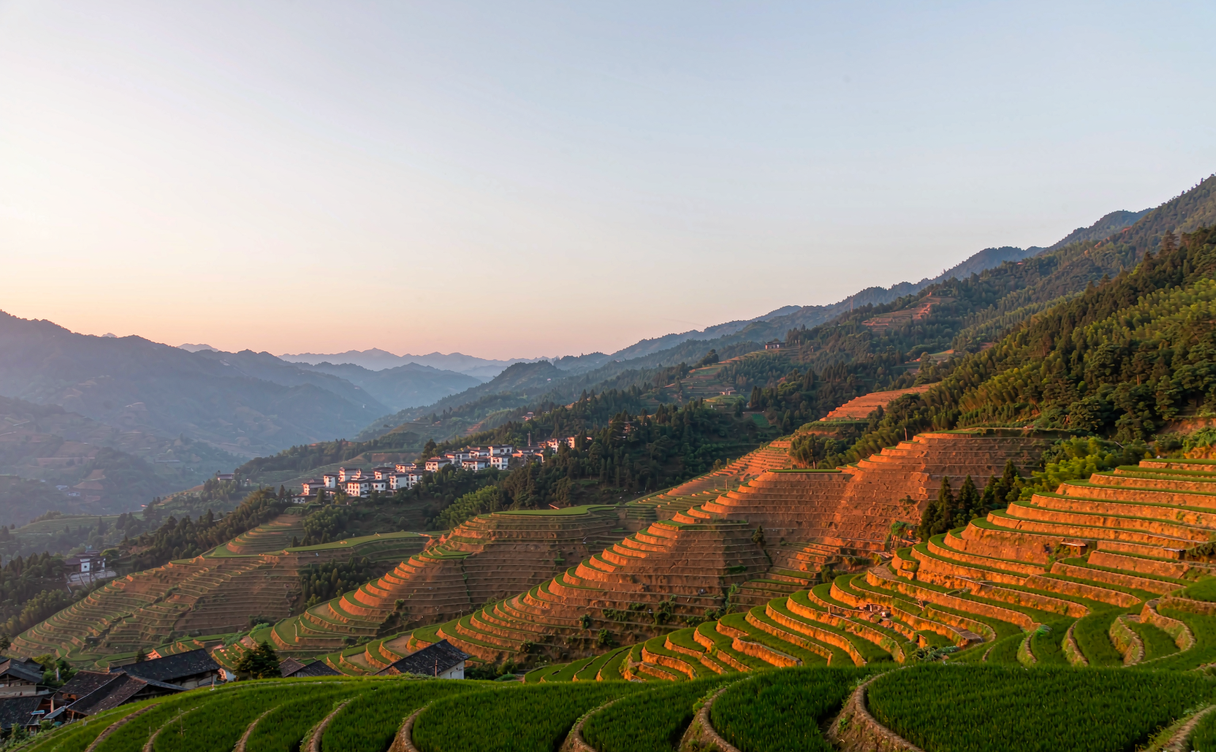
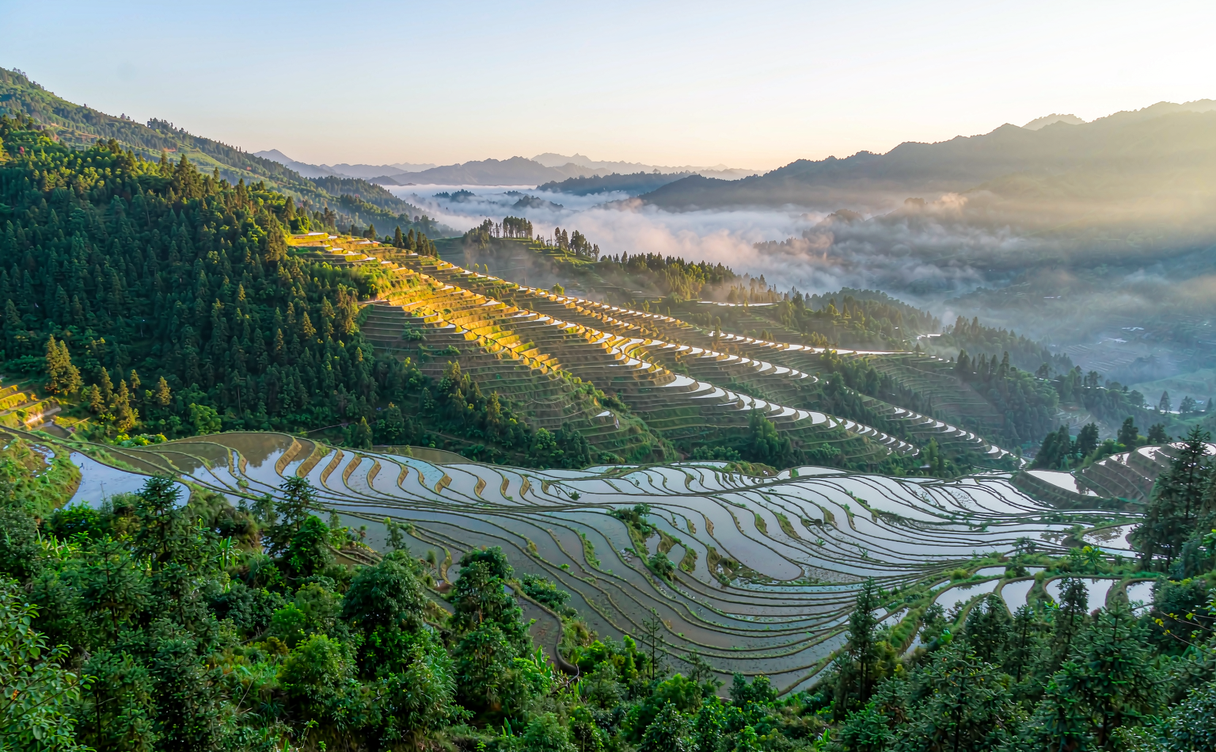
Carved into the steep hills of northern Guangxi, China over more than 600 years, the Longsheng Rice Terraces are among the most photographed landscapes in southern China — and for good reason. We have sent travelers here from Guilin for the mirror-like flooded fields in spring and the gold harvest in autumn, and both seasons feel otherworldly. If you are mapping a China travel guide for first-timers, Longsheng is an easy, rewarding day-or-overnight trip from Guilin.
Where They Are
The terraces sit in Longsheng Various Nationalities Autonomous County, about 100 km northwest of Guilin, in Guangxi Zhuang Autonomous Region, China. The two main viewing areas are Ping’an (a Zhuang village, with the famous “Nine Dragons and Five Tigers” and “Seven Stars with the Moon” viewpoints) and Jinkeng Dazhai (a Red Yao village, with the higher, grander “Golden Buddha Peak”). The Longsheng County overview on Wikipedia gives useful background on the county’s ethnic make-up and terrace history, including how the Zhuang and Yao carved the slopes by hand over generations.
Getting There
From Guilin, buses leave the North Bus Station for Longsheng town (¥30–¥50, 2–2.5 hrs), then a local minibus or taxi continues up to Ping’an or Dazhai (another 40–60 min, ¥30–¥60 shared). A private car from Guilin runs ¥400–¥700 round trip and is the most flexible. There is no train to the terraces, but you can reach Guilin by high-speed rail — our high-speed train guide for foreigners covers booking to Guilin from major cities. Note: vehicles stop at the parking lot below the villages; you walk or hire a porter for the last stretch (porters charge ¥30–¥80 per bag), so pack light and wear a daypack you can carry yourself.
Best Time to Visit
The best time to visit China guide flags two standout windows for Longsheng. Late April to mid-May is when the terraces are flooded and reflect the sky like silver mirrors — magical for photography but busy around the Labour Day holiday. Mid-September to early October is harvest: the rice turns gold and the terraces glow. We slightly prefer late September, just before the National Day crowds. Winter (Dec–Feb) is quiet and misty but cold; some guesthouses close, and the terraces lie fallow and brown rather than gold.
Things to Do at Longsheng Terraces
Walking the terrace ridges is the main event. From Ping’an, the loop to “Nine Dragons and Five Tigers” and “Seven Stars with the Moon” takes 1–2 hours on paved paths. From Dazhai, the cable car (¥55–¥100 one way) or a 2-hour hike reaches Golden Buddha Peak, the best panorama. Sunrise and sunset are the money shots; stay overnight to catch both. You can also visit Yao and Zhuang villages to see traditional wooden stilt houses and embroidery, and in autumn watch the rice harvest — a living heritage that has continued unchanged for centuries.
History of the Terraces
The fields were begun in the Yuan dynasty and perfected through the Ming and Qing, as Zhuang and Yao farmers terraced ever-steeper slopes to grow rice where flat land did not exist. Some plots are barely a meter wide — local saying has it you can “drop a hat and it covers three terraces.” The system is still farmed by hand today, which is why the landscape changes week to week through the season. Many of the best things to do in China for photographers center on exactly this kind of living agricultural scenery, and Longsheng is the most accessible example in the south.
Where to Stay
Overnight in the villages for the light. Ping’an has the most guesthouses (¥150–¥400 per night), many with terrace-view balconies. Dazhai is higher and quieter, with similar pricing and some newer boutique stays (¥300–¥700). Book ahead for May and October. For more city comfort before or after, our Xiamen travel guide is handy if your route continues to the Fujian coast — closer to Longsheng, Guilin itself has the best hotels. If you enjoy historic towns and old villages, the stilt-house hamlets here are a living example of rural Guangxi, China architecture worth slowing down for.
Food and Costs
Village meals are hearty and cheap: bamboo-tube rice, sour bamboo shoots, free-range chicken, and river fish for ¥35–¥70 per person. A guesthouse dinner with the family is often the best meal of the trip. Entry to the terraces scenic area is about ¥80 (covers both Ping’an and Dazhai); cable cars are extra. A typical independent day trip from Guilin totals ¥300–¥600 per person, including transport, entry, and food. Add a night’s lodging if you want both sunrise and sunset, which we recommend.
Practical Tips
The terraces involve real stairs — hundreds of them — so pack good shoes and go light. Mornings are misty and photogenic but slick; bring a walking stick if needed. Homestays are basic: thin walls, sometimes no heating in shoulder season, and intermittent hot water — embrace it. Cash helps in the villages; Alipay/WeChat Pay work at most but not all. Mornings fill with tour groups by 7 am, so set an alarm for the viewpoints before first light.
Sample 2-Day Plan
- Day 1: Guilin to Longsheng to Ping’an; afternoon walk to viewpoints; sunset.
- Day 2: Sunrise at the terraces; optional Dazhai cable car; return to Guilin.
Photography Tips
The terraces are a light-chaser’s dream. In spring, arrive before sunrise so the first gold hits the flooded terraces and turns them into a mirror of the sky; in autumn, the same window sets the ripe rice aglow. A drone is tempting but restricted in the scenic area, so use a tripod on the viewpoint platforms instead. Pack a lens cloth — the mist at dawn is constant and will fog your glass within minutes.
Nearby: Beyond the Two Villages
If you have a third day, the broader Longsheng county hides quieter terraces at Longji Ancient Zhuang Village and the hot-spring town near Ping’an, where locals soak after the harvest. Guilin itself, an hour and a half south, adds karst peaks and the Li River cruise — an easy bookend to the terraces. Our Xiamen travel guide is handy only if you continue southeast toward Fujian; most visitors loop back through Guilin.
What to Bring
The terrace stairs are the real test, so wear cushioned shoes and carry a daypack with water, a rain shell, and cash for the village stalls. A walking stick helps on the descent, and a headlamp is useful if you rise before dawn for the viewpoints. Pack a warm layer even in May and September — the open hills are cooler than Guilin and the wind cuts through at sunrise.
FAQ
Ping’an or Dazhai — which is better?
Ping’an is easier and closer with more guesthouses; Dazhai is higher, quieter, and has the grandest viewpoint. Many visitors do both.
How many stairs are there?
Hundreds. The walk from the parking lot to Ping’an alone is a serious climb — porters and the cable car at Dazhai help.
Is it worth staying overnight?
Yes. Sunrise and sunset light on the water or gold terraces is the whole point; day-trippers miss both.