

If you think Chinese food is all about salt and soy, Guizhou will change your mind at the first spoonful. This Guizhou sour soup guide takes you into the sour-savory cooking of southwest China, where the Miao, Dong, and Buyi peoples have been fermenting tomatoes and rice for centuries. Guizhou sits in a green, mountainous corner of the country, and its signature dish — sour soup fish — is the kind of meal you plan a whole trip around. The sourness is not from vinegar but from live fermentation, a technique born from a climate too humid to keep food any other way. Every family keeps a clay jar of starter by the hearth, and the taste varies from village to village — which is reason enough to eat your way across the province.
Best Time to Visit Guizhou
The best time to visit Guizhou is March through November. Spring (March to May) and autumn (September to November) are the most comfortable, with mild temperatures and clear roads through the hills. Summer (June to August) is warm and lush but rainy, with the occasional heavy storm in the mountains, so watch the forecast if you drive. Winter is damp and cool, though the crowds thin out completely.
For a wider seasonal plan, our best time to visit China page helps you line up Guizhou with neighboring provinces. Avoid the worst of July–August rain if you intend to hike between villages.
How to Get There
How to get to Guizhou runs through Guiyang, the provincial capital. Most visitors fly into Guiyang (贵阳) at Longdongbao International Airport (KWE), with flights from Beijing (about 3 hours), Shanghai (about 2.5 hours), and Guangzhou (about 1.5 hours). Guiyang North is a major high-speed rail hub: Guangzhou is 4 hours (around CNY 260 second class), Chengdu about 3 hours, and Kunming about 2.5 hours. From Guiyang you reach the scenic counties by regional train or a hired car.
Guizhou Sour Soup Guide: The Pot and the Fish
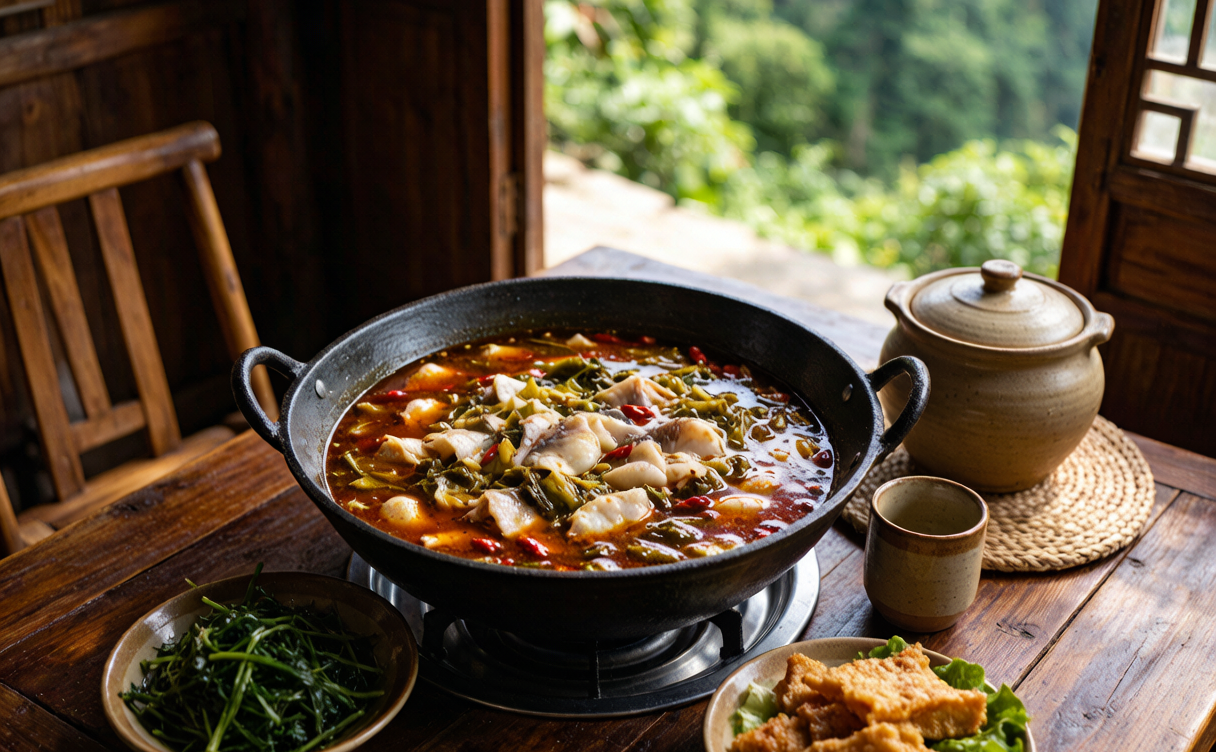
The dish at the center of Guizhou food is suāntāng yú (酸汤鱼), the famous Guizhou sour soup fish. The broth comes in two styles: hóng suāntāng (红酸汤), made from fermented tomatoes and chili for a red, tangy base, and bái suāntāng (白酸汤), made from fermented rice water for a paler, softer sour. A whole river fish — usually carp or catfish — is simmered in the pot, then you keep adding tofu, leafy greens, and noodles as you eat. A pot for two runs CNY 80–150. The red version starts with a jar of tomato pulp left to sour in brine for weeks; the white version uses the runoff from washing sticky rice, caught and fermented until it tingles. Neither tastes like vinegar — the sour is rounder and alive, closer to a good sauerkraut broth than anything bottled.
Ordering tips: pick your soup color first (most visitors prefer the red tomato version), then choose the fish by the jin (500g). Ask for zhé’ěrgēn (折耳根, fish mint) on the side rather than in the pot if you are unsure — this peppery, polarizing herb divides even seasoned travelers. Sour soup beef (酸汤牛肉, suāntāng niúròu) is the easier gateway if fish is not your thing.
Where to Eat: Guiyang, Kaili and the Miao Villages
In Guiyang, head to a dedicated sour soup house such as Lǎo Kǎilǐ (老凯俚) for a reliable, tourist-friendly version, or hunt smaller stir-fry joints where the broth is fiercer. For the authentic taste, go to Kaili (凯里), the Miao heartland two hours east by train, where every family has its own ferment. In Kaili, look for the small storefronts with a row of clay ferment jars out front; that is where the soup is made in-house rather than from a mix. A bowl there costs CNY 30–50 and comes with a plate of picked vegetables you add yourself. The Guizhou Xijiang Miao Village is the largest Miao settlement in the region and a strong base for eating sour soup with a view of terraced wooden homes.
Beyond the soup, try sīwáwá (丝娃娃), thin crepes you fill with shredded vegetables and dress with a sour-savory sauce — a DIY street bite for about CNY 15–25. Chángwàng miàn (肠旺面) is a Guiyang noodle bowl with pig intestine and blood, rich and comforting at CNY 12–20. Sticky rice (糯米饭, nuòmǐfàn) wrapped with pork and peanuts makes a cheap breakfast.

Guizhou Travel Tips and Daily Budget
A few Guizhou travel tips: the cuisine is sour, not chili-hot, though red soup carries heat, so ask for “wēi là” (mild spicy) if you are sensitive. Carry small cash for village stalls. Food runs CNY 80–150 per day in the cities, less if you lean on noodles and wraps; a sour soup feast for two with drinks is CNY 120–200. Markets are the best classroom — go early to see the ferment jars and the fresh herbs, and point at whatever looks unfamiliar to build your own bowl. The Miao and Dong hosts in the villages are happy to explain each ingredient if you show interest, and a few words of thanks in the local language go a long way.
Where to Stay
Base yourself in Guiyang for transport, with mid-range hotels at CNY 250–450 per night. For atmosphere, stay a night in the Xijiang Miao Village guesthouses (CNY 200–400) to eat by the riverside after the day-trippers leave. Book village stays ahead in spring and autumn, the busy seasons.
Sample Food Itinerary
Day 1: Arrive in Guiyang, dinner on sour soup fish and a plate of sīwáwá.
Day 2: Train to Kaili, eat a fiercer homemade sour soup, then on to the Miao village for the night.
Day 3: A morning walk through the village, then a long lunch and a transfer to the Guizhou Huangguoshu Waterfall area, where you can pair the scenery with a roadside sour soup before your ride back.
FAQ
Is Guizhou sour soup very spicy? The red version has chili, but the sourness leads. Ask for mild and you will be fine.
What is fish mint (折耳根)? A peppery herb with a cooling, almost medicinal note. It is optional — order it on the side.
Is sour soup fish safe? Yes, the broth is a rolling boil and the fish is fresh. Stick to busy houses.
Can vegetarians eat in Guizhou? Partly. Sour soup can be made with tofu and vegetables instead of fish, and sīwáwá is meat-free, but broths often use pork bones.
How do I order if I don’t eat fish? Ask for sour soup beef or a tofu-and-vegetable version; the broth works with any protein, and the vegetable wrap (sīwáwá) is fully meat-free.
Plan Your Trip
A Guizhou itinerary rewards travelers who like sour, funky flavors and mountain scenery. These Guizhou travel tips should get you to the pot with confidence. For more things to do in Guizhou beyond the table, the waterfall and village write-ups linked above are the natural next stops.
For transport and regional background, TravelChinaGuide’s Guizhou page (https://www.travelchinaguide.com/cityguides/guiyang.htm) is a reliable reference.