

If you enjoy landscape photography, the Dongchuan Red Land in Yunnan, China is one of the most photogenic places in the country and one of the easiest day or overnight trips from Kunming. This Dongchuan Red Land guide covers how to get there from the provincial capital, the best time to visit, the key viewpoints, and how to plan a shooting circuit that catches the famous red soil at its best.
What the Dongchuan Red Land is
The Dongchuan Red Land is a sprawling area of farmland in the mountains northeast of Kunming where the soil is naturally iron-rich and rust-red. Local farmers plant crops in patchwork strips — barley, buckwheat, rape and potato — that turn the hills into a quilt of crimson earth, green shoots and pale blossoms. The contrast is what draws photographers from across Yunnan and beyond.
Unlike a paid scenic park, the red land is a working agricultural landscape. You drive or walk between fields, often with a friendly farmer happy to pose for a few yuan, and the best compositions are found by wandering rather than following a fixed route. It is a gentle, low-altitude introduction to rural China that feels a world away from Kunming’s traffic.
How to get to Dongchuan from Kunming
The most common question after “what is it” is how to get to Dongchuan from Kunming. The red land sits about 250 kilometres from the city centre, roughly a three-to-four-hour drive depending on traffic. There is no direct high-speed train to the fields, so most visitors go by hired car, private transfer, or a organised photography tour that handles the winding mountain roads.
Public buses run from Kunming’s eastern bus station to Dongchuan town, and from there you can hire a local driver for the final climb to the viewpoint area around Huashitou and Luoxiagou. If you are serious about light, a private car is worth it: it lets you be at a viewpoint before sunrise and stay until the colour fades.
Best time to visit Dongchuan Red Land
The best time to visit Dongchuan Red Land is from May to June and again from September to November. In May and June the fields are a mix of fresh green shoots and flowering rape, while September and October bring the richest reds as the soil is turned and buckwheat blooms white and pink across the slopes. Avoid the depths of winter if you can; the light is flat and the hills can be grey and bare.
Crucially, the red soil photographs best in the hours after rain, when the colour is deepest and the sky most dramatic. Many photographers plan a two-night stay so they can chase whatever weather the mountains offer.
Dongchuan red soil viewpoints
The classic Dongchuan red soil viewpoints are spread along a loop you can cover in a half day with a driver:
- Luoxiagou is the most famous spot and the best for sunset; terraces curve down to a small farmhouse, and the low light sets the earth glowing.
- Huashitou offers wide panoramas over tiered fields and is excellent at both dawn and dusk.
- Yuepuao is known for its circular, bowl-shaped plots and is a favourite for symmetrical compositions.
- Damakan faces east and catches the first light on the red ridges.
A Dongchuan photography tour usually strings these together so you are always on the right side of the hill for the light.
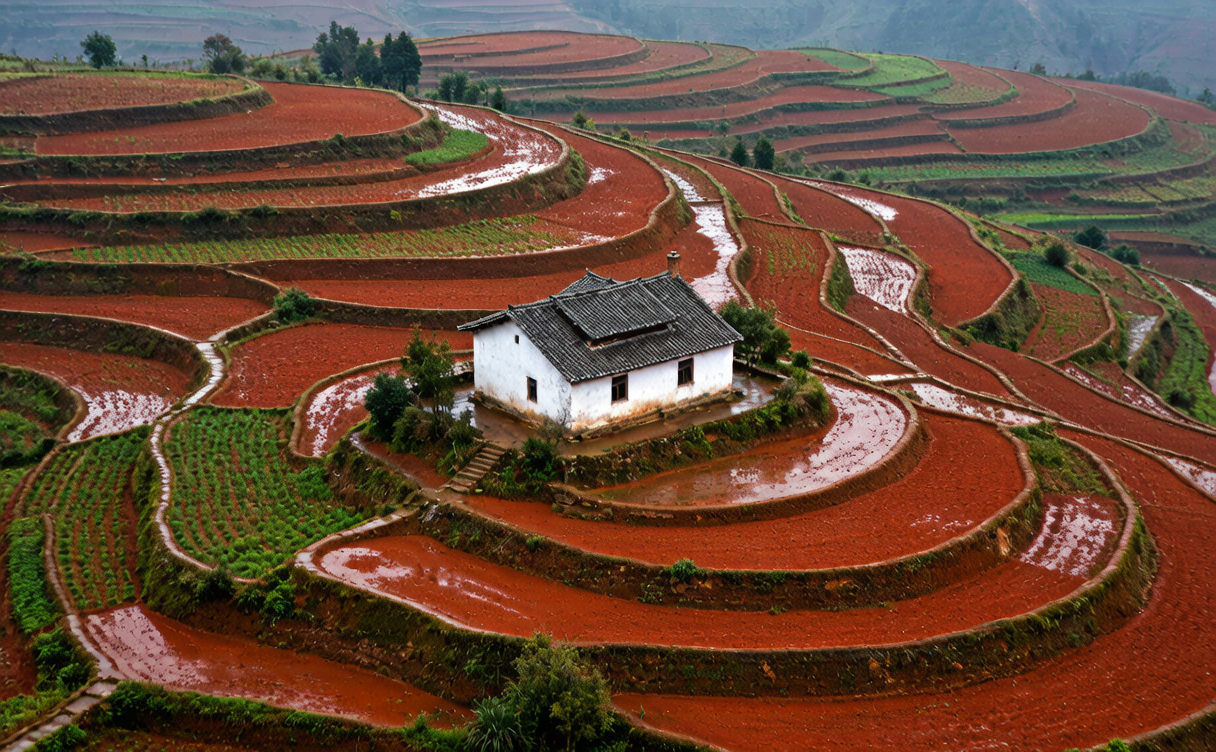
Luoxiagou sunset viewpoint
The Luoxiagou sunset viewpoint deserves its own mention. The name means “sunset valley,” and the orientation is exactly right: as the sun drops behind the western hills, warm light rakes across the terraces and turns the iron soil to molten copper. Arrive at least an hour early to claim a spot on the ridge, set up a tripod, and watch the cloud shadows sweep the valley. On a clear evening this is the image most people came for.
Because the viewpoint is popular, expect company at sunset. That is part of the fun — sharing the moment with other photographers — but if you want solitude, the lesser fields around Yuepuao are quieter and almost as pretty.
Dongchuan photography tour tips
A good Dongchuan photography tour handles transport, timing and local knowledge, which matters because the light windows are short. Bring a sturdy tripod, a wide lens for the big panoramas, and a longer lens to compress the terrace patterns. Polarisers help deepen the sky, and a rain cover is wise in the wet season.
Beyond the camera, wear proper shoes; the field edges are uneven and can be slippery after rain. Carry water and a snack, as there are few shops up on the ridges, and respect the crops — stick to the paths and ask before walking into a planted field.
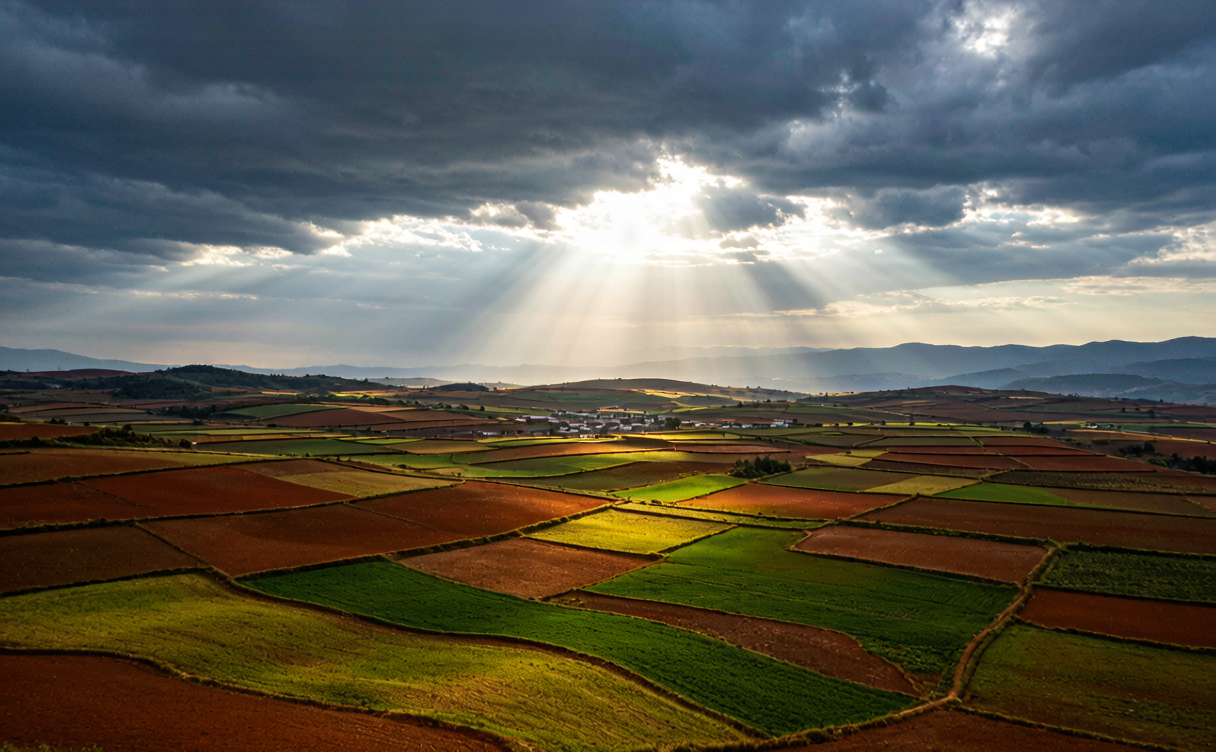
Why the earth is so red
A question many visitors ask is simply why the soil glows. The answer is iron. The bedrock here is rich in iron minerals that, over millions of years and constant wet–dry cycles, have oxidised into iron oxide — essentially rust — tinting the topsoil a deep red. The terraced farming regularly turns the earth and exposes fresh soil, so the colour stays vivid rather than fading under grass. After rain the effect is strongest, which is exactly why photographers time their trips around the wet season.
Food and the Dongchuan town stop
Dongchuan town is where you will eat. The cool mountain climate favours potatoes, and the local roasted-potato stalls are a cult favourite — small, dense, smoky spuds served with chilli and a squeeze of lime. You will also find cured pork, wild greens and simple noodle bowls. If your photography tour includes a lunch stop, expect a family-style table of Yunnan dishes rather than a formal restaurant. Carry small change and a few snacks for the viewpoints, where options are scarce.
A simple one-day plan
If you are basing in Kunming, a tight one-day plan works: leave the city by 7am, reach the fields by late morning, shoot Huashitou and Yuepuao in the soft light, eat in Dongchuan town, then finish at Luoxiagou for sunset before driving back. Two days is far better, letting you catch both dawn and dusk, but a single long day still delivers the signature images.
Pairing Dongchuan with other Yunnan sights
Dongchuan works well as a warm-up or cool-down to a longer Yunnan trip. From Kunming you can easily add the Yunnan Stone Forest, the Dianchi Lake shoreline, or push further to the rape fields of Luoping in late winter. Each offers a different take on the province’s famous red-and-gold farmland colour.
Where to stay
Most visitors base in Kunming and make Dongchuan a long day trip, but staying a night in Dongchuan town or at a guesthouse near the fields lets you catch both sunrise and sunset. Basic but comfortable lodgings exist close to Huashitou; book ahead during the October peak when the red land is busiest.
A wider photography journey
If the red land hooks you, Yunnan has more: the stone forest’s karst spikes, the terraced rice of Yuanyang, and the old towns of Dali and Lijiang. A photography tour of China can string several of these into one trip.
Sources:
- Yunnan Provincial People’s Government: https://www.yn.gov.cn