

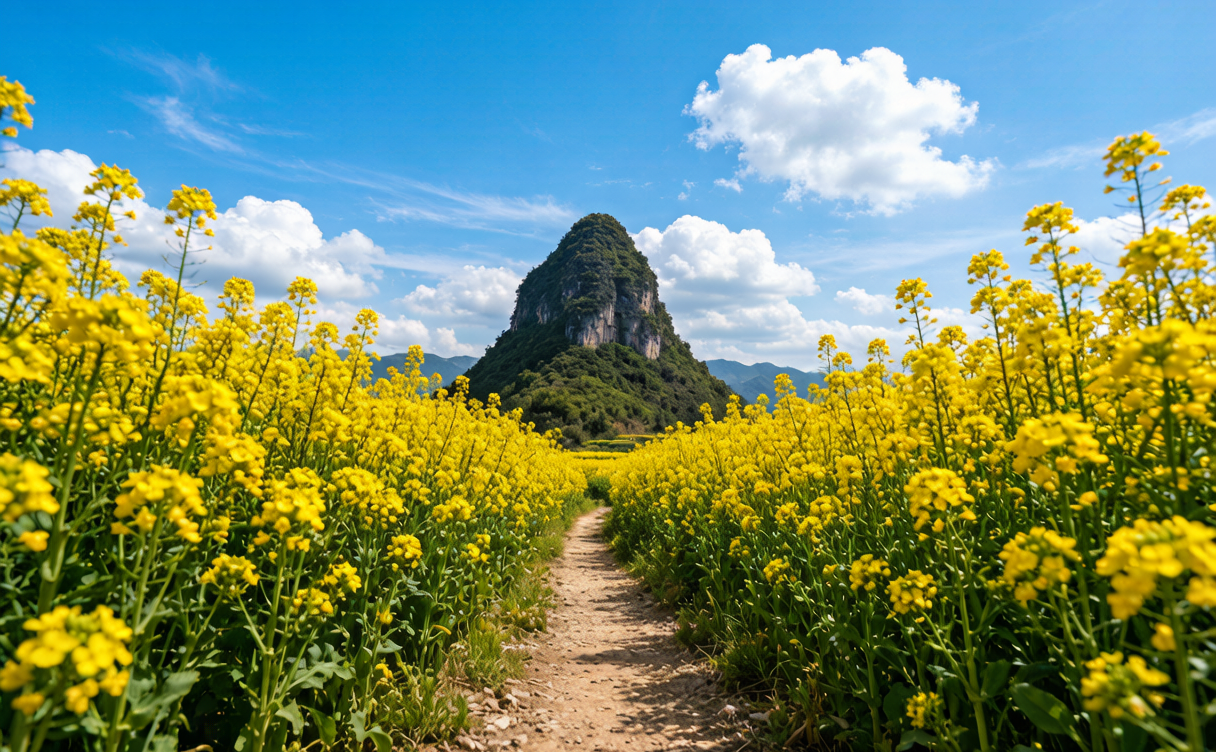
This Luoping rapeseed flower guide covers one of the most photogenic short trips in southwest China: a county in eastern Yunnan where, for about four weeks each late winter, roughly 700 square kilometres of canola bloom at once. Luoping County sits in Qujing Prefecture, about 230 kilometres east of Kunming, and its limestone cone hills rise straight out of the yellow like islands in a bright sea. Most foreign visitors have never heard of it, yet Chinese landscape photographers plan their whole February around it. This guide explains when to go, how to reach Luoping from Kunming, where to sleep, what the fields cost to enter, and how to build a realistic two-day plan.
Why Luoping Looks Different from Every Other Flower Field
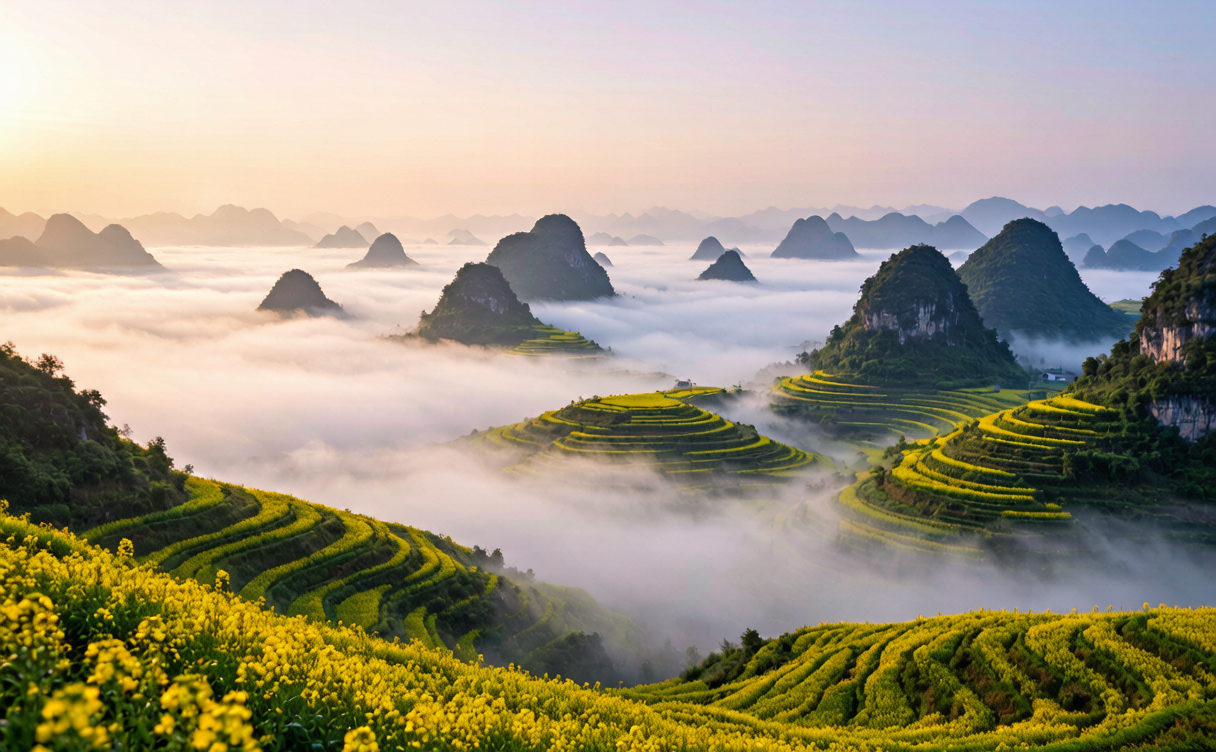
Rapeseed grows all over China, but Luoping’s terrain is what makes it extraordinary. The county sits inside the same cone-karst belt that UNESCO recognises in its South China Karst World Heritage listing, so the fields are not flat. Farmers plant canola between hundreds of conical hills and terrace it into spirals where the land drops into sinkholes. At sunrise, mist pools in the valleys and only the peaks and the yellow show through. That is why any serious Luoping rapeseed guide sends you up a hill before dawn rather than into a field at noon.
Best Time to Visit
The bloom is short and weather-dependent. In a normal year the first fields yellow in the last week of January, the peak runs from roughly 10 February to 10 March, and by late March the flowers have gone to seed and the fields turn green. If you are asking about the best time to visit Luoping rapeseed fields, aim for the 20 February to 5 March window: full colour, and the winter haze usually clears.
Daytime highs in February sit around 16–19°C with nights near 4–7°C, so mornings on an exposed hilltop feel genuinely cold — bring a fleece and gloves for sunrise. March warms to 18–23°C by day. Rain is rare in this season, but morning fog is common, which photographers actively want.
Crowds are heaviest during the Spring Festival holiday (early February in 2027) and on weekends through late February. Hotel rates in Luoping town can double or triple in peak bloom week, and the road to Jinjifeng backs up from 06:30. Travelling midweek solves most of this.
How to Get There
Luoping North Railway Station sits on the Kunming–Guiyang high-speed line, which makes luoping rapeseed travel far easier than it was a decade ago. The station is about 8 kilometres from the town centre.
| From | Option | Time | Approx. Cost |
|——|——–|——|————–|
| Kunming South Station | High-speed train to Luoping North | 1 h 05 m – 1 h 30 m | RMB 65–95 (US$9–13) |
| Kunming East Bus Station | Long-distance coach to Luoping | 3.5–4.5 h | RMB 100–120 (US$14–17) |
| Guiyang North Station | High-speed train to Luoping North | 1 h 20 m – 1 h 50 m | RMB 120–155 (US$17–22) |
| Kunming Changshui Airport | Metro/shuttle to Kunming South + HSR | 3–3.5 h total | RMB 100–130 (US$14–18) |
| Luoping North Station | Taxi or DiDi to town centre | 15–20 min | RMB 25–40 (US$4–6) |
| Luoping town | Chartered car, full day, all viewpoints | 8–10 h | RMB 350–500 (US$49–70) |
Once you are in Luoping, a hired driver is the only sensible way to move between viewpoints: the good spots are 10–45 kilometres apart on rural roads with no useful bus service. Ask your hotel to arrange one the night before.
Where to Stay
Luoping town is functional rather than charming, but it is the practical base. Three tiers work well:
- Town-centre business hotels — clean modern rooms near Zhenxing Road and the bus station, with lifts, hot water and breakfast. Expect RMB 180–320 (US$25–45) per night off-peak, rising to RMB 400–650 (US$56–92) in peak bloom week.
- Village guesthouses near Jinjifeng — simple family-run rooms 10–15 minutes from the sunrise viewpoint, which saves a 05:30 drive. Basic but well located, at RMB 150–280 (US$21–39), up to RMB 450 (US$63) at peak.
- Boutique and photography-focused lodges — a handful of newer properties with terraces angled at the fields and early breakfast for photographers, around RMB 500–800 (US$70–113).
Book at least three weeks ahead for the last two weeks of February. Outside the bloom, Luoping has plenty of empty rooms and prices fall to the bottom of every range.
The Four Viewpoints Worth Your Time
Jinjifeng (Golden Rooster Peak) terraced fields — the classic image. A cluster of hundreds of cone hills about 10 kilometres northeast of town, viewed from a hilltop platform reached by a stepped path of roughly 20 minutes. Come for sunrise; the mist usually burns off by 09:30.
Niujie snail-shell fields — around 25 kilometres southwest, where canola is terraced in tight spirals around sinkholes so the hillsides look like coiled shells. Best in soft late-afternoon light or in early-morning fog. This is the most distinctive landscape in the county and the least crowded of the big three.
Jiulong Waterfall Group — ten tiers of falls on the Jiulong River, about 22 kilometres northeast. The main cascade is roughly 110 metres wide. Water volume is modest in February but the setting, framed by yellow fields on the approach road, is lovely. A cable car and stepped paths connect the viewpoints.
Duoyi River Scenic Area — about 40 kilometres southeast, a green river valley with waterwheels, bamboo and Buyi villages. It works as a half-day change of scene when you have had enough yellow.
Typical luoping rapeseed tickets: the Jinjifeng viewing platform charges roughly RMB 20–40 (US$3–6), Jiulong Waterfall about RMB 95 (US$13) plus RMB 30 (US$4) for the shuttle, and Duoyi River around RMB 60–80 (US$8–11). The Niujie fields themselves are free, though local farmers may ask a small fee to cross private land to a good vantage point — RMB 10–20 is normal and worth paying.
Luoping Rapeseed Hiking and Photography
You do not need to be a hiker, but a little walking transforms the trip. Luoping rapeseed hiking mostly means short, steep climbs: 15–30 minutes up stone steps or dirt tracks to a ridge, then a flat walk along field bunds. The most rewarding easy route runs from the Jinjifeng platform along the ridge for about 2 kilometres, dropping into the fields on farm paths. Wear grippy shoes — the tracks are dusty and slick with red clay after fog.
Photography note: a short telephoto (70–200 mm) compresses the cone hills far better than a wide lens. And step carefully — walk on bunds and existing paths, never through planted rows.
What to Eat
Luoping’s food is eastern Yunnan comfort cooking. Look for zheng ersi, steamed rice noodles in a light broth topped with minced pork — the regional breakfast. Buyi five-colour rice, tinted with plant dyes, appears around the Duoyi River villages. Sour-soup river fish with tomato and wild herbs is the classic lunch after a morning in the fields. And of course rapeseed honey: Luoping keeps hundreds of thousands of hives during the bloom, and the honey sold at roadside stalls is genuinely local. Yunnan staples such as crossing-the-bridge rice noodles and steam-pot chicken are available in town.
Sample Itinerary
Day 1 — arrival and the snail-shell fields
- 09:00 Depart Kunming South by high-speed train
- 10:20 Arrive Luoping North; taxi to your hotel, drop bags
- 11:30 Lunch in town — sour-soup fish or zheng ersi
- 13:00 Drive to Jiulong Waterfall; two hours on the terraces and viewpoints
- 16:00 Continue to the Niujie snail-shell fields for late-afternoon light
- 18:30 Return to town; dinner and arrange a 06:00 pickup
Day 2 — sunrise and departure
- 06:00 Drive to Jinjifeng; climb to the platform in the dark
- 07:00 Sunrise and mist over the cone hills
- 09:00 Walk the ridge path, then descend into the fields
- 11:00 Breakfast of honey and steamed buns at a village stall
- 12:30 Back to the hotel, shower, check out
- 14:30 High-speed train to Kunming or onward to Guiyang
With a third day, add the Duoyi River valley and Lubuge Gorge.
Practical Tips
- Tickets are bought at the gate in cash or by mobile payment; there is no advance online booking for the smaller viewpoints. Carry RMB 200–300 in small notes for farm-gate fees and roadside stalls.
- Opening hours: Jiulong Waterfall runs roughly 08:30–18:00; the Jinjifeng platform is open before dawn during bloom season.
- Payment: Alipay and WeChat Pay work almost everywhere, including village stalls. Foreign cards can be linked to both, but a cash backup matters more here than in big cities.
- Language: almost no English is spoken in Luoping. Download an offline translation app and have your hotel write your destinations in Chinese for drivers.
- Permits: none required. Luoping is an ordinary open county with no special entry paperwork.
- Altitude: about 1,500 metres — high enough that the sun burns quickly, low enough that altitude sickness is not a concern.
FAQ
How long do I need in Luoping?
Two days and one night is the sweet spot: one afternoon for the waterfall and snail-shell fields, one sunrise at Jinjifeng. Photographers often stay three nights to gamble on fog.
Can I visit Luoping as a day trip from Kunming?
It is possible with the 07:00 train out and the 20:00 train back, but you will miss sunrise, which is the whole point. Stay the night.
Do I need to book luoping rapeseed tickets in advance?
No. All the viewpoints sell at the gate. What you should book ahead is your hotel and your driver during the peak bloom fortnight.
Is Luoping suitable for children or older travellers?
Yes, with planning. Jiulong Waterfall has a cable car and paved paths, and the Niujie fields can be photographed from the roadside. Only the Jinjifeng climb involves real steps.
What if I arrive and the flowers are over?
Check social media photo tags a week before you travel. If the bloom has passed, the Jiulong Waterfall, Duoyi River and karst scenery still make a solid weekend, and our best time to visit China guide can help you reshuffle your route.
Written by Karl, last updated August 4, 2026.