

To understand Chinese painting is to understand how a civilization learned to look at the world. For more than two thousand years, artists in China have used brush and ink not merely to record what they saw, but to suggest what it felt like to stand before a mountain, a bamboo grove, or an empty stretch of river. A single stroke may carry the discipline of calligraphy, the restraint of a poem, and a lifetime of careful observation. This Chinese painting guide follows the tradition from its earliest silk banners to the studios where travelers can still hold a brush today, looking at techniques, schools, painters, and museums. Whether your interest is scholarly or you simply want a quieter kind of travel, learning to read a scroll will change how you see China.
Chinese Ink Painting History: From Silk to Scroll
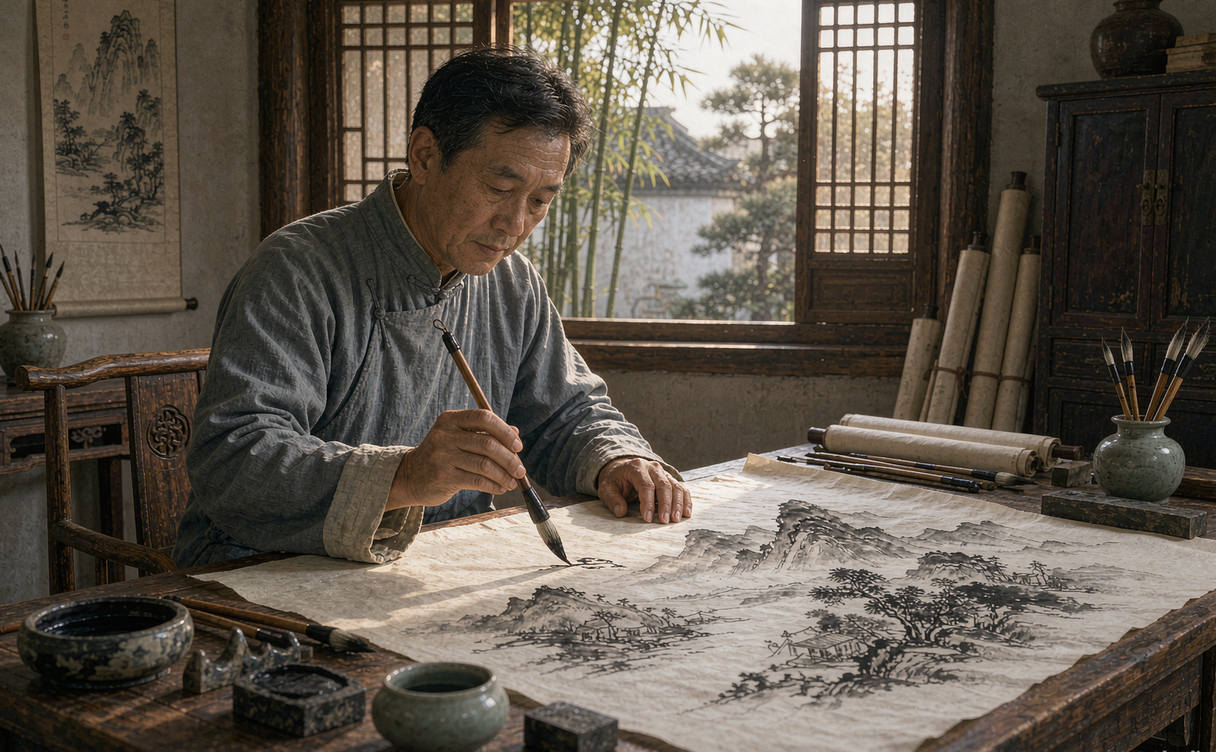
The roots lie in painted pottery and Warring States silk banners, but it was the Han dynasty that gave narrative scenes a distinctly Chinese sense of line. The arrival of Buddhism transformed the visual language. From the fourth century onward, the cave temples at Dunhuang were covered with murals in which flowing outlines and mineral colors told stories across enormous walls; the tradition continued for centuries and remains a painted archive of Asia.
The Tang dynasty is often described as a golden age. Figure painters such as Wu Daozi were celebrated for brushwork that seemed to move with the wind, while the poet Wang Wei is remembered for spare ink landscapes that joined painting to poetry. During the Song dynasty, landscape reached maturity. Fan Kuan and Guo Xi built towering mountains that invite the eye from foreground to distance, and the scholar Mi Fu painted misty hills in a dotted manner all his own. The classic overview in Encyclopaedia Britannica traces these shifts in style and patronage across the dynasties.
Under the Yuan dynasty, the literati ideal took hold. Zhao Mengfu argued that painting should borrow the energy of calligraphic brushwork, and the Four Masters of the Yuan turned landscapes into statements of personality rather than descriptions of place. The Ming dynasty produced the Wu School of Suzhou, with Shen Zhou and Wen Zhengming working as scholars rather than court professionals, while the theorist Dong Qichang framed the history of the art as a contest between scholarly and professional manners. In the Qing period, individualists such as Bada Shanren and Shitao painted with striking freedom, the Eight Eccentrics of Yangzhou turned subjects like bamboo into personal emblems, and the Jesuit painter Giuseppe Castiglione introduced elements of European modeling at court. By the late nineteenth century, the Shanghai School had pushed the tradition toward a bolder, more public visual language. Crafts traveled alongside painting, and the same brush discipline appears in the porcelain painting of Jingdezhen.
Traditional Chinese Painting Techniques
Every practice begins with the Four Treasures of the Study: the brush, the ink stick, the paper, and the inkstone. The painter grinds ink with water on a stone, loads the brush tip, and tests its pressure before touching the paper. Xuan paper, made in Anhui, is prized for the way it absorbs ink and water in soft, unpredictable halos. Unlike oil on canvas, ink on paper cannot be freely scraped away, so each mark is a decision.
Two broad modes dominate. Meticulous gongbi painting builds images through fine outlines and layered mineral color, often on silk, and demands great patience. Freehand xieyi painting, literally “writing an idea,” reduces a subject to a few expressive strokes. The fifth-century theorist Xie He set out Six Laws that still frame discussion; the first two, spirit resonance and the bone method of the brush, explain why the quality of a line matters more than photographic likeness. Painters speak of the five tones of ink, from dry and broken to wet and splashed, and of leaving white, the deliberate emptiness that lets a mist or a river suggest more than it states.
Composition is equally distinctive. A handscroll is not taken in at a glance but unrolled section by section, so the viewer wanders through a landscape as if walking. Perspective shifts rather than fixing on a single vanishing point, allowing several viewpoints to coexist in one image. Finally, inscription and seals complete the work: a poem, a date, and small red stamps of carved stone. These are part of the structure, linking what is seen to what is thought. Many travelers encounter these methods indirectly through traditional Chinese painting techniques taught in brush-and-ink sessions.
The best way to understand ink is to watch it move: try a guided brush session with a local teacher before your next museum visit.
The Literati Ideal and Its Painters
The word literati refers to educated scholars who painted as a form of self-cultivation rather than paid craft. For them, a landscape was a state of mind, and a few strokes of bamboo could stand for integrity and resilience. The Four Gentlemen, namely plum, orchid, bamboo, and chrysanthemum, became a shared vocabulary through which artists spoke about character. This is why so much Chinese painting looks plain at first glance: the drama is in the pressure, speed, and moisture of the line.
The ideal of the scholar’s studio joined several arts. Qin music, chess, calligraphy, and painting were traditionally grouped together, and a cultivated gathering might move from poetry to a scroll to a cup of tea. The painter Ni Zan left vast empty spaces in his landscapes, while Huang Gongwang spent years on a single handscroll, revising it as a meditative practice. In the modern era, Qi Baishi turned humble subjects such as shrimp into works of striking vitality, and Xu Beihong experimented with merging Chinese brushwork and Western drawing. Zhang Daqian became known for bold splashed color after years of copying the old masters, a reminder that imitation was traditionally regarded as serious study, not a lack of originality. The gardens where scholars painted still shape historic cities, their influence easy to feel once you understand the idea of a painted world to walk through.
Where to See Chinese Painting in China
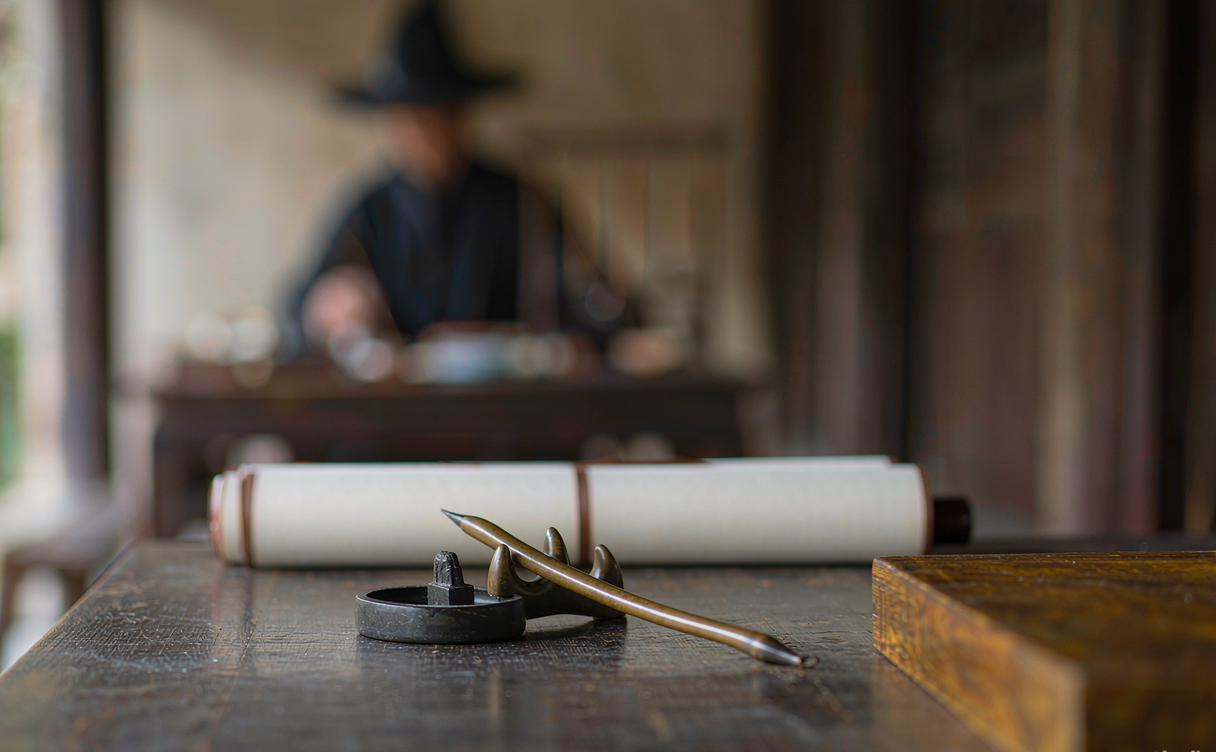
For most visitors, the Palace Museum inside the Forbidden City in Beijing is the essential starting point. Its imperial collection is immense, though the most fragile works appear only in rotating exhibitions because light damages paper and silk. Check the current display before you travel. Shanghai Museum offers a strong survey of later dynastic painting in a compact setting that is easy to combine with a city itinerary. Liaoning Provincial Museum and Nanjing Museum are also respected for early and regional holdings, while Suzhou Museum is the natural place to encounter the Wu School on its home ground.
Further west, the Mogao Caves near Dunhuang provide the context no gallery can match: painted walls preserved for centuries in dry desert air. Many sites limit visitor numbers, so book ahead. Gallery labels in English are often brief, so consider hiring a qualified guide. Photography is normally forbidden in painting halls. Because works rotate, a second visit can reveal entirely different pieces. If you want to plan a route rather than visit a single museum, our where to see Chinese painting in China guide suggests how to link collections across several cities.
Extend the journey into the gardens where scholars painted and wrote: plan a classical garden visit.
Chinese Painting vs Western Painting
The comparison between Chinese painting vs Western painting is often reduced to a simple contrast between realism and suggestion, but the deeper difference lies in intention. European oil painting from the Renaissance onward generally assumes a fixed viewer, linear perspective, and the careful modeling of light and shade. The painted surface is treated as a window. Chinese painting more often treats the surface as a field of energy, using shifting perspective and tonal ink to build a place that the imagination can enter. Empty space is meaningful rather than unfinished.
The tools reinforce the difference. Oil paint is opaque, slow drying, and reversible; ink on xuan paper is immediate and permanent. Western training historically prized the unique hand of the individual artist, while Chinese training long required copying canonical masters to internalize their brush methods. Neither tradition is lesser: one pursues convincing presence, the other resonance and the trace of a cultivated mind. This explains why a simple landscape by Ni Zan can be as demanding as a grand canvas.
Chinese Painting Workshops for Beginners
The good news for curious travelers is that Chinese painting workshops for beginners are widely available in Beijing, Shanghai, Suzhou, Hangzhou, and Yangzhou. A typical session lasts between one and three hours and focuses on a single skill: gripping the brush, varying pressure, or painting one of the Four Gentlemen. Materials are usually provided, and you will often leave with a small finished piece. Instructors normally begin with copying a model, which is the traditional way to learn rather than a shortcut.
Book ahead and ask whether an English-speaking teacher is available. Wear something dark, because ink travels farther than expected. Beginners do best with a simple subject such as bamboo, and should accept that the first sheet is a lesson in water control. Some studios pair a painting class with time in a traditional tea house, which echoes the unhurried rhythm of the old scholar’s studio. In Jingdezhen, you can even paint directly onto porcelain and watch a piece fire in a kiln.
Frequently Asked Questions
What is the difference between Chinese painting and Chinese ink painting?
Ink painting uses only ink and water, relying on tone and brushwork for all its effects. Chinese painting is the broader category and includes meticulous works with mineral color on silk, as well as court and folk traditions.
Is Chinese calligraphy the same as painting?
No. Calligraphy writes characters while painting depicts images, but both use the same tools and value the energy of a single stroke. The literati ideal asked painters to paint with a calligrapher’s hand.
Why do the paintings include poems and red seals?
Poetry, calligraphy, painting, and carving are known as the four perfections. An inscription can extend the meaning of an image, while seals identify the artist, a collector, or an imperial owner and become part of the composition.
Can a complete beginner join a workshop?
Yes. Most classes are designed for visitors with no experience. The aim is to understand the behavior of ink and the pressure of the brush, not to produce a finished masterpiece in an afternoon.
How much time does it take to learn?
Mastery takes years, but a first session is genuinely rewarding, and many visitors discover the art through a single morning at a studio.
Chinese painting rewards slow looking. Give yourself time with one scroll, notice the spaces between strokes, and listen for the poem hidden in the image. From a palace collection in Beijing to a studio in Suzhou, the tradition offers deliberately unhurried travel.
Bring a notebook, leave room for silence, and let the brush lead you deeper into the artistic heart of China.