

China built 45,000 kilometres of high-speed railway and most travellers never need anything else. Then you decide to visit a rice-terrace village in Yunnan, a Dong minority town in Guizhou, or a lake three hours off the nearest rail line, and you discover the country’s other network: several thousand coach stations moving people to places the trains do not go. Long distance buses in China are slower, scruffier and far less documented in English, and for a certain kind of trip they are the only sensible option. This guide covers when to take one, how to buy the ticket, what it costs, and what the ride is actually like.
Content Preview
- When a bus beats the train
- Bus stations versus train stations
- How to book a ticket, step by step
- Sample routes and prices
- The sleeper bus, and whether you will meet one
- Luggage, comfort and safety
- Practical tips and FAQ
When Long Distance Buses in China Are Worth It
Almost never between major cities. If two places both have high-speed rail stations, take the train — it is faster, more comfortable, easier to book and often cheaper once you count the time.
Buses earn their place in four situations:
Getting to places without trains. County towns, minority villages and most scenic areas have no station. Jiuzhaigou, Yuanyang’s terraces, Zhaoxing, Kanas, Tashkurgan and hundreds of similar destinations are reached by coach or not at all.
The last leg. High-speed rail drops you at a station 40 km outside town, in the middle of farmland. The connecting coach or shuttle is the piece nobody tells you about.
Awkward geography. Two cities 150 km apart can be four hours by rail if the line detours, and 90 minutes by road.
Border and frontier regions. In parts of western China the road network is simply older and denser than the railway.
Everything else — Beijing to Xi’an, Shanghai to Hangzhou, Guangzhou to Guilin — belongs on the train. Our high-speed train guide for foreign travellers explains why, and the train versus flight comparison covers the longer hauls.
Bus Station vs Train Station in China
They are separate systems with separate buildings, separate ticketing and no shared information. This trips up more travellers than anything else on this page.
A Chinese city typically has one or two railway stations and three to six coach terminals (汽车客运站, qìchē kèyùnzhàn), usually named by direction: North Bus Station, West Bus Station and so on. Which one you need depends entirely on where you are going, and the wrong guess can mean an hour across town. Before you set out, get the exact terminal name in Chinese characters and show it to your taxi driver — do not rely on “the bus station”.
Terminals look like small airports and work the same way: X-ray your bags at the door, buy or collect at the ticket hall, wait in a numbered gate area, show ticket and passport at the gate, walk out to the bay. Departures are announced in Chinese only. Arrive 30 minutes early; gates close five to ten minutes before departure and they do not wait.
How to Book a Bus Ticket in China
Coach travel is real-name registered on most routes, which means your ticket is tied to your passport.
1. Decide the terminal. Ask your hotel to confirm which station serves your destination and to write the name in Chinese.
2. Buy at the window if you can. Hand over your passport and a slip of paper with the destination in Chinese characters and your preferred time. The self-service machines read Chinese ID cards only, so foreign passports mean the counter.
3. Or use an app. Bashi Guanjia (巴士管家) covers most provincial operators, and Trip.com lists a limited number of intercity routes in English. Both require passport details and a payment method linked to Alipay or WeChat Pay.
4. Buy same-day or one day ahead. Frequencies are high and seats rarely sell out, except around Spring Festival and the October holiday, when they sell out completely.
5. Collect and check. The ticket prints the gate number (检票口) and departure time. Photograph it — you will need the characters again.
Rural feeder routes work differently. Small county buses often leave when full rather than on a timetable, and you pay the driver or conductor in cash on board. Keep ¥100 in small notes for exactly this.
China Intercity Bus Prices
Fares run roughly ¥0.25–0.40 per kilometre, which makes coaches the cheapest intercity transport in the country by a wide margin.
| Route | Duration | Typical fare |
|—|—|—|
| Guilin → Yangshuo | 1 hr 30 min | ¥35 (US$5) |
| Zhangjiajie → Fenghuang | 4 hr | ¥85 (US$12) |
| Lijiang → Shangri-La | 4 hr | ¥65 (US$9) |
| Kunming → Yuanyang terraces | 5 hr | ¥130 (US$18) |
| Chengdu → Jiuzhaigou | 8 hr | ¥145 (US$20) |
| Xining → Qinghai Lake | 3 hr | ¥60 (US$8.50) |
| Guiyang → Zhaoxing Dong village | 5 hr | ¥130 (US$18) |
| Kashgar → Tashkurgan, Xinjiang, China | 6 hr | ¥95 (US$13) |
For comparison, the equivalent distances by high-speed rail cost three to five times as much where the line exists at all. On a long budget trip that difference adds up fast — see our China budget backpacking guide for how it fits a wider daily spend.
The Sleeper Bus Experience
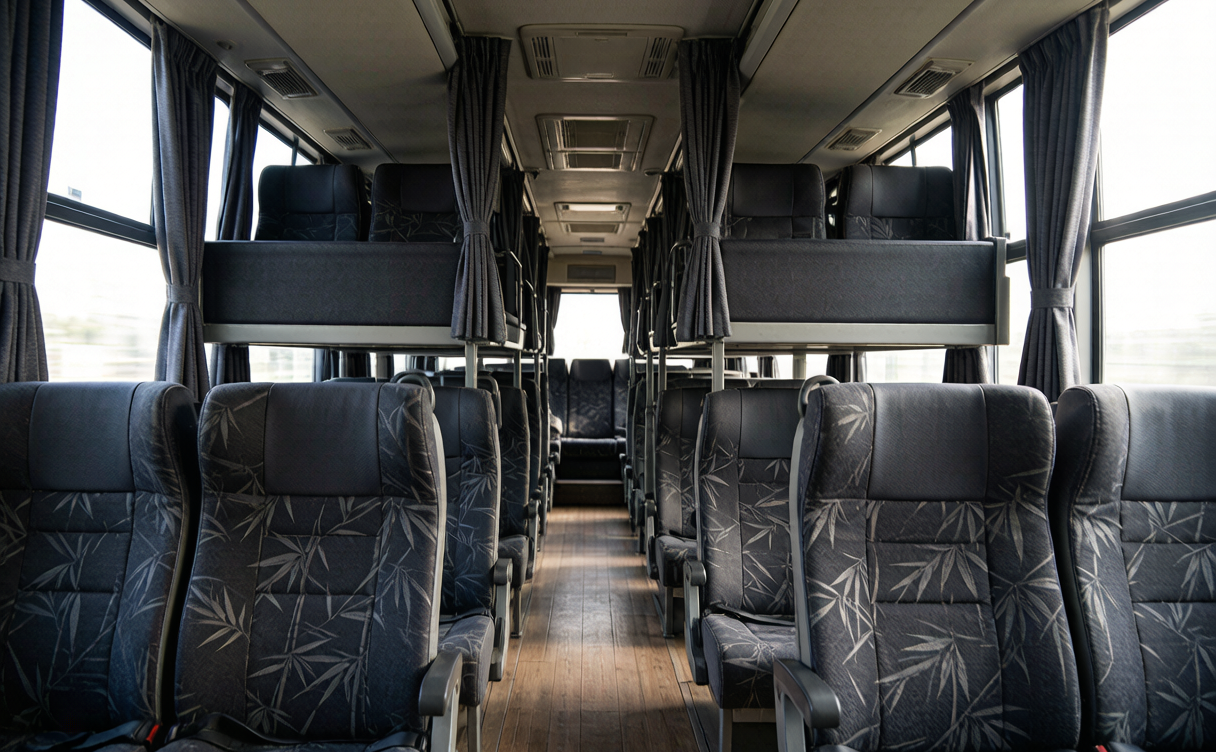
The Chinese sleeper bus is a genuine cultural artefact: three columns of two-tier berths running the length of the coach, shoes off and sealed in a plastic bag at the door, 1.8-metre bunks with a shallow footwell under the head of the berth in front. You lie down for eight to fourteen hours, usually overnight, usually with the curtains drawn and someone’s phone playing a soap opera two berths away.
They are far rarer than they used to be. Safety reforms in the early 2010s stopped new sleeper coaches entering service, so the surviving fleet has thinned out and most eastern provinces no longer run them at all. Where you still meet them is the west and southwest — Xinjiang, China; Gansu; Qinghai; parts of Yunnan, Guizhou and Sichuan — on routes of ten hours or more.
If you get the chance, take it once. Practical notes: the berths suit anyone under about 1.75 m and nobody taller; there is rarely a toilet on board, with stops every two to three hours instead; bring a sleep mask, earplugs and your own blanket in winter; and keep your bag in the berth with you rather than in the hold.
Luggage, Comfort and Safety
Luggage. One large bag in the hold is free on almost every route, with an informal 20 kg limit; oversized items attract a small charge paid to the driver. There is no tagging system on most services — you point at your bag when you arrive. Keep your passport, cash and electronics on your lap.
Comfort. Seated coaches are two-by-two with reclining seats, USB ports on newer vehicles and air conditioning that is either arctic or absent. There is no catering. Stops come every two to three hours at service areas with toilets, instant-noodle counters and hot water.
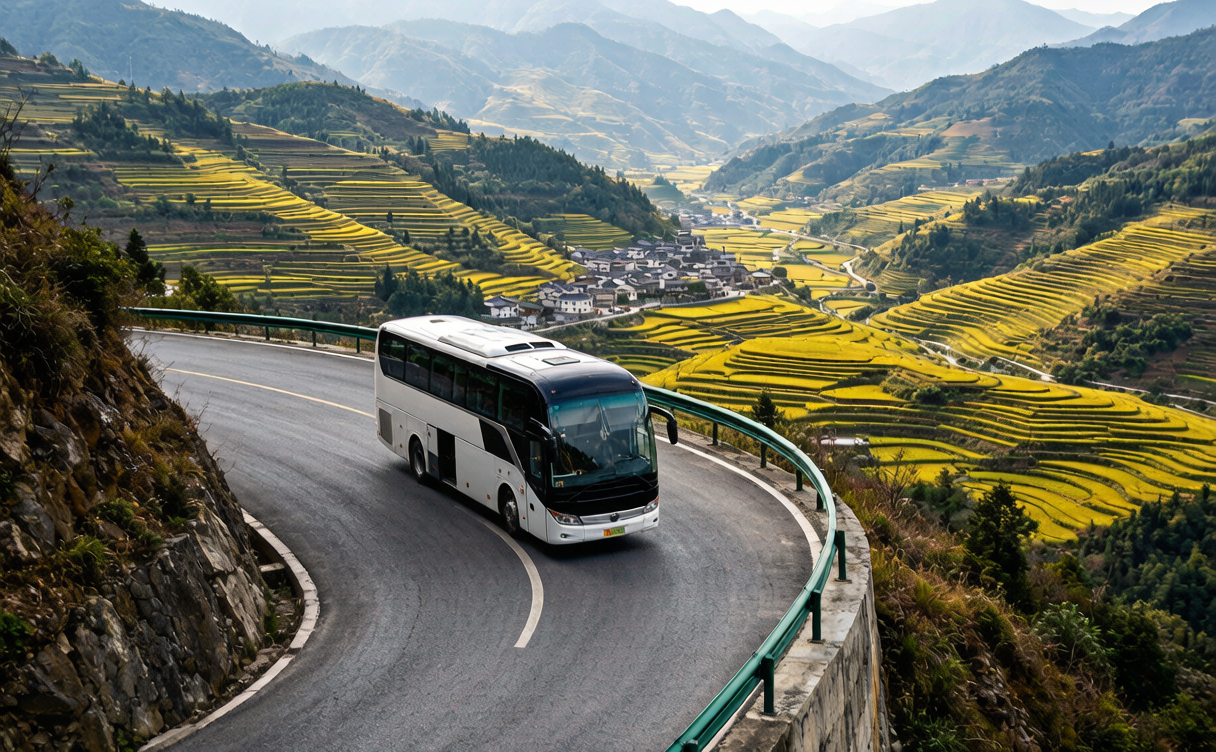
Safety. Long-haul coaches are speed-limited and GPS-monitored under national transport rules, and seatbelt use is now enforced on intercity services. The real variables are mountain roads and weather. Avoid overnight departures on winding routes if you have a choice, keep your seatbelt on, and check current road conditions during summer rains, when landslides close routes in the southwest at short notice. The Ministry of Transport of the People’s Republic of China publishes national road and transport notices in English.
Motion sickness is a genuine issue on mountain routes. Sit forward, eat lightly, and buy ginger sweets at the terminal shop like everyone else.
Practical Tips
Save the terminal name offline. Screenshot the Chinese characters for both your departure terminal and your destination. Mobile data drops out in the mountains exactly when you need it.
Sit near the front. Less bounce, better views, faster exit, and easier to hear the driver announce a stop.
Carry cash. Terminals take mobile payment; rural conductors and roadside pick-ups often do not.
Confirm the arrival point. Many coaches terminate at a suburban station rather than the town centre, and the last local connection may leave before you land.
Give yourself a buffer day. Bus arrival times are estimates. If a flight or a booked train follows, do not schedule them for the same evening.
FAQ
Can foreigners buy bus tickets in China?
Yes. Bring your passport to the ticket window, since self-service machines only read Chinese ID cards. Some app bookings accept passport numbers, but the counter is the reliable route.
Are long-distance buses safe for tourists?
Broadly yes. Licensed intercity coaches are speed-limited, GPS-tracked and seatbelt-enforced. Use official terminals rather than unlicensed operators touting outside stations, and prefer daytime departures on mountain routes.
How far in advance should I book?
Same day or one day ahead is normally fine. The exceptions are Spring Festival and the first week of October, when you should buy several days early or avoid coach travel entirely.
Do buses have toilets?
Most do not. Drivers stop at service areas every two to three hours, including on overnight services. Carry tissues — many rural station toilets have none.
Is there English signage at bus terminals?
Rarely, and announcements are in Chinese only. Show your printed ticket to a staff member at the gate area and they will point you to the right door; this works every time.
Written by Karl · Updated August 6, 2026