

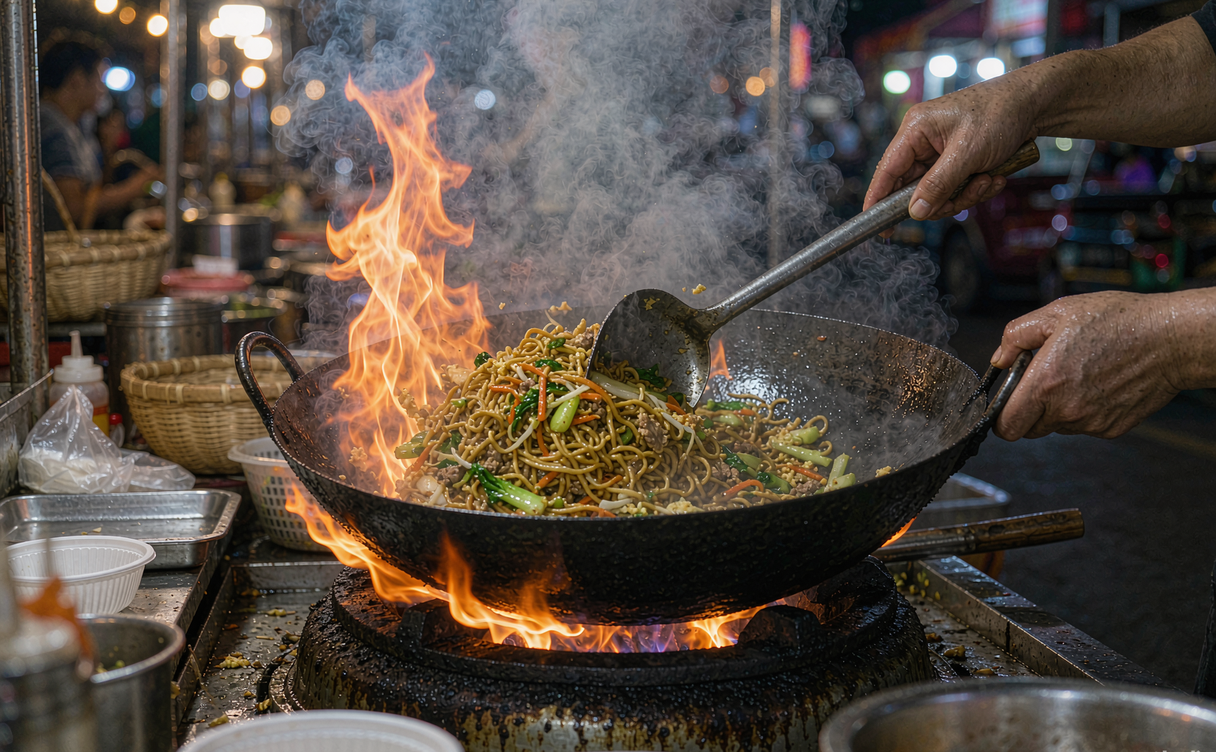
The best meal I ate in China last year cost RMB 23 and came from a plastic stool on a Xi’an side street at 10 p.m. Street food is where China’s cuisine actually lives — not in the banquet halls, but at the carts, the night-market stalls, and the fold-out tables of a city’s working neighborhoods. Over a dozen trips I’ve crawled the country bite by bite, and this Chinese street food guide is the route I’d give a friend who wants to eat their way across the mainland without a single white-tablecloth reservation.
If you want the safety and etiquette side first, the street food safety guide is required reading before you point at a wok — I’ll touch on the basics below, but it goes deeper. And for the bigger picture of regional cooking, the eight cuisines guide explains why each city tastes the way it does.
How to eat street food without getting sick
Quick rules from hard experience: eat where the line is long and local, not where the menu is in six languages. Watch the oil temperature — a screaming-hot wok kills more germs than a lukewarm one. Carry tissues (most stalls don’t offer napkins), and keep a small hand sanitizer in your daypack. I’ve sent dozens of clients street-food crawling and the only ones who got sick ignored the “busy stall” rule. The night markets guide lists the cleanest, most tourist-friendly markets city by city if you want a gentler start.
Xi’an: the Muslim Quarter and beyond
Start in the northwest. Xi’an’s Muslim Quarter (回民街) is the most famous street-food strip in China, and for good reason: 肉夹馍 (roujiamo, the “Chinese hamburger,” RMB 8–15), 凉皮 (cold noodles, RMB 8–12), 羊肉泡馍 (mutton stew you tear bread into, RMB 25–40), and 镜糕 (sticky rice cakes). Go after 7 p.m. when the lanterns are up and the grills are firing. I spent two evenings there and barely repeated a dish.
But the real tip: skip the main drag’s busiest stretch and walk two blocks to the side alleys (like 大皮院), where locals queue and prices drop 30%. Budget RMB 40–60 a person for a full graze. This is where best street food in China first clicked for me as a traveler, not just a diner.
Chengdu and Chongqing: Sichuan’s numbing crawl
Central China is where heat lovers belong. Chengdu’s 锦里 and 宽窄巷子 are tourist-polished but fun; the real action is in neighborhood 串串香 (skewer hot pot, RMB 60–90 per person) and 龙抄手 (wontons). Chongqing, an hour away by high-speed train, gives you 酸辣粉 (hot-and-sour glass noodles, RMB 10–15) and 山城小汤圆 (tiny sweet dumplings). The China food tour guide often pairs these two cities, and they’re the street-food heart of the southwest.
If you can only do one Sichuan stop, pick Chengdu for variety and Chongqing for intensity — but doing both on a single rail hop gives you the full numbing-and-hot spectrum. Plan two nights each and save your stomach for the skewers.
Guangzhou: the late-night congee capital
Head south for Cantonese comfort. Guangzhou’s street eating centers on 北京路 and the riverside, where you’ll find 肠粉 (rice rolls, RMB 6–12), 艇仔粥 (boat congee, RMB 10–18), and 牛杂 (beef offal stew, an acquired but beloved RMB 15 bowl). The culture here is “yum cha” by day and graze by night; I’ve rolled out of Guangzhou at midnight having eaten six small things and spent under RMB 50. It’s the most beginner-friendly street food city in China — flavors are mild, portions small, and hygiene generally high. China night market cities don’t get friendlier than this for first-timers.
Wuhan and Lanzhou: the noodle anchors
Two more stops worth building into a China food tour cities route. Wuhan’s breakfast culture (早点) is legendary: 热干面 (sesame-noodle breakfast, RMB 6–10), 豆皮 (egg-and-rice rolls, RMB 8–12), best eaten standing at a corner stall before 9 a.m. Lanzhou’s 牛肉面 (beef noodle soup, RMB 8–15) is a religion — locals eat it for breakfast, and a proper bowl is eaten standing, in under ten minutes, at a hole-in-the-wall near the station. I timed myself in Lanzhou: in, slurp, out in eight minutes, RMB 9, best meal of the week.
Shanghai and Beijing: the big-city bites
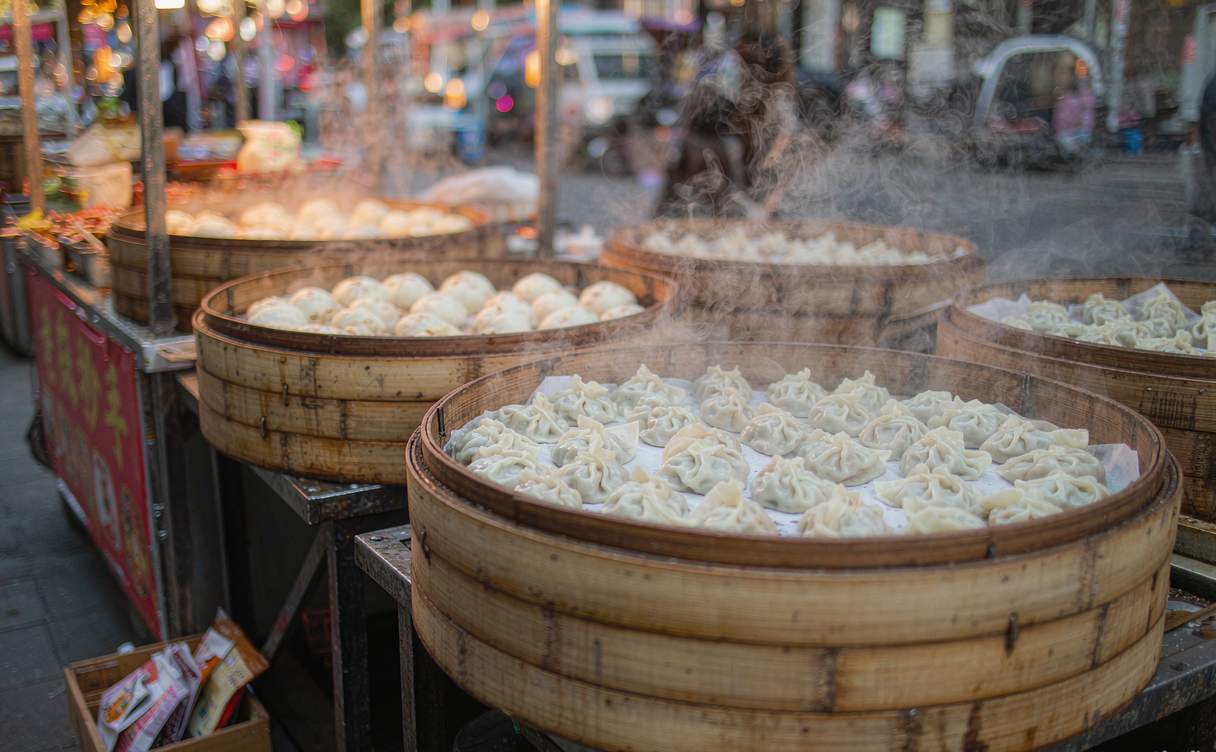
Don’t sleep on the metropolises. Shanghai’s 城隍庙 (Chenghuangmiao) and 吴江路 snack streets serve 生煎 (pan-fried buns, RMB 10–18) and 小笼 (soup dumplings). Beijing’s 簋街 (Gui Street) runs late with 麻辣小龙虾 (spicy crayfish, RMB 80–150 per person in summer) and 卤煮 (intestine stew for the brave, RMB 20–30). These cities are pricier than the regional ones — figure RMB 60–120 a person — but the variety is unmatched.
The night-market tradition itself has deep roots across Asia; the night market concept explains how these evening eating streets evolved, and China’s versions are among the largest and most diverse.
For vegetarians, street food gets trickier but isn’t impossible — the vegetarian and vegan guide flags which stalls and cities are safe, with Guangzhou and Kunming being the easiest for meat-free grazing.
Ordering when you don’t speak the language
The good news is that street food is visual. I point at what the person next to me is eating, hold up fingers for the number of portions, and use a translation app for anything tricky — Pleco for dishes, or Google Translate’s camera on a menu. Most stall owners appreciate the effort and will ladle you a taste before you commit. Carry RMB 20 and 50 notes plus some coins; while mobile pay (Alipay and WeChat) dominates in cities, smaller rural stalls and older vendors in places like Lanzhou or Wuhan still prefer cash. I keep a “translate this” photo album on my phone of the five dishes I most want, so ordering takes ten seconds even in a queue.
A sample 10-day crawl
If you want to string these into one trip, here’s the arc I’ve run with clients:
- Days 1–3: Xi’an (Muslim Quarter + side alleys)
- Days 4–6: Chengdu and Chongqing (Sichuan heat)
- Days 7–8: Guilin or Kunming (rice-noodle contrast)
- Days 9–10: Guangzhou (gentle Cantonese finish)
Transport is cheap and fast: high-speed trains link all of these, and a cooking class in Chengdu or Guangzhou — see the cooking class guide — lets you take the skills home. Total street-food spend for ten days runs about RMB 600–900 per person if you graze rather than feast.
Practical budgeting and timing
Street food is the cheapest eating in China, but costs climb in the big cities and tourist strips. Expect RMB 30–60 per person in regional cities (Xi’an, Lanzhou, Wuhan) and RMB 60–120 in Shanghai or Beijing’s named streets. Go at night — most great stalls open after 5 p.m. and peak at 8–10 p.m. Carry small bills and a mobile pay setup; the night markets guide has a payment section worth reading before you land.
My honest closing tip: build your crawl around three or four cities max, not all eight. Street food is about repetition and neighborhood rhythm, not checklist tourism. Pick Xi’an for history, Chengdu for heat, Guangzhou for comfort — and let the stalls surprise you.
Closing
China best street food cities aren’t a ranking so much as a regional map — each place teaches you a different corner of the country’s palate. From Xi’an’s charcoal sandwiches to Lanzhou’s ten-minute noodles, the food is cheap, honest, and unforgettable. Bring an empty stomach, a sense of adventure, and this guide, and you’ll eat better in a week of stalls than in a month of hotels.