

We first took a client to Cangyan Mountain on a whim between Beijing and Shijiazhuang, expecting a minor temple hill — and both of us fell silent when we stepped onto the bridge hall and looked straight down a 70-meter gorge. This Cangyan Mountain guide exists because almost no foreign itinerary mentions it, yet the place is one of the most vertiginous, beautiful temple complexes in northern China. If you want a hanging temple Hebei experience that’s far less crowded than Shanxi’s famous cliff monastery, Cangyan is the answer, and it makes a superb Hebei mountain day trip out of Shijiazhuang.
The Setting: A Gorge Wearing a Temple
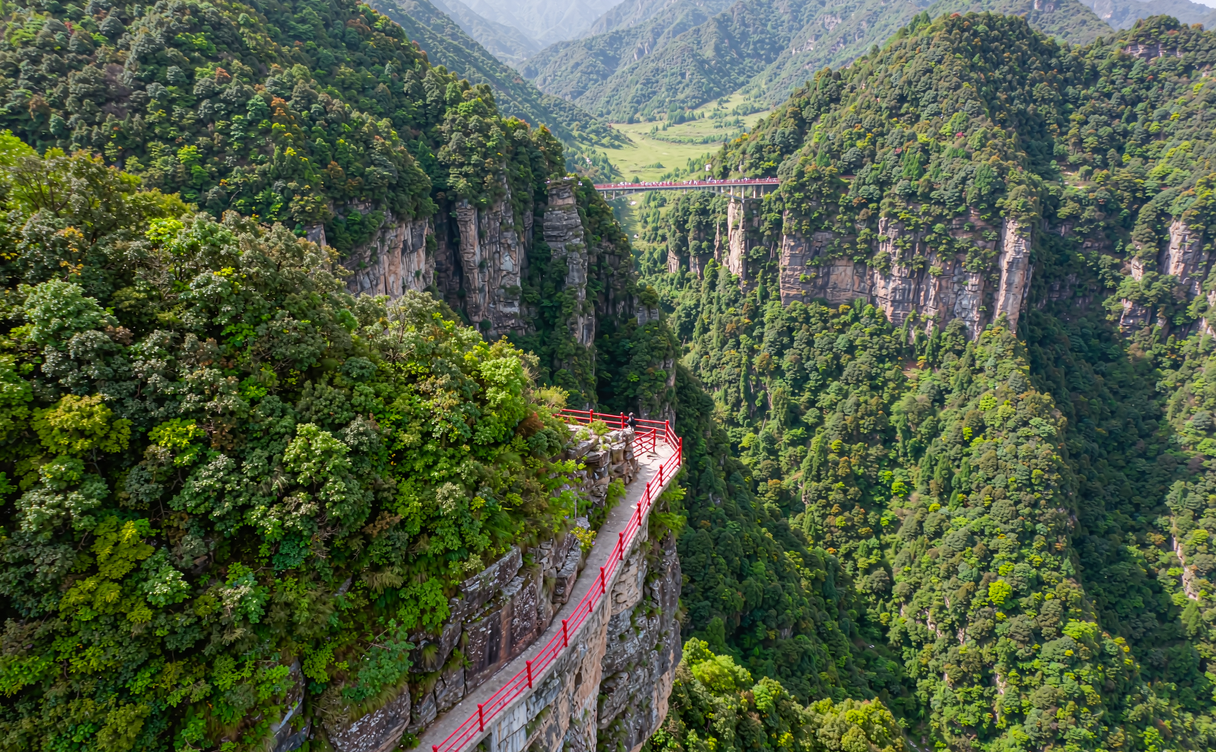
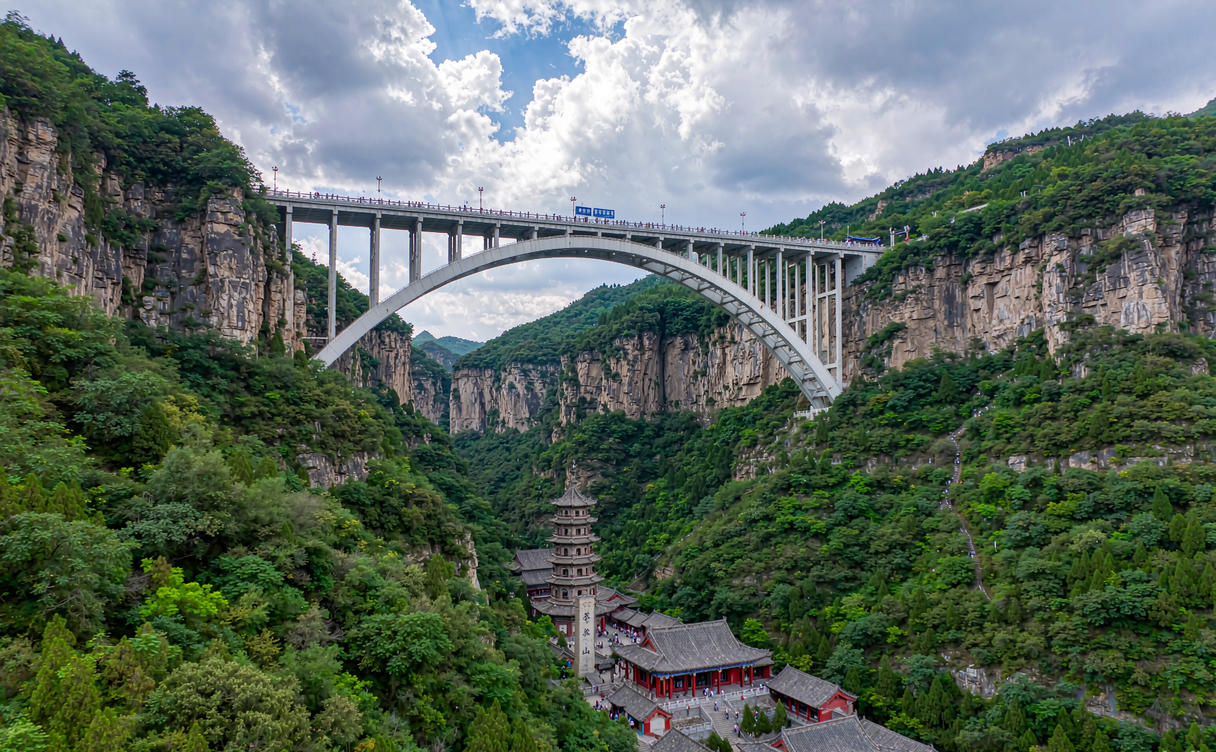
Cangyan Mountain (苍岩山) lies in Jingxing County (井陉县), about 70 km southwest of Shijiazhuang, the capital of Hebei province. The mountain isn’t especially tall — peaks around 1,000 m — but what makes it extraordinary is how the temples are built into a narrow quartzite ravine. Two cliffs face each other across a deep cleft, and the monasteries are slotted onto ledges, into caves, and, most spectacularly, on top of stone arch bridges thrown across the gap. The effect is a hanging temple Hebei style: architecture seemingly pinned to the rock by faith and good masonry.
The star is the Qiaolou Dian (桥楼殿), the “bridge hall.” A single stone arch, roughly 15 m across and spanning the gorge at about 70 m above the stream, carries a small temple pavilion on its back. You walk through the pavilion, glance over the red railings, and the floor drops away into trees. It’s the kind of image that ends up as someone’s phone wallpaper within minutes. Three such suspended structures once existed; the bridge hall is the survivor and the icon of the whole mountain.
Getting There
Shijiazhuang is your base. High-speed trains reach Shijiazhuang from Beijing West in about 1–1.5 hours (74–155 RMB / 10–22 USD) and from Taiyuan or Jinan in 2–3 hours. The city’s airport (SJW) has domestic links across China. From there, the cleanest route is a private car or taxi for the 70 km drive to Cangyan Mountain, about 1.5–2 hours via the Jingxing expressway; expect 300–500 RMB (42–70 USD) round trip with a driver who waits. Public buses run from Shijiazhuang’s West Bus Station to Jingxing and then a local connection up to the scenic gate, totaling around 30–45 RMB (4–6 USD) but taking 2.5–3 hours with transfers — fine if you’re on a budget and not pressed for time.
We usually recommend basing in the city and treating this as a Hebei mountain day trip: leave by 8:00, be on the bridge hall by 10:00, and be back in Shijiazhuang for dinner. Our Shijiazhuang travel guide has hotel and transport details for the city itself.
Tickets and Bookability
Entry to the Cangyan Mountain scenic area is about 65 RMB (9 USD) at the gate, with half-price for children and students on presentation of ID; children under 1.2 m enter free. There’s no separate charge for the bridge hall — it’s inside the loop. Tickets are sold on Ctrip/Trip.com and at the gate, and because crowds are modest you rarely need to pre-book except on the May and October national holidays, when the narrow cliff paths can bottleneck. The site opens around 8:00 and closes about 17:30, with last entry near 16:00. Note that the walk from the lower gate to the bridge hall is a steady uphill of 30–45 minutes on stone steps and shaded paths — not strenuous, but wear real shoes, not sandals.
The Walk: Bridges, Caves, and a Princess’s Vow
The route is a loop, and we suggest going up the western stair to reach the bridge hall first, while your legs are fresh. After the Qiaolou Dian, continue to the Fuhan Temple and the Cangyan cliff walk — a series of ledges and short tunnels cut into the rock, with red-painted railings and small shrines tucked into niches. The Cangyan bridge that carries the hall is the headline, but the quieter pleasure is the forest: old cypresses and pines lean out over the void, and in spring the cliffs blush with wild roses and peach blossom.
Legend gives the mountain its heart. The site is tied to Princess Nanyang of the Sui dynasty, who is said to have become a nun here after a broken royal marriage and founded the nunnery. Whether or not you buy the story, the presence of a still-active convent of nuns gives Cangyan a lived-in calm you don’t feel at more commercial peaks. Visitors often light incense at the hall and walk the cliff circuit in silence. For travelers who enjoy engineered landscapes as much as wild ones, our China classical gardens guide explains the design logic behind exactly this kind of human-shaped nature.
Best Seasons and Conditions
April to early June is the sweet spot: mild (15–25°C), flowers on the cliffs, and good light for the gorge. September–October is equally fine, with clear air and the first yellowing of the valley. Summer is green and a little humid but shaded by the canyon walls, so it stays comfortable; thunderstorms can make the stone slick, so avoid the cliff walk in heavy rain. Winter brings ice and occasional closures of the upper ledges — picturesque but risky, and we don’t send first-timers then. A Cangyan Mountain Hebei visit is best on a weekday; weekends see coach tours from Shijiazhuang, and the bridge hall gets a short queue.
Where to Eat and Stay
Food near the gate is simple northern Hebei fare. Look for Jingxing minxu noodles (抿须面), a hand-pressed noodle in a savory vegetable broth (15–25 RMB / 2–4 USD), and ganglu shaobing (缸炉烧饼), sesame flatbreads baked against a clay kiln wall, sold hot for 3–5 RMB each. Up the mountain, a few stalls sell corn, eggs, and tea. For a proper meal, return to Shijiazhuang, where local guides point to the city’s noodle and dumpling spots.
Lodging is easiest in Shijiazhuang: everything from 180 RMB (25 USD) budget hotels to 600–900 RMB (84–125 USD) international-chain properties. A handful of family guesthouses sit in Jingxing village below the mountain for 150–250 RMB (21–35 USD) if you want an early start, but book by phone since few list in English. If you’re building a broader Hebei circuit, our Chengde travel guide pairs well for the imperial summer-mountain angle.
Cangyan Mountain’s fame reached global screens through its appearance in period wuxia film locations, and its architecture is documented in the Wikipedia entry for Cangyan Mountain, which is a good primer on the bridge-hall structure before you go. Travelers collecting protected sites will also appreciate our China UNESCO World Heritage guide for context on how such sacred mountains are conserved.
Want Cangyan worked into a Beijing–Hebei loop? Our Beijing first-time travel guide plus a private Shijiazhuang driver makes an easy two-day plan.
Prefer to walk more than one cliff temple? Our China hiking treks guide lists other northern ridge and gorge routes graded by difficulty.
Need a driver from Shijiazhuang who waits at the gate? Send your travel date and we’ll confirm a round-trip car and the 65 RMB entry sorted in advance.
A Cangyan Mountain guide should end where the visit begins: on the bridge hall, hands on the red railings, gorge dropping away below. It’s a short, sharp, glorious reminder that China’s best mountain temples aren’t always the tallest — sometimes they’re the ones pinned impossibly across a cleft in Hebei.