

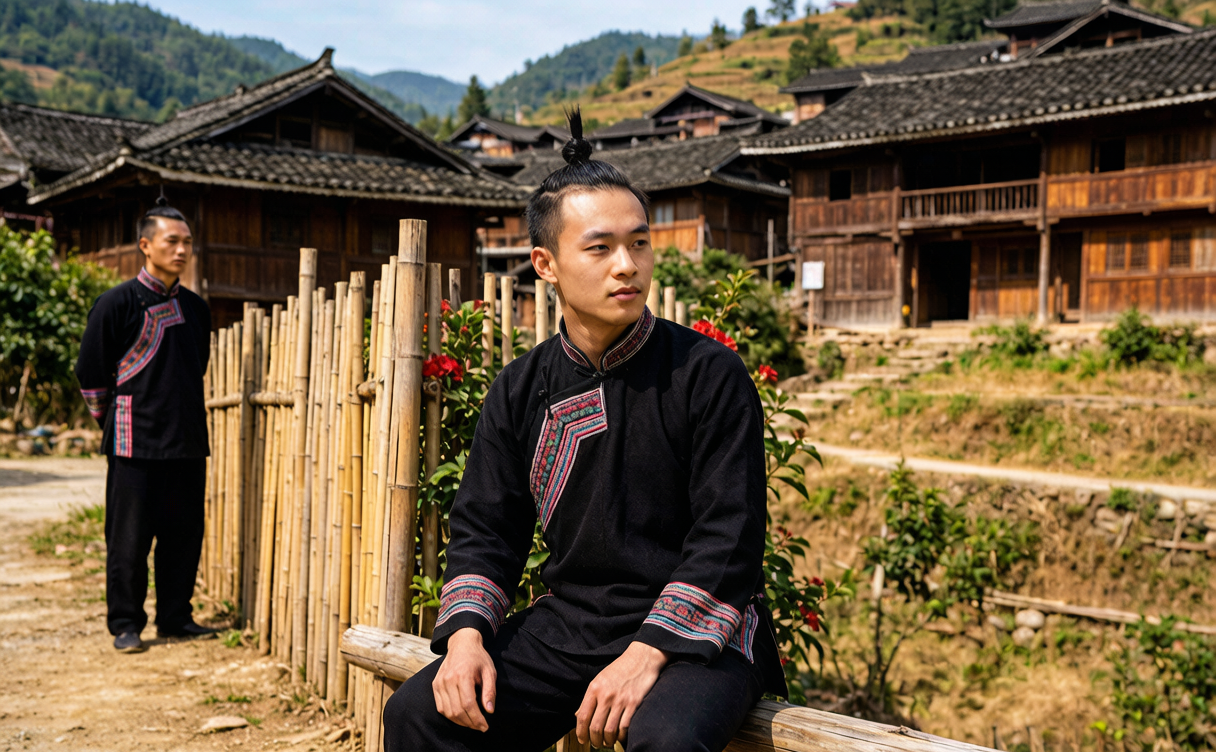
The last kilometre of road to Basha climbs out of the Duliu River valley through fir forest so dense the light turns green. Then the trees open and you are standing among black timber houses on stilts, watching a man walk past in an indigo tunic, his head shaved except for a single topknot, a long-barrelled hunting gun over one shoulder as casually as a hoe. This Basha Miao Village guide covers what that scene actually is, how to reach a village that sits an awkward distance from its own high-speed rail station, what the entrance ticket buys, and how to behave so that you leave as a guest rather than a spectator.
Why Basha Is Worth the Detour
Basha (岜沙) is a cluster of five small hamlets on a ridge above Congjiang county in southeastern Guizhou, home to roughly 2,000 Miao people at about 550 metres of elevation. Its fame rests on two things. The men here are permitted to keep muzzle-loading fowling pieces, which is why Chinese travel writing calls Basha “the last gunslinger village” — the guns are hunting and ceremonial tools, fired in salute, not props for tourists. And the village keeps an unusual relationship with its forest: a tree is planted when a child is born, and when a person dies, a tree is planted over the grave instead of a headstone. Walk the ridge and you are walking through a cemetery that looks like a wood.
I would not call Basha undiscovered — Chinese tour buses arrive daily — but foreign visitors are still rare, and it pairs beautifully with the wider off-the-beaten-path China itinerary ideas that take you into Guizhou’s back roads. Guizhou remains one of the least-visited provinces by international travellers, as this overview of the province’s geography and ethnic makeup on Britannica makes clear.
Best Time to Visit
Congjiang sits low and warm compared with the rest of Guizhou, so the seasons behave differently here than in Guiyang.
April to early June is my pick. Daytime temperatures run 20–28°C, the terraced fields below the village are flooded and mirror-bright, and the fir forest smells like resin after rain. Bring a shell — this is also the start of the wet season, and afternoon downpours are frequent.
Late June to August turns humid and hot, 28–35°C, with the heaviest rain of the year in late June. Landslides occasionally close the mountain roads. Go only if you must.
Late September to November is the other strong window: 15–25°C, dry, clear light, golden rice terraces in early October, and Miao New Year celebrations in the surrounding villages in late November. Skip the 1–7 October national holiday, when domestic crowds triple and Congjiang’s hotel prices double.
December to February drops to 5–12°C with damp fog. The village is quiet and photogenic, but the performances are shorter and some guesthouses close. For how this fits into a wider trip, see our best time to visit China breakdown.
How to Get There
The single most important thing in this guide: Congjiang high-speed railway station is not in Congjiang town. It sits about 60 km away near Luoxiang, close to Zhaoxing Dong Village. Plenty of visitors book a taxi assuming a ten-minute ride and get a shock.
| From | Mode | Duration | Approx. fare |
|—|—|—|—|
| Guiyang East | High-speed rail to Congjiang | 1 hr 30 min – 2 hr | ¥138 (US$19) second class |
| Kaili South | High-speed rail to Congjiang | 55 min | ¥73 (US$10) |
| Guilin West | High-speed rail to Congjiang | 1 hr 20 min | ¥95 (US$13) |
| Guangzhou South | High-speed rail to Congjiang | 3 hr 30 min – 4 hr | ¥285 (US$40) |
| Congjiang station | Shuttle bus to Congjiang town | 60–70 min | ¥25 (US$3.50) |
| Congjiang station | Taxi / ride-hail to Congjiang town | 50 min | ¥150 (US$21) |
| Congjiang town | Taxi up to Basha (7.5 km) | 15–20 min | ¥30–40 (US$4–6) |
Shuttle buses meet most arriving trains outside the station forecourt; the last one usually leaves in the early evening, so aim to arrive before 18:00. From Congjiang town, taxis wait near the bus station and drivers will happily hold for two hours while you visit. Agree a round-trip price of ¥80–100 (US$11–14) before setting off.
What to See and Do
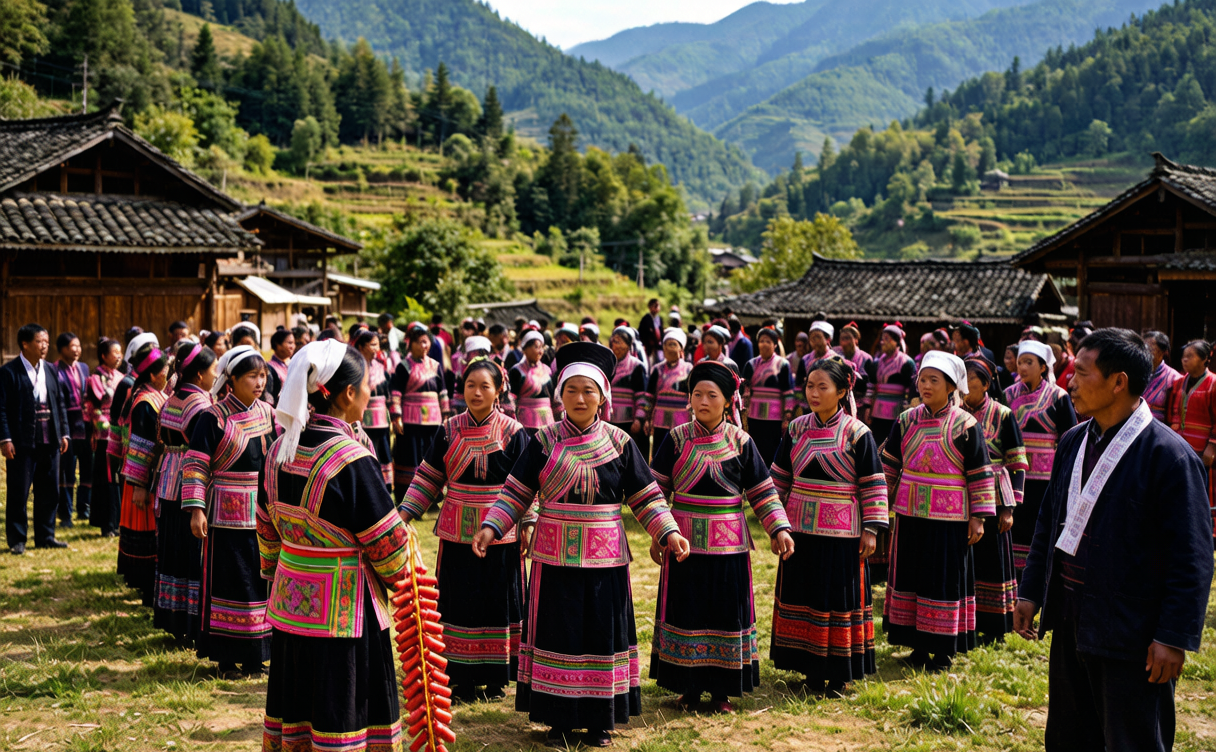
The performance ground. Twice a day, usually around 10:30 and 15:30, the village stages a 40-minute show on the packed-earth clearing: lusheng reed-pipe music, a courtship dance, a demonstration of the sickle haircut, and a volley of gunfire that will make you jump. Confirm the times when you buy your ticket, as they shift with the seasons. It is unashamedly a performance, but it is performed by villagers rather than an outside troupe, and the musicianship is real.
The sickle haircut. Boys receive their first ritual haircut at around fifteen, with a farming sickle rather than scissors, leaving the topknot known as hugun (户棍). You will see it done on stage. Do not ask to touch anyone’s topknot — it is considered deeply personal.
Walking the hamlets. The ticket area covers the main hamlet, but the paths continue past granaries raised on stone mushrooms, drying racks hung with indigo cloth, and terraces dropping away to the river. Give yourself ninety minutes to wander beyond the performance ground; that is where the village stops being a stage.
The forest trail. A gentle 40-minute loop leads up through the fir wood behind the houses. Signs ask you to stay on the path, and you should — many of those trees mark graves.
Where to Stay
Budget — inside Basha. A handful of family guesthouses rent plain rooms with a hard bed, a shared or basic private bathroom and inconsistent hot water for ¥100–180 (US$14–25). Almost nobody speaks English, but staying overnight means seeing the village empty out after the last bus. This is the memorable option.
Mid-range — Congjiang town. Chain and independent hotels along the river run ¥180–350 (US$25–49) for a clean modern double with reliable Wi-Fi and air conditioning. Practical, dull, and the right base if you are also visiting Jiabang rice terraces or Xiaohuang.
Splurge — Zhaoxing. The Dong village of Zhaoxing, beside the high-speed station, has genuinely good boutique guesthouses in restored timber buildings at ¥600–1,200 (US$85–169) a night, several with drum-tower views.
What to Eat
Congjiang’s kitchen is sour, smoky and pork-forward.
- Congjiang fragrant pig (从江香猪, Cóngjiāng xiāngzhū) — a small local breed, usually roasted whole or braised. The regional specialty, about ¥60–90 (US$8–13) a portion.
- Sour soup fish (酸汤鱼, suāntāng yú) — river fish in a fermented tomato-and-rice broth, the defining dish of southeastern Guizhou. ¥80–120 (US$11–17) for a shared pot.
- Grilled sticky rice (糯米饭, nuòmǐfàn) — sold in banana-leaf parcels at the village gate for ¥5 (US$0.70).
- Niubie (牛瘪) — a bitter beef offal soup made with partially digested grass. Locals adore it. I found once was enough, and I say that with respect.
Sample Itinerary
Half day from Congjiang town
- 09:00 — Taxi up to Basha, buy your ticket at the gate.
- 09:20 — Walk the upper hamlet before the tour buses arrive; the light on the stilt houses is best now.
- 10:30 — Performance on the earth clearing.
- 11:15 — Forest loop behind the village, then the terraces on the west side.
- 12:30 — Sticky rice and grilled river fish at a village stall.
- 13:30 — Taxi back down; afternoon train onward from Congjiang station.
Full day, staying overnight
Add the Jiabang rice terraces (加榜梯田), two hours north by car, for sunrise on day two, then return via Basha for the afternoon performance. A driver costs ¥400–600 (US$56–85) a day.
Tickets, Etiquette and Practical Basha Miao Village Guide Tips
- Admission is around ¥80 (US$11), including the daily performances; gates open roughly 08:00–18:00. Prices change, so check at the ticket window rather than trusting old blog posts.
- Ask before photographing people. A gesture towards your camera and a smile is enough. Some residents will decline; a few expect a small tip of ¥5–10. Accept both answers gracefully.
- Never handle the guns, and do not pose with one for a photograph unless you are invited to.
- Stay on marked paths in the forest for the reason described above.
- Bring cash. Mobile payment works at the ticket office, but signal on the ridge is patchy.
- Language. Expect no English at all. Download offline translation and have your hotel write your destination in Chinese characters.
FAQ
How long do I need at Basha Miao Village?
Three to four hours covers the performance, the hamlets and the forest loop. Stay overnight only if you want the village without day-trippers, which is a genuinely different experience.
Is it ethical to visit?
Basha charges admission and stages performances, so your money goes into the community rather than around it. Behave as you would in any small village: ask before photographing, buy something local, keep your voice down, and do not wander into private courtyards.
Do I need a guide?
Not to visit, but a Chinese-speaking driver-guide from Congjiang (¥400–600 per day) makes the logistics painless and can explain the performance, which has no English commentary.
Can I combine Basha with Xijiang Qianhu Miao Village?
Yes. Xijiang is about two and a half hours away via Kaili. Do Xijiang first for the scale and the night views, then Basha for the atmosphere — the reverse order makes Xijiang feel like a shopping street.
What should I wear?
Modest, practical clothing and grippy shoes — the stone paths are steep and slick after rain. Nobody expects local dress, and I would avoid renting a Miao costume for photos unless it is offered by the village itself.