

Guilin sells Guangxi to the world: polished limestone peaks, bamboo rafts, postcard mist. Bamei is what happens a whole province southwest of that postcard. Bamei village sits deep in the far corner of Guangxi, a spread of working farming hamlets in Napo County under Baise’s administration, close to the border country of the southwest and very far from any coach car park. Villagers tend terraced paddies that hold spring water like mirrors and flatten into gold in autumn, and the hills behind the fields open into caves with streams running straight through the rock. Travelers who make the trip often call it the most complete Shangri-La they have found in China: not a theme park, not a restored old town, but a living valley that happens to be extraordinarily beautiful.
This Bamei village guide is the practical version rather than the poetic one. It covers how to get to Bamei village Guangxi from Nanning, Baise and Guilin by rail, bus and hired car; what the Bamei stone cave tunnel entrance involves once you are standing in front of it; whether a Bamei village homestay stay is the right call; what the Bamei farming shows and ferries are like when the village is not performing; and, most usefully, the best time to visit Bamei, when the terraces photograph well and the cave floors are not ankle-deep mud.
Where Bamei Sits, and Why No Gift Shop Got Built
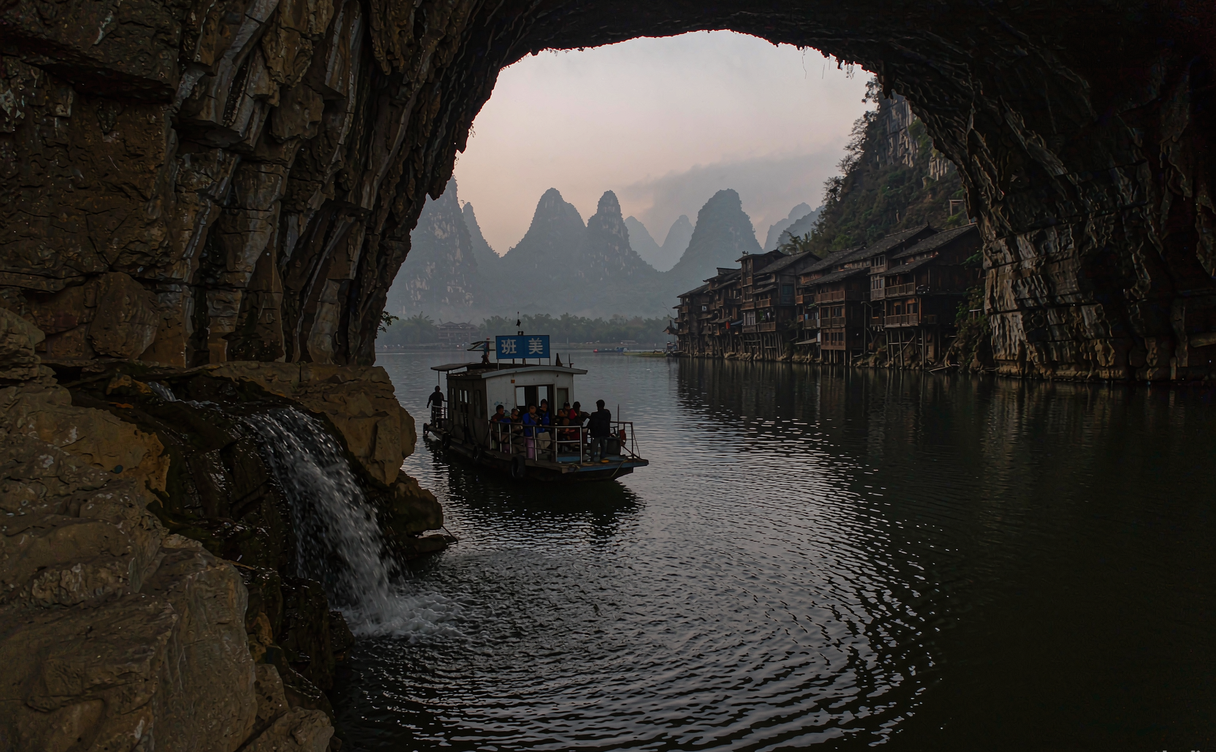
Bamei belongs to the southwestern rim of Guangxi, in the hills of Napo County, which Baise administers. It is the kind of place that took its Shangri-La nickname from travel writers rather than a hotel brochure, because the geometry is so simple: a river enters the valley on one side, terraced paddies climb the gentler slopes in stair steps, and a solid wall of karst limestone shuts out the road behind. Houses cluster along the water, some on low stone bases, with drying racks and rice in raised wooden lofts.
What separates it from the better-known karst villages of the north is simply distance. Nothing here has been rebuilt for visitors and paddy work still arranges the year. Even on a day when the village is staging something, the fields keep being worked and the cows keep walking the lane ahead of you.
How to Get to Bamei village Guangxi
There is no airport near Bamei, so every route funnels through Nanning, Baise or Napo county town. Fly into Nanning Wusu and take the high-speed train west to Baise; that leg runs on the Nanning-to-Kunming line and takes roughly an hour to an hour and twenty minutes. From Baise, long-distance buses depart for Napo county town regularly through the day, about two hours over rolling mountain road, and Napo is where the limestone country really starts to stack up.
Two options remain from Napo. The first is a rural bus or shared van heading the last thirty-odd kilometres into the hills; the road is two-lane and winding, the ride takes close to an hour, and departures thin out after mid-afternoon. The second, our recommendation for anyone on a fixed number of days, is a hired car with a local driver for the day. A driver who knows Bamei also knows which rural road was washed out after the last storm.
If you are starting from the classic karst north, get to Baise first. Our Baise travel guide covers the city as a base, including the canyon and waterfall days that pair naturally with a village night.
Building a western Guangxi loop? Our seven-day plan stitches Baise, Bamei and the terraced south into a route that does not waste a day on transfers.
Opening Hours, Entrance Fees and What They Charge For
Bamei is a village, not a fenced scenic area, so there is no closing time and no gate. What does exist is a small village entrance fee, commonly quoted in the region of thirty to fifty yuan as of 2026, and the cave and ferry are often charged separately or sold together. Because prices at rural sites move and local notices change the arrangement, treat those numbers as a guide, not a promise, and check at the kiosk on arrival.
The Bamei Stone Cave Tunnel Entrance
The sight most visitors come for is the stone cave tunnel entrance: a limestone passage through the hill behind the village, big enough that a person can walk a stream straight through it, dark at the mouth and cool ten paces in. Locals once used it as a passage between valleys and as shelter, which is why the path is worn smooth rather than built.
Going in is a walk, not a scramble, but it is genuinely rough in parts. Expect a wet stone floor, shallow water in the deeper runs, low ceilings that force you stooping in two or three places, and a headlamp or a bright phone torch if you want the interior to look like anything. Budget anywhere from ninety minutes to two and a half hours for the out-and-back traverse depending on how far you push. Shoes with real grip matter more than anything else in your packing list. In heavy rain, skip it: locals will tell you the stream rises fast and the limestone gets like soap.
For a clear explanation of how these Guangxi caves formed and why they look the way they do, see the reference work on karst landscapes published at Lonely Planet’s Guangxi destination pages.
Rice, Ferries and the Farming Shows
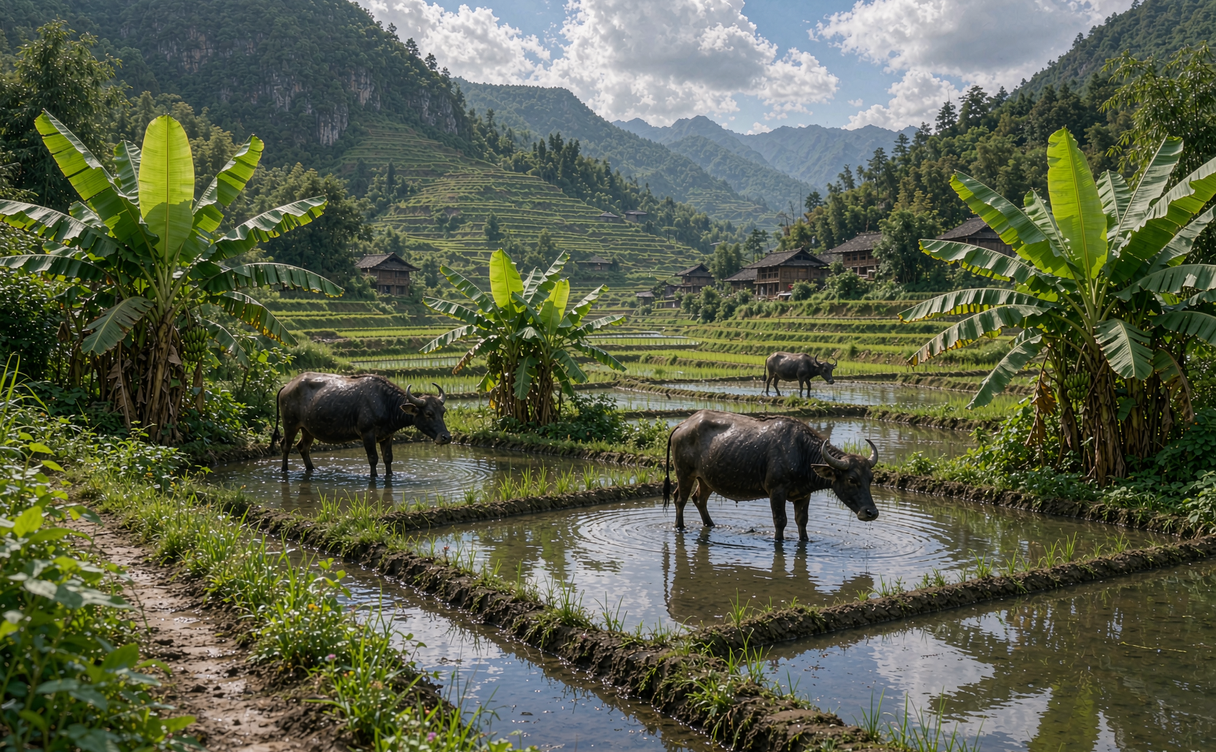
The valley floor is the reason to linger. Terraced paddies step up the slope in fan shapes, planted with rice in late spring and cut through September. In May and June, when the water is right, the fields behave like mirrors and the whole valley becomes the picture people mean by a Shangri-La.
The Bamei farming shows are seasonal rather than daily. Villagers stage transplanting rice, hand-threshing, winnowing in bamboo baskets and spreading the harvest on the village square, then sing and drum in the lanes in Zhuang festival colours. Treat it as a village doing its own work with visitors watching, which is what it is: unhurried, slightly formal, and warmly uninterested in performing for you.
The ferry is smaller business. A shallow-draught wooden boat shuttles across the river linking Bamei to the lower hamlets, a crossing of only five or ten minutes, but it follows daylight hours rather than a timetable. If you want the far side of the valley, be on the landing by late afternoon; the last boat back is the one that decides your evening.
Hiking Around Bamei: Honest Difficulty
Three routes cover most visits. The village lane loop is flat, paved in part and takes about forty minutes; it is fine for any fitness level and gives you the houses, the drying racks and the smell of steamed sticky rice. The terraced ridge climb is the middle option: roughly a hundred and fifty to two hundred and fifty metres of gain on stone steps and farm tracks, about an hour and a half up, and loose underfoot when wet. The cave traverse above is the hard one. Longer valley-to-valley walks of four or five hours exist with a village guide, but only after a villager has shown you the line.
Where a Bamei village Homestay Stay Puts You
A Bamei village homestay stay means a family guesthouse rather than a hotel: rooms above a courtyard or beside the kitchen, thin walls, a shared bathroom block in most cases, and a host who will likely cook dinner for you if you ask a day ahead. Rooms typically run from about a hundred and twenty to two hundred and sixty yuan a night, and the better ones are run by villagers who came back from city work and rebuilt the house with a little more glass and a lot more patience for foreigners. Some hosts speak enough English to plan your day; most do not, so bring a translation app and a printed address for the driver.
Take a Bamei village homestay stay if you want the valley to keep existing while you sleep in it. If you need a lift, an English menu and a quiet night, Napo county town suits you better. Our overview of rural China village travel explains how these family guesthouses work if it is your first night in one.
Want the cave, the terraces and the ferry without guessing at bus timetables? Start from our shortlist of the places most worth your days in China.
Best Time to Visit Bamei
The best time to visit Bamei is late spring and early to mid autumn. May and June give you flooded terraces, green hills and cave water at a manageable depth; September through November gives you the gold terraces, cleared skies and the harvest shows in full swing. Each window has one flaw: May and June are the wettest stretch, and after a big storm the cave floor and the ridge tracks turn dangerous, so keep two dry days in hand.
Winter in the valley is dry, clear and bright, with cold mornings and warm afternoons, and almost nobody around. July and August are hot, humid and the slipperiest of the year for the karst paths. Whatever month you pick, check the forecast in Napo county town the morning you drive, not the night before, because mountain weather here changes on its own schedule.
Practical Tips for Foreign Visitors
Carry cash. Alipay and WeChat Pay dominate even the rural guesthouses, but a ferry keeper and a family cook are likelier to take yuan notes than your phone. Withdraw in Napo, because there is no reliable bank in the village. Carry your passport: this is border country and you may be asked for it on the mountain road.
Download offline maps before you leave the county town, since signal dips in the valley and dies behind the ridge. Photograph people only after asking, and expect a laugh rather than refusal. Pack a headlamp, a rain layer, grippy shoes and cash for a second night if the road washes out. Two nights is the sensible minimum, three if you want the cave dry plus a farming day and a dawn on the terraces.
Fitting Bamei Into a Guangxi Trip
Do not try to squeeze Bamei into a day trip from Guilin. The honest shape is Nanning or Baise as your rail hub, a night in Napo county town and two nights in the village. From there the classic karst north reads as our Guilin travel guide and the river itself in our Li River guide; both are reachable by rail and make a satisfying contrast, because Bamei is what the Li River valley looked like before anyone sold tickets to it. Build the whole shape in our seven-day Guangxi itinerary, and if you are still deciding whether rural nights are your thing, our longer village guide makes the case better than we can manage in one paragraph.
Tell us how many days you have and where you land in Guangxi, and we will sketch a Bamei day that fits the rest of your route.