

When people say “Chongqing,” they usually mean the fog-wrapped megacity of bridges and hotpot. But Chongqing is a municipality the size of a small province, and its southeastern corner — the Youyang Tujia and Miao Autonomous County (酉阳) — is a different country entirely: river gorges, terraced hills, and one of the most dramatically sited ancient towns in the region. This Youyang travel guide focuses on the star, Gongtan, and shows how to build a real visit around it.
Gongtan: the town that moved uphill
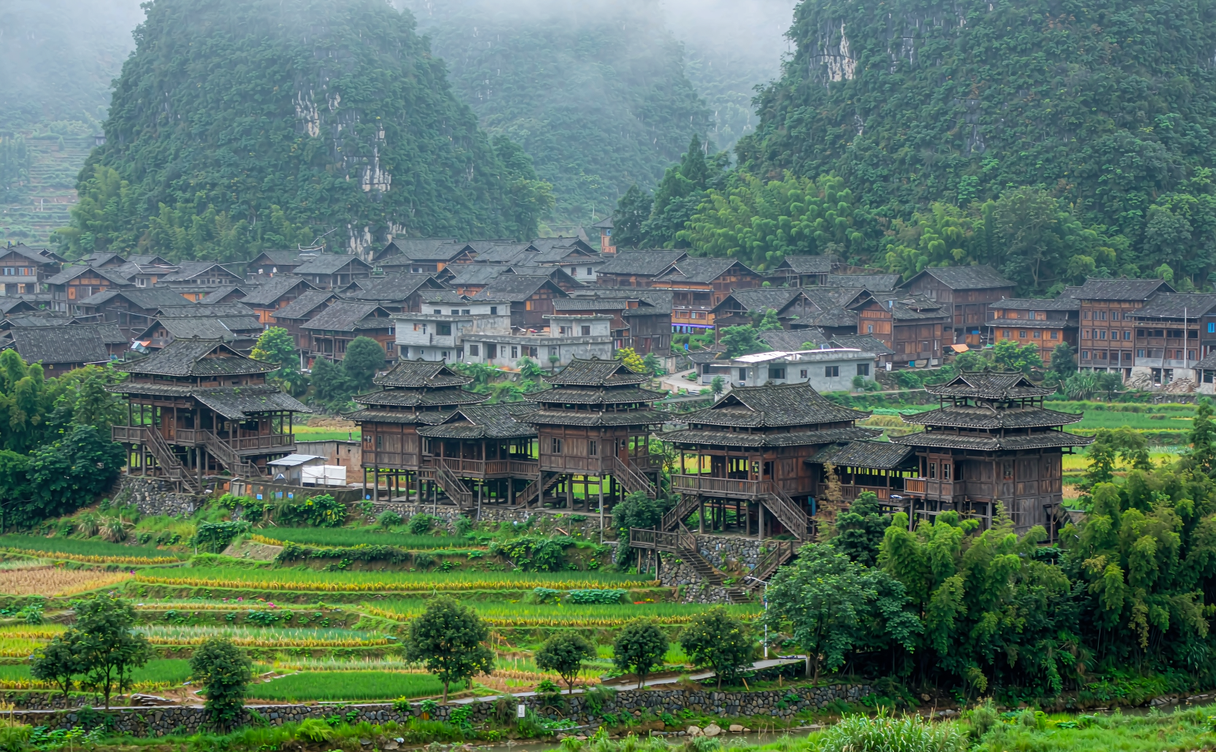
The reason Gongtan ancient town (龚滩古镇) is worth the long haul is its setting. It clings to a cliff above the confluence of the Wu River (乌江) and the Apeng River (阿蓬江), a cascade of grey-stone lanes and Tujia stilt houses (吊脚楼) stacked down to the water. What’s remarkable is that this is a faithful relocation: between 2005 and 2006, as the Pengshui hydroelectric reservoir rose and would have drowned the original site, the town was taken apart beam by beam and rebuilt stone-for-stone on higher ground, preserving the layout, the carvings, and the feel. In our experience, you don’t notice the move at all — it reads as ancient because, in the parts that matter, it is.
Gongtan ancient town Youyang rewards slow wandering. The main flagstone street runs parallel to the river; off it, alleys drop through arched gateways to the water’s edge. The Xiqin Guild Hall (西秦会馆), with its carved opera stage, and the riverside teahouses where old men play cards are the anchors. Come for the late-afternoon light on the stone and stay for the lanterns.
Things to do in Youyang
Things to do in Youyang center on Gongtan but reach further:
- Walk Gongtan at dawn and dusk. The tour groups arrive mid-morning and leave by mid-afternoon; the edges of the day are when the town is yours. A riverside room lets you step out at 6 a.m. onto an empty flagstone street.
- Take a Wu River boat. Short cruises from below the town show the gorges from the water — the cliffs fold in, and you understand why this was a ferry crossroads for centuries. Expect ¥60–120 depending on the route.
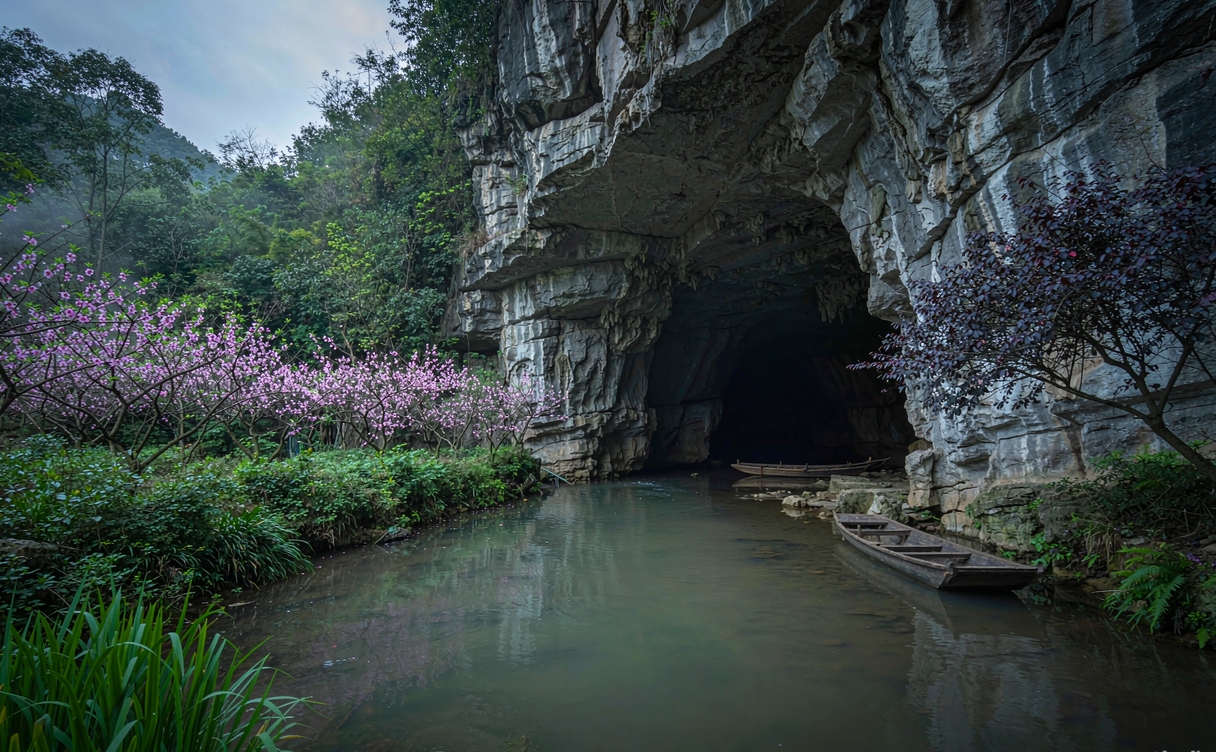
- Youyang Peach Blossom Spring (酉阳桃花源). Just outside the county seat, this karst ravine and cave system is locally claimed as the inspiration for Tao Yuanming’s famous essay “The Peach Blossom Spring.” Whether or not the claim holds, the walk through the cave to a hidden green valley is genuinely lovely. Allow 2–3 hours; entry around ¥100–120.
- Apeng River drifting. In warmer months, gentle raft or boat sections on the Apeng give you the quiet Tujia countryside without a guide’s megaphone.
Best time to visit Youyang
The best time to visit Youyang is March to May and September to November. Spring fills the terraces with water and green, and the Peach Blossom Spring lives up to its name; autumn is dry, clear, and the most comfortable for the cliff walks. Summer (June–August) is hot and humid, 30–34°C, with sudden storms, but it’s the season for river activities and for escaping Chongqing’s worst heat in the higher hills. Winter is cold and damp, occasionally near freezing, and some riverside rooms go unheated — pack layers. Avoid the October holiday if you can; Gongtan’s lanes are narrow and a crowd turns them into a queue.
How to get to Youyang
How to get to Youyang is the one real planning task. There is no high-speed station at Youyang; the standard approach is the Chongqing–Huaihua railway (渝怀铁路), with Youyang Station (酉阳站) about 30–40 km from both the county seat and Gongtan. Trains from Chongqing North take roughly 2.5–3.5 hours (¥40–70 second class). From the station, a bus or taxi covers the last leg to Gongtan in about 1 to 1.5 hours (taxi ¥100–160, bus ¥20–30). Coming from the east (Hunan/Zhangjiajie side), the same railway works in reverse.
If you’re building a Chongqing trip, our Chongqing travel guide explains the city hub, and our China high-speed train guide for foreigners covers ticketing for the legs that do have fast rail. For first-timers, our China travel guide for first-timers handles the ground-level logistics.
Where to eat and stay
Youyang eats are Tujia and Miao mountain food. Youcha (油茶, savory oil-tea), larou (腊肉, smoked cured pork), sour fish from the Wu River, and sticky rice cakes dominate. A bowl of cured-pork noodles is ¥12–20; a shared riverside dinner runs ¥40–70 per person. Gongtan’s riverside guesthouses (¥200–450 a night) are the move — you pay for the view and the silence, and the thin walls are the trade-off. Chain hotels in the county seat are cheaper (¥160–300) but mean a daily commute to the town.
Youyang Chongqing attractions pair well with other riverside settlements; our Furong ancient town guide covers another dramatic Wu-river cliff town you can chain into the same loop, and Gongtan sits naturally on any list of best ancient towns in China.
A half-day and a full-day plan
With half a day, arrive by lunch, walk the main street and the guild hall, take a short Wu River boat, and leave by evening. With a full day (what we recommend), do Gongtan at dawn, the boat mid-morning, a long lunch, then the Peach Blossom Spring the next morning before heading out — or flip it if you’re basing in the county seat.
For a wider sweep of the region’s highlights, our best things to do in China roundup places Gongtan in context with the country’s other riverside and minority-region sights.
Getting between the sights
Gongtan and the Peach Blossom Spring are about an hour apart by road, so stringing them into one day means a private car (¥200–300 for a half-day) rather than wrestling the sparse public buses. In our experience, the smoother plan is to sleep in Gongtan, do the town and river boat, then have your guesthouse arrange a car to the Peach Blossom Spring the next morning before the coaches arrive, dropping you at Youyang Station afterward. Shared minivans link the county seat, Gongtan, and the station throughout the day for ¥15–25 a seat, but they wait to fill — budget slack time.
Practical notes before you go
English is minimal; a translation app is essential for menus and the occasional sign. Carry cash for the smaller stalls and guesthouses. The lanes are uneven stone — closed shoes, not sandals. Riverside rooms can be damp in summer; ask for a higher-floor room. The town is safe and calm after dark, and the only hazard is a slippery step after rain.
For neutral background on the area’s ethnic makeup, the Youyang County page on Wikipedia is a useful primer before you go.