

Tucked into the web of waterways in central Jiangsu, Xinghua is the kind of place most foreign travelers have never heard of, and that is exactly why we keep sending clients there. On our first scouting trip in early April, we watched the sunrise turn thousands of small earthen mounds covered in yellow rapeseed flowers into a floating golden sea, with narrow wooden boardwalks threading between the water channels. Locals in straw hats were already poling flat-bottomed boats through the canals to tend the fields. That single morning sold us on Xinghua as one of the most photogenic, least crowded spring destinations in the entire Yangtze River Delta.
This guide pulls together what we have learned from repeated visits, long conversations with local farmers, and the practical logistics our readers actually ask about: when the flowers peak, how to arrive without a private car, what it costs in 2026, and how to build a relaxed two-day plan that does not feel rushed.
When is the best time to visit Xinghua
If you take only one thing from this article, let it be this: the best time to visit Xinghua is the last three weeks of March through mid-April. That is when the rapeseed comes into full bloom and the raised-bed “Qianduo” terraces become the famous golden sea. In a normal year the flowers open around March 25 and hold for two to three weeks before the petals begin to fall. We tell clients to book the final week of March or the first two weeks of April and to build in a buffer, because a late cold snap or an early warm spell can shift the peak by as much as a week.
Spring is not the only season worth considering. Late September to early October brings the rice harvest, softer light, far fewer crowds, and cheaper hotels. Summer is hot and humid, with frequent afternoon thunderstorms, and we generally advise against July and August unless you are already combining Xinghua with a longer Jiangsu trip. Winter is quiet and misty, pleasant for photographs of empty channels but with little color in the fields. Whatever month you choose, check the local bloom forecast a week before you travel, since the county tourism board posts updates on social media during the flowering season.
How to get to Xinghua
Figuring out how to get to Xinghua is the part that trips up first-time visitors, because the city has no airport of its own. The nearest airports are Yangzhou Taizhou International Airport, about 1.5 hours by car, and Nanjing Lukou International Airport, about 2.5 to 3 hours away. Most of our readers fly into Shanghai or Nanjing and then take high-speed rail, which is by far the most comfortable option.
Xinghua has its own high-speed railway station on the Nanjing-Yancheng line, and direct trains from Nanjing take roughly 1.5 to 2 hours. From Yangzhou the ride is about 40 minutes to an hour, which makes Yangzhou the most convenient base if you want a city stay before heading into the countryside. We have also routed clients from Suzhou and Shanghai by taking a fast train to Taizhou or Yangzhou and then a short connection onward. Direct long-distance buses run from Yangzhou bus station to Xinghua several times a day, costing around 30 to 40 yuan and taking about 1.5 hours.
Once you arrive at Xinghua station, the Qianduo scenic area is roughly 40 minutes away by car or shuttle. Ride-hailing apps work in the county town, but out at the flower fields the signal can be spotty, so we recommend arranging a driver for the day or joining a local transfer. On our last visit, a private car for a half-day loop of the fields and the water forest cost about 200 to 300 yuan.
Things to do in Xinghua
The core list of things to do in Xinghua is built around water and farmland, and that simplicity is the appeal. Beyond the headline flower fields, the Li Zhong Water Forest is a surprising gem: a planted forest of dawn redwood standing in shallow flooded channels, with elevated boardwalks and a slow boat ride that glides between the trunks. On a calm morning the reflection is mirror-still, and the birdsong is loud enough to make you forget your phone. Entry is usually 80 yuan, and the boat is an extra 50 to 80 yuan depending on the route.
Back in the county town, the Zheng Banqiao Memorial Hall honors the Qing-dynasty painter and magistrate who was born here, and the old canal streets near the eastern gate are pleasant for an evening stroll. We also like taking clients to a local morning market to try Xinghua’s river fish and the chewy “longsi” noodles. None of this requires a guide, but a local driver who knows the side roads will save you hours of wrong turns, and he will usually stop at a roadside stall selling freshly pressed rapeseed oil that makes a great souvenir.
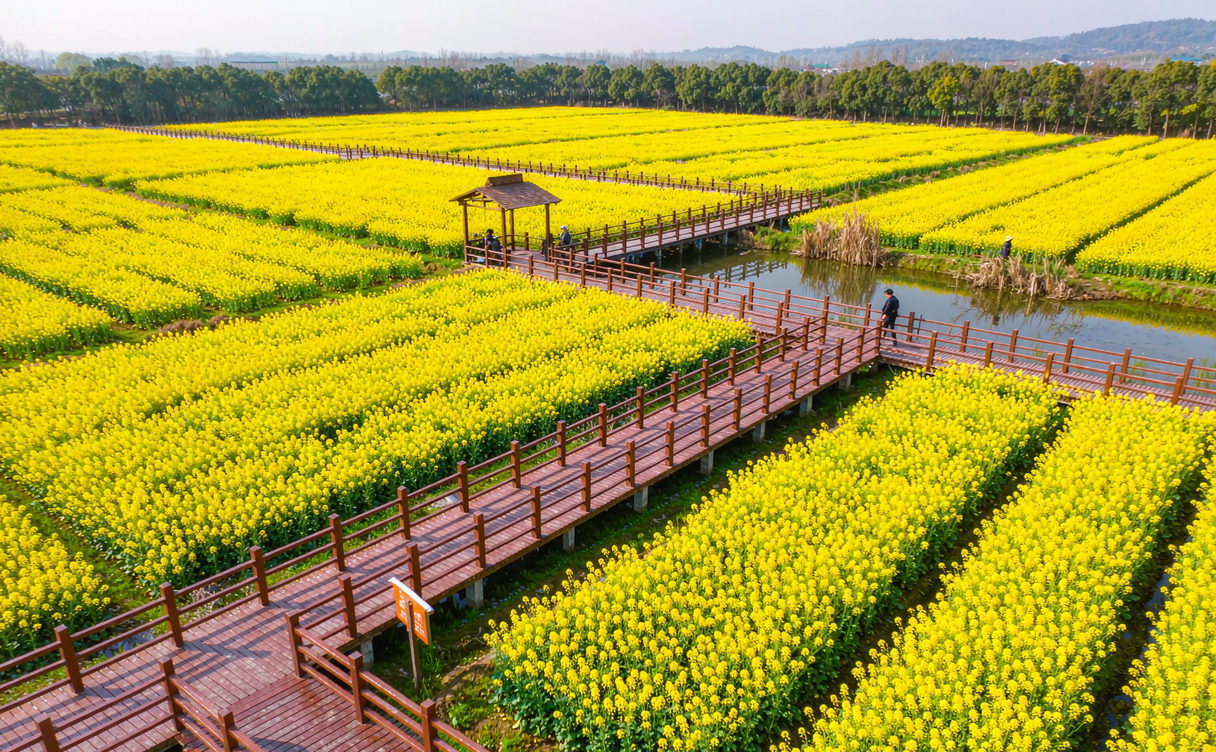
The Xinghua Qianduo scenic area
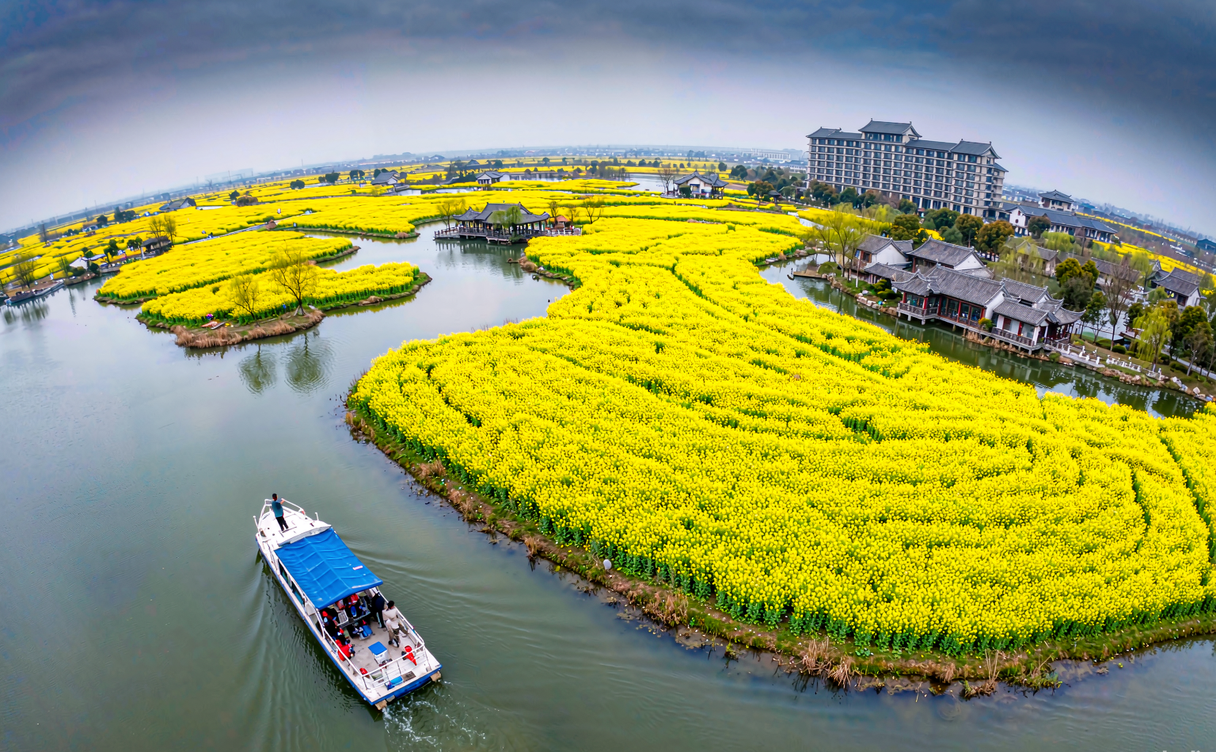
The heart of any visit is the Xinghua Qianduo scenic area, sometimes written as “Qiandao” or “thousand mounds.” The name describes the farming method: generations of locals dug canals to drain the low wetlands, piling the soil into narrow raised beds where rapeseed is planted. Viewed from the observation towers, the pattern looks like a patchwork quilt of gold floating on water. You can walk the wooden paths at ground level or take a small boat through the channels for the classic postcard angle.
Tickets to Qianduo run about 80 to 100 yuan in peak bloom, from late March to mid-April, and drop to roughly 60 yuan in the off-season. The site is busiest between 9:30 a.m. and 3 p.m., so we usually arrive right at the 7:30 a.m. opening for soft light and empty paths. A full loop on foot plus a boat ride takes about three hours. Locals told us the best light is the first hour after sunrise and the last hour before sunset, and after a dozen visits we wholeheartedly agree. Bring a light jacket even in April, because the breeze off the water is cooler than the town center would suggest.
The Xinghua rape flower fields: practical tips
Photographing the Xinghua rape flower fields is the main event, and a few honest tips will improve both your shots and your mood. Wear waterproof shoes, because the boardwalks can be damp and the edges muddy after rain. Drones are restricted inside the core scenic zone, so use the observation towers for height instead. Food and water inside the scenic area are limited and marked up, so we pack water and a snack; for a proper meal, head back to the county town where a solid lunch of river fish, greens, and rice runs 40 to 70 yuan per person.
If you want the fields almost to yourself, avoid the Qingming Festival holiday, usually in early April, when domestic crowds triple and the better hotels sell out. We have learned to book accommodation at least three weeks ahead for any April date, and to keep the itinerary flexible in case the bloom runs early or late. The tourist shuttle from the county town to the fields runs roughly every 30 minutes in season, but a private driver remains the easiest way to also reach the less-visited eastern fields where farmers work without an audience.
Where to stay and what it costs
Xinghua is not a luxury destination, and that is part of its charm. The county town has a row of comfortable business hotels in the 250 to 500 yuan range, while family-run guesthouses near the Qianduo entrance charge 150 to 300 yuan for a clean room and a home-cooked breakfast. On our last visit we stayed at a small farmstay whose owner lent us rubber boots and pointed us toward a private viewpoint the tour buses never reach. For a splurge, base yourself in Yangzhou and do Xinghua as a day trip, using our Suzhou travel guide and our Nanjing travel guide to extend the trip.
A realistic daily budget for two people, including entrance fees, a driver, meals, and a mid-range room, lands around 700 to 1,100 yuan. The flower fields are the one fixed cost; almost everything else can be scaled up or down. We always remind readers that the scenic area accepts mobile payment, so carry a working Alipay or WeChat Pay account rather than relying on cash at the gate.
A Xinghua travel itinerary
Here is the Xinghua travel itinerary we recommend to most first-timers, built for two relaxed days without a rental car. Day one: take a morning high-speed train from Nanjing or Yangzhou to Xinghua, drop your bags at the hotel, then spend the late afternoon at the Li Zhong Water Forest for the sunset reflection and dinner at a county-town noodle shop. Day two: arrive at the Qianduo scenic area at 7:30 a.m. for sunrise on the flower sea, walk the boardwalks, and take a boat through the channels; late morning, visit the Zheng Banqiao Memorial and the old canal streets, then leave for Yangzhou or Nanjing by mid-afternoon train.
If you have a third day, we suggest a slow boat trip on the local canals or a cycle out to the eastern fields. For broader context on the region’s waterways, our China Grand Canal travel guide explains how Xinghua’s canals fit into the world’s longest artificial river system, while our guide to the best ancient towns in China helps you compare Xinghua with more famous water towns before you commit.
Xinghua is a modest county town with an outsized spring spectacle. For background on the city and its geography, see the overview at Xinghua on Wikipedia. We have sent photographers, families, and slow-travelers here, and all came back with full memory cards and empty snack bags, which for us is the mark of a trip done right.