

Ge Garden (个园) sits just off Yangzhou’s Yanfu East Road, a few hundred meters from the east end of Dongguan Street. We’ve sent clients there on every Yangzhou itinerary we build, and the reaction is always the same: nobody expects a garden this compact to feel this layered. This Ge Garden Yangzhou guide walks you through what the place actually is, what to see, when to go, how to get there, and how to pair it with the rest of your Yangzhou classical garden trip.
What makes Ge Garden different
Most visitors know Yangzhou for Slender West Lake, but ask any local which garden they’d take a picky relative to and Ge Garden (个园) comes up first. It was built in 1818 by Huang Zhiyun (黄至筠), a salt-merchant magnate who made his fortune under the Qing court’s salt monopoly. The name “Ge” is a pun: the character 个 looks like two bamboo leaves, and Huang was obsessed with bamboo. Walk in and you’ll understand — there are more than sixty varieties planted across the grounds, from golden-striped phyllostachys to short, knotted buddhist bamboo and the black-stemmed species that photographs so well against white walls. If you want a bamboo garden Yangzhou travelers actually remember, this is it, and it’s the single best answer to the question of where to find a true bamboo garden Yangzhou can be proud of.
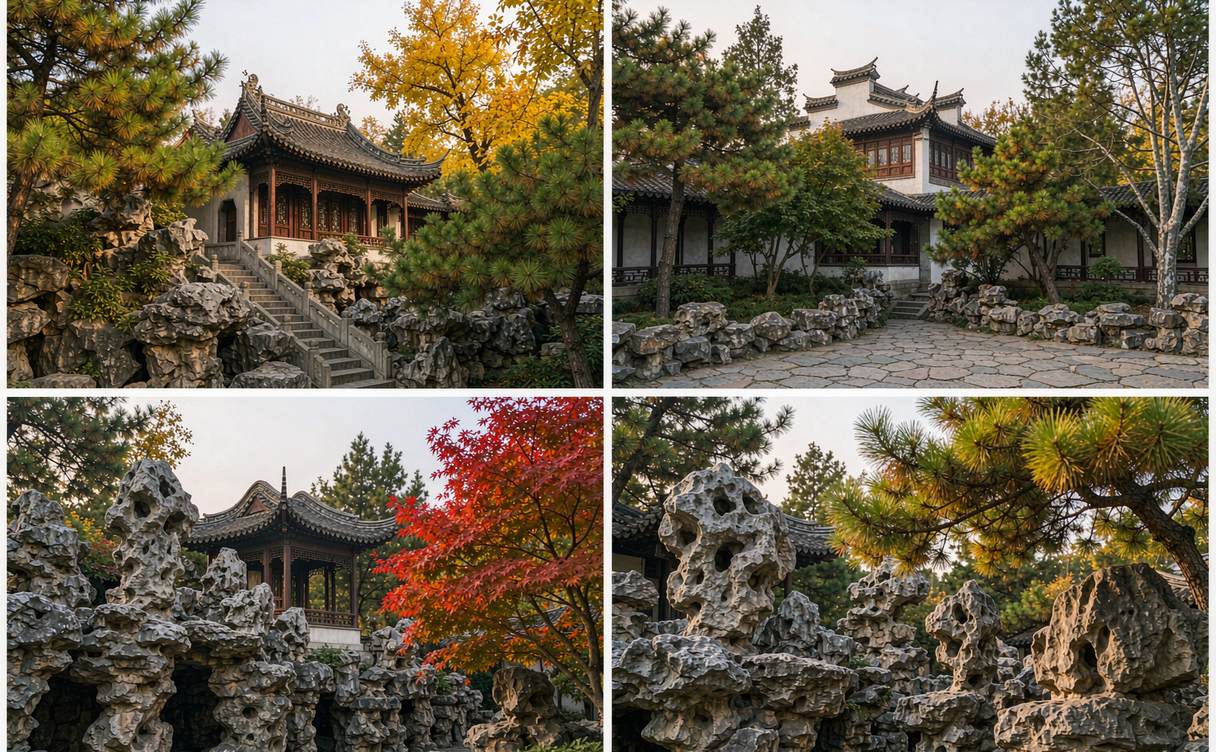
But the bamboo is only the opening act. Ge Garden is famous above all for its four seasonal rockeries — a set of rock landscapes that, read in sequence, walk you through spring, summer, autumn and winter using nothing but stone, planting and light. We last visited in late October and the autumn rockery — built from the warm red and ochre of Huangshan stone — was glowing under the low sun, with a single maple throwing shadow across the path.
The four rockeries, season by season
The spring garden uses slender Taihu stones and tender green planting to read as new growth; a small stream and a few peonies do the rest. The summer rockery is piled from gray limestone into a cool, cave-like mass with a hidden pool — the place to be on a July afternoon when the rest of the city is simmering. The autumn section, as noted, is Huangshan stone in fiery tones, often paired with maple and chrysanthemum. The winter rockery is the clever one: white xuan stone (snow-stone) shaped into a frozen ridge, backed by a wall with twenty-four round holes. When the wind blows through those holes it whistles — the garden’s version of winter wind, engineered three centuries ago by a designer who clearly thought about more than sightlines.
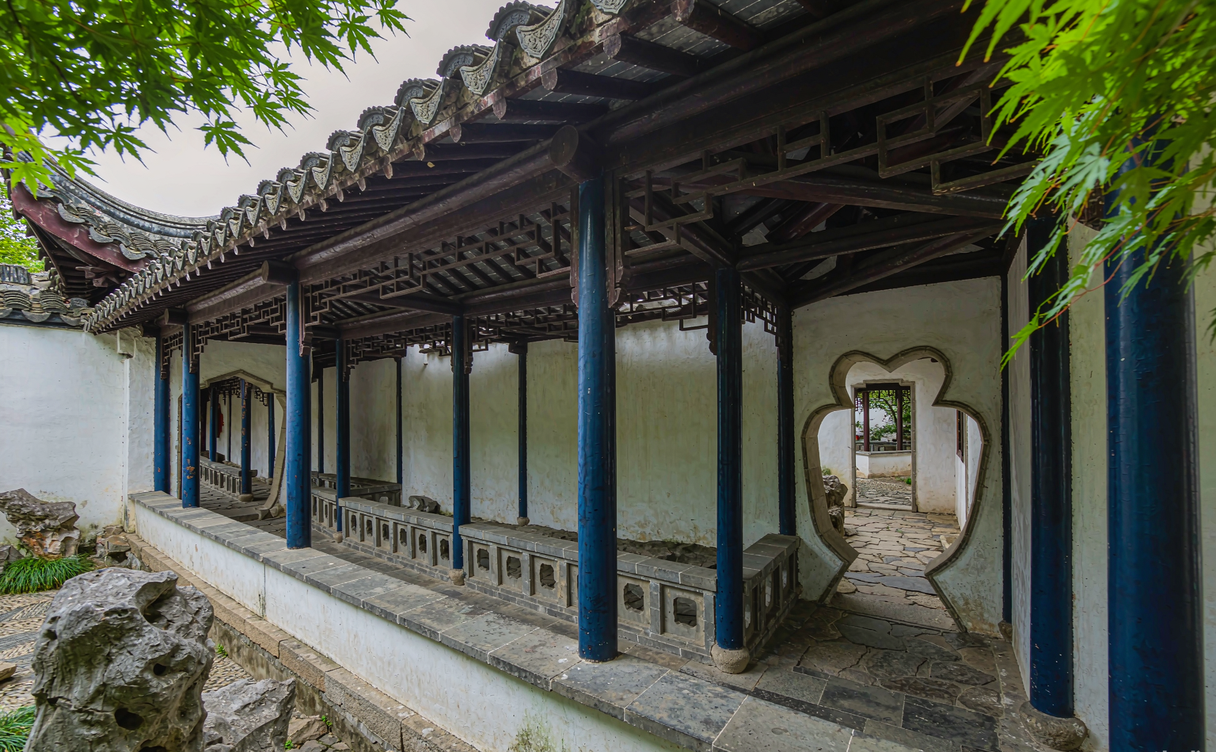
That winter wall is also the start of the famous covered corridor. The Ge Garden rockery circuit is wrapped in a roofed walkway with moon-gates, so you can do the whole four-season loop without getting rained on. On our last trip a light drizzle hit and we just kept walking — the corridor turns a flaw into the best part of the visit, and the rain on the tile roof is part of the soundtrack. This Yangzhou garden guide would be incomplete without saying the corridor alone is worth the entry fee on a wet day.
The residential quarter you shouldn’t skip
A lot of people miss that Ge Garden is really two attractions in one. Behind the rockeries sits a full Qing-dynasty salt-merchant mansion — a warren of courtyards, a private theater, and the kind of carved timber screenwork you’d otherwise pay to see in a museum. The north gate on Yanfu East Road drops you straight into this section, so if you enter there first you see the house before the garden. We usually advise entering from the south gate near Dongguan Street so the garden comes as a reveal, then exit through the mansion and out the north side toward the bus stop. The mansion also holds a small exhibition on Yangzhou’s salt trade, which explains why a merchant could afford to build something this intricate in the first place.
Practicalities: tickets, hours, getting there
Tickets run about ¥45 in peak season (March–November) and ¥30 in the winter months, bought at the gate or via the usual Chinese travel apps (Ctrip, Meituan). Hours are roughly 07:30–17:00, with last entry around 16:30. The garden is small enough that 60–90 minutes covers it well; budget two hours if you want to linger in the mansion and the bamboo groves.
Getting to Yangzhou is easier than it used to be. The nearest airport is Yangzhou Taizhou International Airport, about 40 km east, with domestic flights from major hubs and a handful of international routes. Far more convenient for most is the high-speed train: trains from Shanghai Hongqiao reach Yangzhou East Railway Station (扬州东站) in roughly 1.5–2 hours, and from Nanjing about 50 minutes. From the station, a taxi to the garden runs ¥30–40; public bus 27 or 29 also gets you close to Dongguan Street. If you’re coming from Zhenjiang across the Yangtze, the run is short and there’s a direct bus link worth considering — we cover the cross-river pairing in our Zhenjiang travel guide.
When to go, and how to beat the crowds
Yangzhou has four real seasons and Ge Garden rewards each. Spring (April–May) brings peonies and azaleas across the rockeries. Summer is lush and green but hot and humid — go at opening or after 16:00. Autumn (September–November) is our favorite: cool, clear, and the maple in the autumn rockery is at its best. Winter is quiet and a little bare, but the snow-stone winter garden earns its name if you catch a frost. Crowds peak on Chinese public holidays (National Day in early October, the Qingming festival in April); a weekday in May or late September gives you the garden almost to yourself.
What to eat nearby
You’re a two-minute walk from Dongguan Street, Yangzhou’s food strip. Don’t leave without trying Yangzhou fried rice (扬州炒饭 — done properly with shrimp, ham and pea, not the airport version), lion’s-head meatballs (狮子头), and crab-roe soup dumplings (蟹黄汤包) in season (roughly September–December). For a sit-down meal, the teahouses along the street serve proper morning tea — arrive before 8am if you want a table at the famous ones. We wrote up the wider region and more dishes in our Yangzhou travel guide.
Where to stay
Most visitors base themselves near Slender West Lake or Dongguan Street. The lake side is quieter and prettier at dusk; the street side puts food and the garden on your doorstep. Either way you’re within a ¥15 taxi hop of Ge Garden. Mid-range hotels cluster around the east end of Dongguan Street at ¥300–500 a night; the lakefront international brands run ¥700–1,200. If you want a deeper classical-garden circuit, our China classical gardens guide maps how Ge Garden fits with Suzhou and the canal towns.
Pairing it with the rest of Yangzhou and beyond
Ge Garden is rarely the only stop. Slender West Lake is a 10-minute drive north and is covered in our Slender West Lake Yangzhou guide. If you’re tracing the Grand Canal, our China Grand Canal travel guide explains why Yangzhou was the richest port on it. Wuxi, a few hours southeast, makes a logical next stop with its own gardens and lake — see our Wuxi travel guide. A good Yangzhou garden guide rule of thumb: one garden is a visit, two gardens is an education, and Ge Garden plus Slender West Lake is the minimum we recommend.
For background on how these private gardens developed and what makes a Yangzhou garden guide worth reading, the encyclopedic overview at Wikipedia’s Ge Garden page is a decent starting point.
Planning a Yangzhou trip? Our Yangzhou travel guide has day-by-day routes that slot Ge Garden in beside Slender West Lake.
Want to build a full classical-garden circuit across Jiangsu and beyond? Read our China classical gardens guide before you book trains.
Coming from across the Yangtze? Our Zhenjiang travel guide covers the short hop and what to see there.