

We’ve walked Suzhou’s classical gardens with clients hundreds of times, and the one we keep sending people to is also the one many skip: the Master of the Nets Garden (网师园, Wangshi Yuan). At roughly 0.6 hectares it’s the smallest of Suzhou’s major gardens, but connoisseurs rate it the most perfectly composed — every rock, window, and reflection placed with intent. This Master of the Nets Garden guide comes from our own visits, including the celebrated evening show where Kunqu opera floats out of the pavilions. If you only have time for one garden in Suzhou, make it this one; the smaller Suzhou garden next door will feel busy by comparison, and the big ones will feel like parades.
The Suzhou gardens as a group are a UNESCO World Heritage site; the official listing and criteria are at UNESCO: Classical Gardens of Suzhou.
Getting there and the basics
The garden sits at 阔家头巷23号 (23 Kuojiatou Lane), just south of 十全街 (Shiquan Street) and a short walk or ¥10 ($1.5) DiDi from Suzhou’s old city. It’s an easy add-on to any Suzhou travel guide itinerary, and it’s walkable from the 相门 (Xiangmen) gate along the canal. Daytime entry is about ¥40 ($6) in high season (April–October) and ¥30 off season; open roughly 7:30–17:30. Because it’s compact, 60–90 minutes is enough by day — which is exactly why it pairs well with the larger Suzhou Humble Administrator’s Garden nearby if you want a scale contrast between the smallest Suzhou garden and the largest, just a short DiDi north.
Why the smallest Suzhou garden matters
Founded in the Southern Song (12th century) as a retired official’s “Fish Hideaway” and rebuilt in the Qing by Song Zongyuan in the 1760s, the garden’s name — “Master of the Nets” — is a humble pun on the fisherman who fishes not for fish but for tranquility. Its genius is proportion: a central pond (彩霞池, “Rosy Cloud Pond”) anchors the western garden, edged by the 月到风来亭 (Moon-Comes-Wind-Blows Pavilion), the 濯缨水阁 (waterside pavilion), and the 看松读画轩 (pine-and-painting hall). The eastern half is the residential quarter, with courtyards and a famous small study, 殿春簃 (Dianchunyi). That study was so admired it was faithfully copied as the 明轩 (Ming Pavilion) in New York’s Metropolitan Museum of Art in 1979–80 — the first time a Chinese garden was rebuilt abroad, and still the template for how the West reads “Suzhou.” For the broader design grammar, our China classical gardens guide explains the borrowed-scenery and window-framing principles at work here.
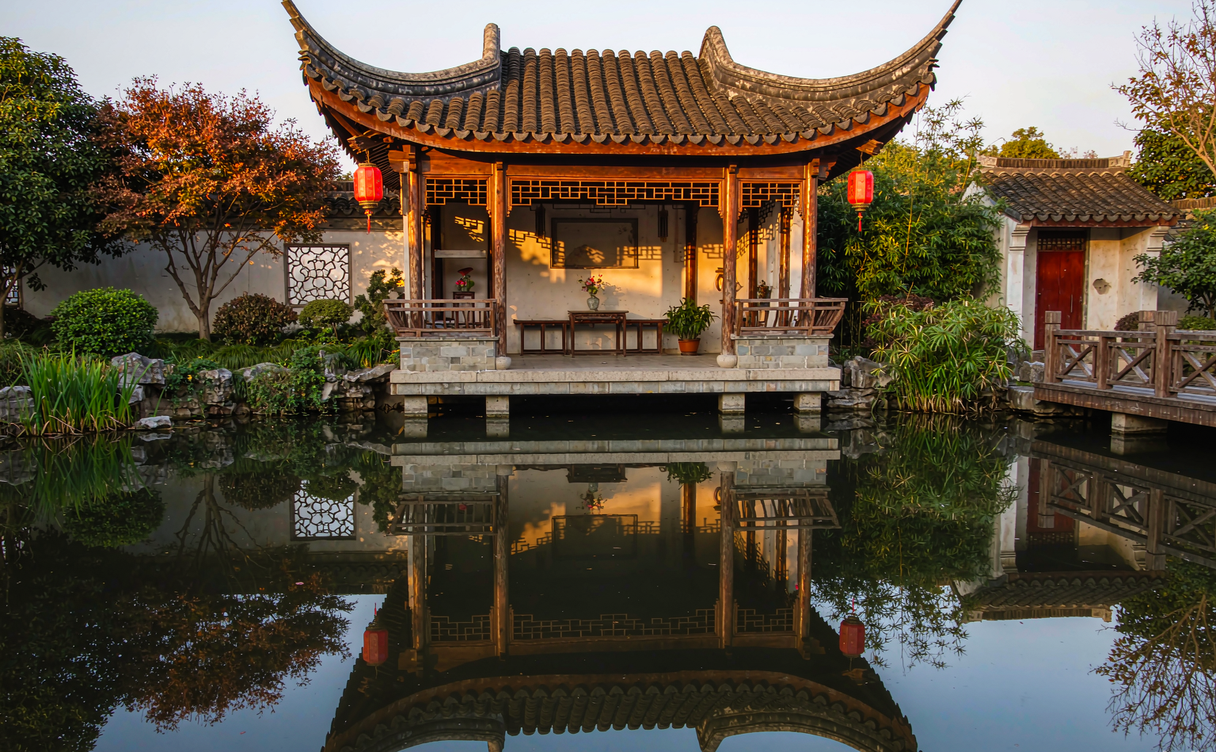
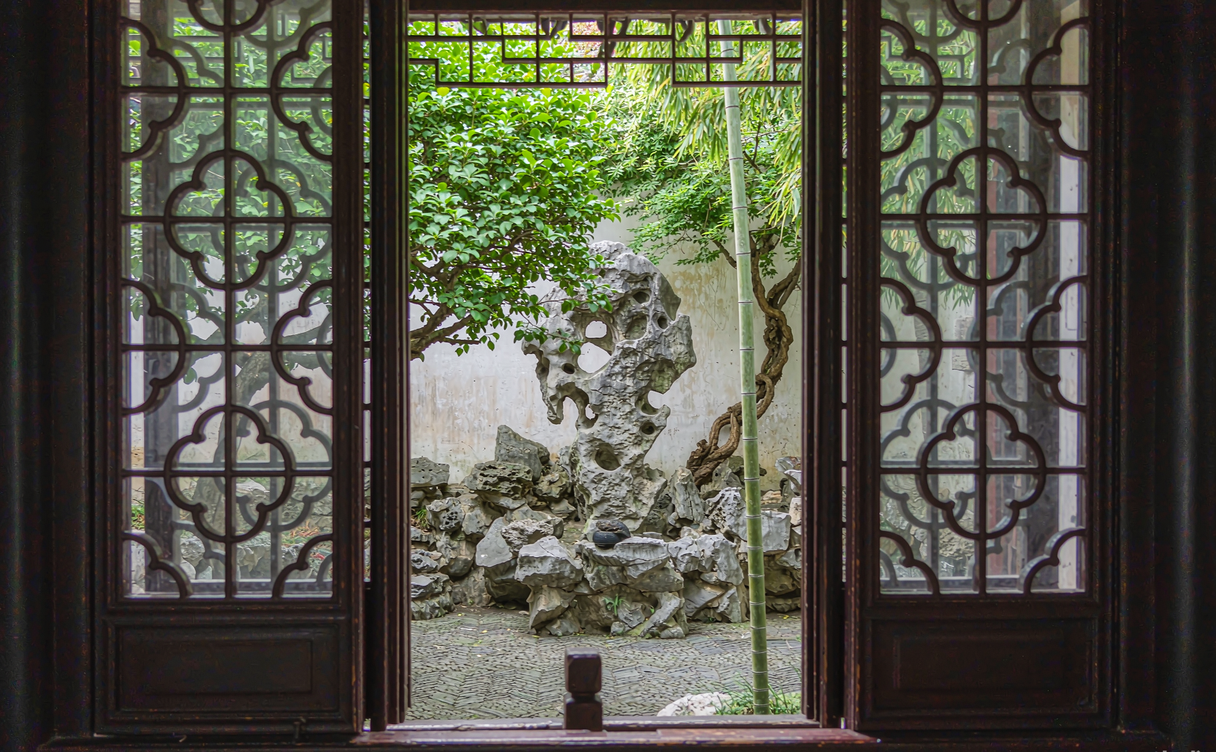
What makes it sing is the use of “borrowed view” — the pond is small, but the placement of a single rock or a single moon-gate window makes the whole thing feel larger than it is. Notice the lattice windows: each frames a fixed composition like a living scroll, and the gardeners have pruned the trees to hold those frames year-round. We tell clients to stand at the pond’s far corner and look back at the pavilions — that’s the postcard, and it’s real, not a trick of the light.
The Master of Nets evening show
The garden’s signature experience is the 夜花园 (night garden), running on selected spring–autumn evenings (roughly April–October, around 19:30–22:00, weather permitting). Small audiences move between lit pavilions for snippets of 昆曲 (Kunqu opera), 评弹 (Pingtan storytelling), 古琴 (guqin zither), and 江南丝竹 (Jiangnan chamber music). The program rotates, but the Kunqu and guqin sets by the pond are the constants, and they’re the reason to stay late. Tickets are about ¥100–¥150 ($14–$21) on top of daytime entry and must be booked ahead through Ctrip or a hotel concierge — they sell out on weekends and on public holidays. We last caught a Kunqu aria by the pond on an October night, and it’s the single most atmospheric thing we recommend in Suzhou. This is the experience to plan a Suzhou garden guide around, and the Master of Nets evening show is the reason many of our clients return to the city a second time.
Want the evening show booked into a Suzhou stay? Our Yangzhou travel guide pairs well if you’re doing a canal-city circuit with Suzhou and Yangzhou.
Best time and practical tips
Spring (April–May) and autumn (October–November) are best; avoid the National Day week (early October) and the May holiday, when even this small garden crowds. Mornings are quietest by day — arrive at the 7:30 opening and you may have the pond to yourself for ten minutes. Combine with a stroll down 十全街 for dinner (Songhelou-style 苏帮菜 and craft beer) or 平江路 for canals and silk shops. Photography: the lattice windows and the pond reflections are the money shots — bring a prime lens, and a small tripod for the night show if staff allow it (they often do, away from the performers). A good Suzhou garden guide always reserves the evening, not just the daylight hours.
Where to stay and bookability
The garden is walking distance from central Suzhou hotels; the 南园宾馆 (Nanyuan Hotel) and riverside boutiques near 十全街 put you steps away (¥400–¥900 / $55–$125 a night). Day entry is walk-up, but the night show needs advance booking — let your hotel concierge secure it two days ahead in peak season. English signage is decent; a guide greatly improves the symbolism, and we can arrange one who meets you at the lane entrance and stays through the evening performance. Note the garden closes the inner rooms during the day, so the study and residence are best appreciated on the night tour when they’re lit and staffed.
One booking tip we always give: buy the day ticket and the night ticket as separate transactions on Ctrip, because the combined product sells out fastest and the day portion alone won’t admit you to the evening performance. The lane entrance is unmarked from the street — look for the grey-tiled wall and a small wooden sign, not a grand gate — and arriving 30 minutes before the show lets you hear the musicians tune up, which is part of the magic. Groups are capped, so a party of two has a far better chance of a same-day walk-in than a large tour would, and a hotel concierge can usually secure the night ticket two days ahead in peak season.
Exploring more of the Yangtze delta? Our Wuxi travel guide covers the Taihu lake gardens an hour west of Suzhou, a natural follow-on to the classical gardens.
A suggested visit
07:30 — arrive at opening for a quiet daytime walk (60–90 min), focusing on the pond composition and the lattice windows. 09:00 — walk to 十全街 for a 苏式早餐 (Suzhou-style breakfast) of 汤包 and porridge (¥20–¥40 / $3–$6). 10:30 — optional second garden (Humble Administrator’s) or the 平江路 canals. Afternoon — rest at the hotel. 19:00 — return for the night garden; the show runs about two hours. If you’re building a multi-city trip, Zhenjiang adds a lesser-known Jiangsu stop between Suzhou and Nanjing, rounding out a classical-garden and canal theme, and that leg is an easy half-day by high-speed rail.
Need a Suzhou garden itinerary with the night show secured? Reach out via the Zhenjiang travel guide and we’ll lock in Master of the Nets plus the big gardens and a guide who stays for the performance.