

We’ve been guiding travelers through Hubei’s lesser cities for years, and Tianmen (天门) is a sleeper: most people blow through on the train between Wuhan and Yichang without realizing they’re passing the birthplace of Lu Yu, the Tang-dynasty “Sage of Tea,” and one of the largest Neolithic city sites in the Yangtze basin. This Tianmen travel guide is built from our own visits — the willow-lined Stone-Qin Lake inside Lu Yu Garden, the brick-tea legacy that once rolled north toward Mongolia and Russia, and the steamed-dish banquets the city is quietly famous for. If you want Hubei without the tour-bus crowds, Tianmen Hubei travel is the move, and it fits neatly into a Wuhan–Yichang rail day.
Tianmen is a directly administered county-level city on the Jianghan Plain, historically known as Jiling (竟陵). For a neutral overview of its status and history, see Wikipedia: Tianmen.
Getting there: the Tianmen to Wuhan hop
The easiest approach is the high-speed train to Tianmen South Station (天门南站) on the Wuhan–Yichang line. From Wuhan (Hankou or Wuchang) it’s just 40–55 minutes and ¥35–¥55 (about $5–$8) in second class — one of the shortest provincial-capital hops in Hubei. There’s also Tianmen Station (天门站) on a separate branch, so confirm which your hotel is near before you book, because a wrong-station mix-up adds 40 minutes by road across the city. By car, the drive from Wuhan is about 1.5 hours via the Hanyi Expressway for ¥160–¥240 ($22–$33). Trains run roughly every 20–40 minutes through the day, so you don’t need to plan around a fixed departure. For a wider loop, our Wuhan travel guide pairs well with a stop here before heading west toward Jingzhou and the gorges.
Best time to visit
Spring (April–May) and autumn (September–October) are ideal, with mild highs of 22–27°C and low humidity. Summer brings lotus on the lakes and the steaming-dish festivals, though it’s hot and sticky by midday. Winter is quiet and cheap, with hotel rates dipping to ¥150 ($21) for a decent double. The city’s tea-culture events tend to cluster around the April 茶圣节 (Tea Sage Festival) tied to Lu Yu’s memory, when the garden hosts tea ceremonies and calligraphy displays; dates shift year to year, so check locally before you commit train tickets. We generally send clients in April or October for the cleanest light and the liveliest garden atmosphere.
Things to do in Tianmen
The centerpiece is 陆羽故园 (Lu Yu Garden), a lakeside park built around the memory of Lu Yu (733–804), author of the 茶经 (Classic of Tea), the first systematic treatise on tea anywhere in the world. At its heart stands the 茶经楼 (Tea Classic Tower), a tall pavilion with tea-history exhibits — early kilns, tribute-tea jars, and a circular reading room of tea texts — and a panorama over the central lake. That lake is the willow-fringed Stone-Qin Lake (石琴湖), where locals walk, fish, and practice tai chi at dawn, and where a slow loop path takes about 40 minutes. Admission to the garden is free; the tower is a modest ¥20–¥30 ($3–$4). We last visited on a foggy March morning and had the lakeside path almost to ourselves, with egrets working the reeds. For more on the region’s living heritage, our China off-the-beaten-path guide covers similar low-key sites that most itineraries miss.
Just northeast of the city, the 石家河遗址 (Shijiahe Archaeological Site) is the headline for history buffs: a walled Neolithic settlement dating to roughly 5900–4200 years ago, among the biggest of its era in the middle Yangtze, with jade, pottery, and city-wall remains spread across an enormous earthen enclosure. It’s an active excavation, so visits are low-key — a small museum hall plus the open site — but genuinely significant for understanding how complex society formed in the south. Allow two hours including the drive. Pair it with a stop in Jingzhou to the west if you want more Chu-state history alongside the prehistoric layer, since the two together span several millennia of Jianghan Plain civilization.
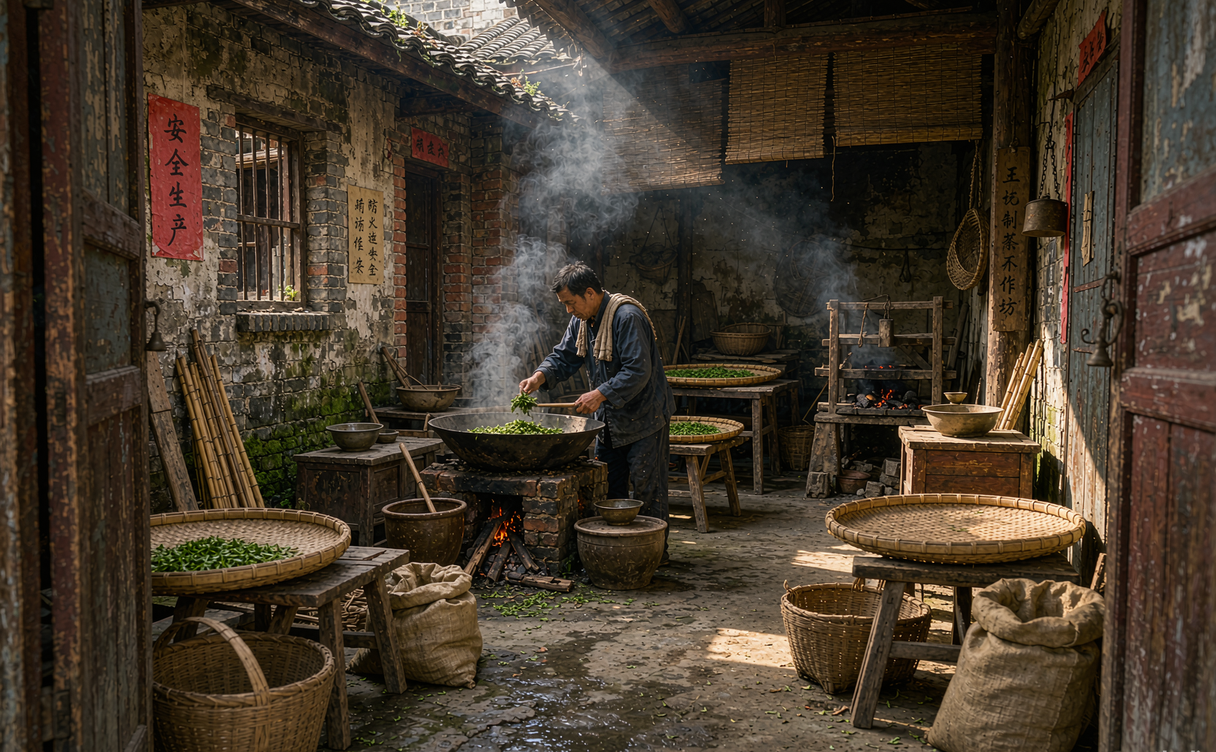
The Tianmen tea brick story sits at the intersection of these threads. In the 19th century the nearby 羊楼洞 (Yangloudong) hills produced compressed brick tea that was carried through Tianmen and Hankou and shipped north along the historic tea route to Mongolia and tsarist Russia. Tianmen was a transit and trading node on that corridor, and you can still trace the old tea-commerce streets in the old town, where warehouses once stored the pressed bricks before they went north on camel caravans. The legacy is celebrated at tea houses around Lu Yu Garden rather than in a single museum, so the best experience is to sit down for a 天门茶 (local green tea) and a plate of steamed snacks. The Tea Sage’s hometown makes the brick-tea connection tangible in a way a display case never could.
Things to do in Tianmen are unhurried: a morning at the garden, an afternoon at Shijiahe, and an evening of 天门蒸菜 (Tianmen steamed cuisine). The city also brands itself 中国蒸菜之乡 (hometown of steamed dishes), and the local style is lighter than the heavier 沔阳 version to the south, leaning on river fish and young greens rather than fatty pork.
Want the steamed-dish tradition explained region by region? Our Hubei Chu cuisine guide breaks down Tianmen, Jingzhou, and Wuhan cooking side by side.
What to eat
Tianmen’s table is built on 蒸 (steaming): 蒸鱼 (steamed fish), 蒸肉 (steamed pork), 蒸菜 (steamed vegetables), often with rice flour that turns translucent and slightly sweet in the basket. A full 蒸菜 banquet for two runs ¥100–¥160 ($14–$22) and is best shared family-style with rice. Local specialties worth seeking out include 黄潭米粉 (Huangtan rice noodles) for breakfast at ¥6–¥10 ($1–$1.5), a silky noodle soup that beats any hotel buffet; 麻洋糖心皮蛋 (Moyang “sugar-heart” preserved eggs), with a amber, jammy yolk; and 蒋场香干 (Jiangchang fragrant dried tofu), eaten cold with chili oil. For a sit-down dinner, the restaurants around 陆羽大道 and the 大润发 area are reliable; expect ¥120–¥180 ($17–$25) for two with beer. Tea-house snacks — 茶点 with local green tea — are the low-cost highlight and a direct link to the city’s tea-brick past; a pot and a plate of 麻饼 runs ¥30–¥50 ($4–$7) and can easily fill an afternoon.
Heading on to the gorges? Our Yichang travel guide lays out the river logistics from Tianmen westward and where to base for the Three Gorges.
Practical tips
Tianmen is compact and easy to handle. DiDi starts at ¥7 ($1) and a cross-town ride is ¥12–¥20; the Shijiahe site is best reached by hired car (¥80–¥120 round trip from the center, 50–70 minutes), so arrange that the day before through your hotel. English is limited, so keep your hotel’s name in Chinese on your phone and use a translation app for menus. The garden and tower take cards and mobile pay; the old-town tea houses are cash-friendly. Build in a buffer if you’re connecting to a specific train, because the two stations are not interchangeable.
Where to stay and bookability
Lodging is practical: Vienna, Atour, and Jinjiang Inn around Tianmen South Station and the city center run ¥200–¥340 ($28–$47) a night, bookable on Ctrip. The city is compact and walkable, with DiDi starting at ¥7 ($1). No special foreigner formalities beyond the standard passport check at check-in, and front desks are used to registering guests. Book the Shijiahe car the evening before, as drivers near the site are scarce.
A sample one-day plan
07:30 — high-speed train from Wuhan to Tianmen South (under an hour). 08:40 — taxi to Lu Yu Garden for the Tea Classic Tower and a Stone-Qin Lake walk (2 hours). 11:00 — hired car to Shijiahe (1 hour each way), museum and site (1.5 hours). 14:00 — back in the city for a steamed-dish lunch (¥100–¥160). 15:30 — tea-house session by the lake. 17:00 — train back to Wuhan, or continue west. If you want water-based adventure too, the region’s rivers feed into the China river rafting guide options toward the Yangtze gorges.
Want Tianmen folded into a custom Hubei route? Reach out through our Jingzhou travel guide and we’ll add Shijiahe and the tea gardens to your plan.