

There is a particular kind of tiredness that only arrives after a long ridge hike, and the best cure I have found is a hot shower and a window looking straight at the peaks you just climbed. China is unexpectedly good at this. Over the past few years I have slept in timber lodges bolted to the side of Huangshan, in misty forest cabins outside Emei, and in family-run wooden inns tucked into valley villages that most tourists bus straight past. This China mountain lodge stays guide collects what I learned: where the lodges are worth it, how to book, and what to actually pack.
A “mountain lodge” in China spans a wide range — from the bare-bones summit hotels on Huangshan where you sleep to catch sunrise, to design-forward forest cabins that cost more per night than a city five-star. Knowing which end of that spectrum you want changes everything about your trip.
Huangshan and the case for a cliffside inn
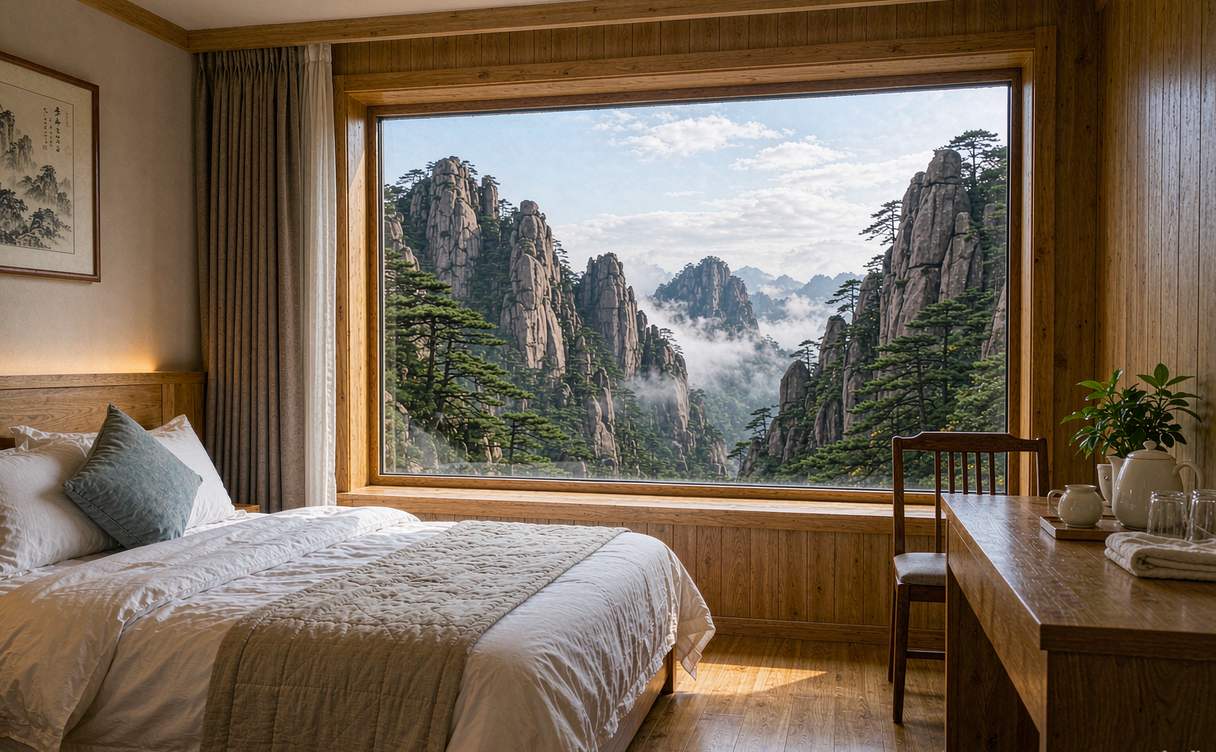
The most famous (and most crowded) mountain lodge experience is on Huangshan, the Yellow Mountain in Anhui, China. Here the summit hotels are the point. The Huangshan Yellow Mountain guide explains the two main ridgelines, but the lodging reality is this: there are a handful of state-run hotels at the top — Beihai, Xihai, Baiyun, and the pricier Paiyunlou — and they exist so you can watch the sunrise without a 3 a.m. ascent. A cliffside inn Huangshan summit stay runs 800–1,600 RMB ($112–224) for a double in peak season (April–November), and yes, that buys you a small room, thin walls, and a breakfast buffet. But it also buys you the sea of clouds at 6 a.m. with maybe forty other people instead of two thousand.
Book these through Ctrip exactly 7 days ahead, the moment the booking window opens — they sell out within hours on weekends. Bring earplugs; the walls are paper. The UNESCO-listed Mount Huangshan is the official reason it is protected, and the management limits summit beds precisely to keep the mountain from being loved to death.
Forest cabin stays China — the quieter alternative
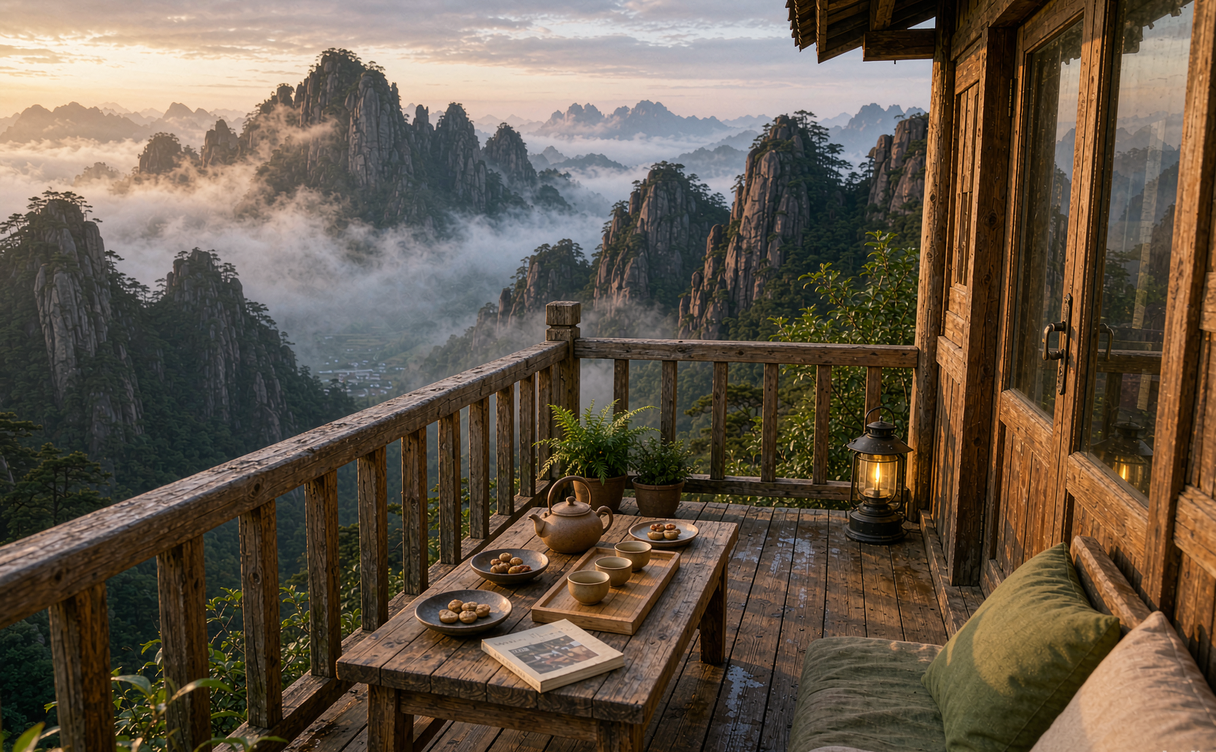
If you would rather hear birds than tour-group megaphones, look at forest cabin stays China offers in the temperate mountains of the southwest. Near Emei Mountain in Sichuan, the Emei Mountain guide points to the lower temple routes where wooden guesthouses sit among bamboo and monkey-filled paths. I stayed in a cedar cabin at the 1,800-metre mark for 360 RMB ($50) a night, woke to mist sliding through the trees, and hiked up to the golden summit the next morning. Quieter, cheaper, and the air smells of pine instead of diesel buses.
Other strong forest-cabin regions:
- Changbai, Jilin — log cabins near the forest edge, good for autumn colour.
- Moganshan, Zhejiang — the original boutique-cabin destination, 90 minutes from Hangzhou, with designed homes from 900 RMB ($126).
- Wuyishan, Fujian — riverside wooden lodges below the red cliffs (covered in the Fujian itinerary articles).
Mountain lodge booking China
For mountain lodge booking China, the rules differ by region. State-run summit hotels (Huangshan, Taishan) open a fixed window — usually 7 days out — and only on Ctrip or the park’s own app. Private forest cabins and homestays list on Ctrip, Airbnb (limited), and Xiaozhu; read the Chinese reviews and translate them. A few practical points:
- Summit rooms are non-refundable in peak season. Weather can white-out the view for days; that is the gamble you take.
- Confirm heating. Above 2,000 metres, even in May, nights are near freezing. “No heating” listings are common in shoulder season — avoid them.
- Luggage forwarding exists on Huangshan: porters (or a cable-car-plus-cart service) will move your big bag to the summit hotel for 40–80 RMB ($6–11) per item. Use it; you do not want to drag a roller suitcase up 1,800 steps.
- Check the [China homestay guide](https://www.chinatravelplaces.com/china-homestay-guide/) for etiquette and booking norms that apply to family-run mountain inns too.
What to pack for a mountain lodge stay
This is where people go wrong. Here is my packing list for what to pack for a mountain lodge stay, refined across a dozen trips:
- Layers, not a coat. Base tee, fleece, and a windproof shell beat one puffy jacket when the temperature swings 15°C between noon and midnight.
- Slippers. Summit hotels and cabins usually have tile or wood floors and no in-room shoes.
- A power bank. Heating and the thin mountain air drain phones fast if you are shooting timelapses.
- Earplugs and an eye mask. Thin walls, early hikers, and 5 a.m. daylight.
- Snacks. Mountain food is pricey and limited; a stash of nuts saves you at 3 p.m.
- A dry bag if your cabin is a walk from the car park in rain.
Best mountain lodges in China — my shortlist
If I had to name the best mountain lodges in China for a first timer, I would send you to four places: the Xihai Hotel on Huangshan for the sunrise-and-clouds combo; a bamboo cabin on Emei’s middle slope for quiet and monkeys; the designed cabins of Moganshan for comfort and good coffee; and the wooden riverside lodges at Wuyishan for the raft-plus-mountain pairing. Each is different enough that you could chain two on one trip.
For travellers who like their stays even more unusual, our China treehouse stays guide and the broader China glamping camping guide cover elevated sleeping options near several of these ranges. And if the lodge is a base for walking, the China hiking treks guide maps multi-day routes that pair naturally with an overnight on the mountain.
Food and the half-board question
Most mountain lodges, especially the summit hotels, push a half-board or full-board option because there is nowhere else to eat. On Huangshan a set dinner runs 80–120 RMB ($11–17) and is exactly what you would expect — stir-fried greens, a small piece of fish, and rice — but after a long hiking day it lands well. The trap is breakfast: the buffet opens at 5:30 a.m. for sunrise-goers and the good stuff (soy milk, eggs, buns) is gone by six. Go early or go hungry. Forest cabins and homestays usually include a simple breakfast of congee and pickles; anything more is ordered in the village below, so tell your host the night before. If you are vegetarian or have allergies, message the lodge a day ahead — mountain kitchens stock little, and a last-minute request often means plain rice and cabbage for three days.
Getting to the lodge without a car
You rarely drive to the door. On Huangshan you ride a cable car then walk 20–40 minutes to the hotel; porters in orange vests meet the upper station and will carry a suitcase for 40–80 RMB ($6–11). On Emei, a combination of sightseeing bus and cable car delivers you near the mid-mountain guesthouses. Build this transfer time into your plan — “check-in at 3 p.m.” really means “reach the trailhead by 1 p.m.” in summer when the last shuttles fill. Snow in winter closes several upper cable cars, so confirm the access route is open before you book a summit room in December–February.
When to go
Spring (April–May) and autumn (September–October) are the sweet spots — clear air, manageable crowds, and colour in the trees. Summer brings greenery and thunderstorms; winter brings ice, closed upper paths, and magical solitude if you are equipped. Avoid Chinese public holidays (Labour Day in early May, National Day in early October) entirely; the summit hotels triple in price and the queues are miserable.
My take
A mountain lodge is the rare travel splurge that earns its cost through a single moment — coffee in hand, clouds below you, the mountain you climbed still glowing. Pick the right one, pack light and warm, and let the altitude do the rest.
Dreaming of a sunrise above the clouds? Subscribe to chinatravelplaces.com for monthly China lodge and cabin picks delivered to your inbox.
Ready to book a Huangshan or Emei summit stay? Grab our packing checklist and booking-window calendar so you don’t miss the 7-day opening.
Compare lodges, cabins and treehouses across China in one place — save our mountain-stay guides and start planning your ridge escape.