

I arrived in Luoyang on a grey March afternoon with one mission: eat my way through the cradle of Chinese civilization. Henan sits at the geographic heart of China, and its food tells the story of a thousand years of capitals, granaries and caravans. People here don’t cook for spectacle — they cook for warmth, for the wheat fields that stretch to the horizon, and for the simple pleasure of a steaming bowl when the north wind bites. If you want the real Henan, skip the hotel buffets and follow the steam.
This Henan cuisine guide is built from three trips and a lot of noodle broth. I’ll walk you through the Luoyang water banquet, the braised noodles that fuel Zhengzhou, the night-market snacks of Kaifeng, and the practical spots where I actually ate.
The Luoyang Water Banquet: twenty-four soups, one long table
The single dish Henan is famous for is the shuixi — the water banquet. Legend ties it to Empress Wu Zetian, who supposedly loved a peony-shaped soup so much the format stuck. A proper water banquet is a progression of 24 courses, almost every one soup-based or braised in broth. The name “water” refers to the fact that nearly everything is served in liquid. You don’t get dry platters here; you get bowls.
The signature is luoyang shuixi “Peony Stewed with Silver Threads” (mudan yan cai), a clear soup with shredded turnip carved to look like a blooming peony. It’s theatrical but delicate. Around it come sweet-and-sour ribs in broth, braised gluten, tofu skins, and a final bowl of mi zhi bing tang sweet soup.
Where to eat it: Zhen Duo Guan (真不同饭店) on Kaocheng Road in Luoyang is the old granddaddy, open since the Qing era, and a full banquet runs roughly ¥80–160 per person depending on the tier. A smaller shuixi set for two at a mid-range restaurant costs about ¥120. If you’re pairing your food trip with sightseeing, our Luoyang travel guide has the logistics for getting between the Longmen Grottoes and the dinner table.
Insider tip: don’t try to order the full 24-course banquet solo. Most restaurants offer a 6- or 8-bowl “mini water banquet” set — enough to understand the format without exploding. Go hungry, and pace yourself: the savory bowls come first, the sweet ones last.
Henan braised noodles (hui mian): the working-class soul
If the water banquet is Henan’s formal wear, huimian — braised wheat noodles — is its daily uniform. This is the dish I ate most in Zhengzhou. Wide, hand-pulled ribbons of wheat noodle are braised (not just boiled) in a rich mutton or beef bone broth with soybean sprouts, sliced lamb, and a hit of coriander and chilli oil.
The key word is hui — braised. The noodles sit in the broth and absorb it. A proper bowl is thick, salty, deeply savory, and topped with a spoonful of red chilli paste you stir in yourself. In Zhengzhou you’ll pay ¥16–28 for a generous bowl at a local chain like Hui Mian Li (烩面李) or He Ji (合记), the latter a Zhengzhou institution since 1953. Upscale versions with extra lamb ribs push toward ¥45.
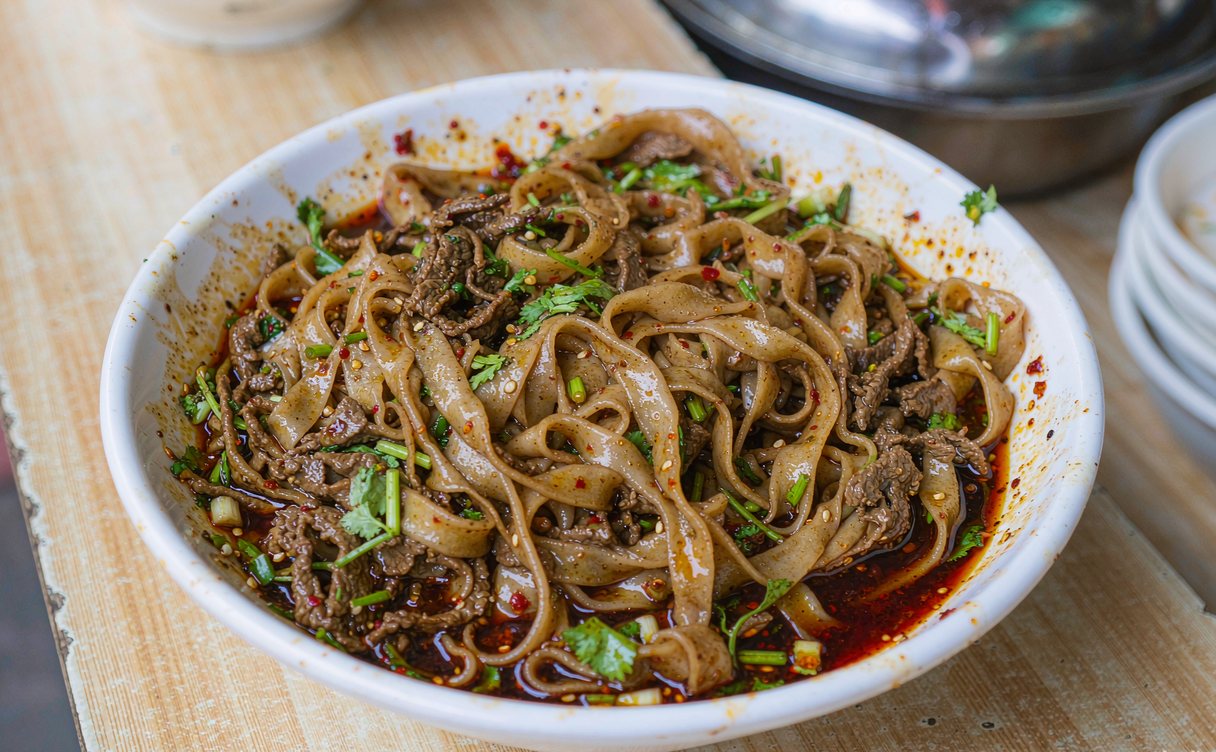
I once ordered huimian at 7 a.m. in a Zhengzhou railway-station cafe and was not judged at all — this is breakfast, lunch and dinner food. For noodle lovers plotting a broader route, our China regional noodles guide connects Henan’s braised style to Lanzhou, Shanxi and beyond.
Kaifeng night market: the Song-dynasty snack street alive again
Kaifeng was the Northern Song capital, and its night market culture is the closest thing China has to a living medieval street-food scene. The Xisi Night Market and the riverside Book Market Street (书市街) light up after dark with stalls selling bingbing cold noodles, fried ciba cakes, candied haws, and the famous kaifeng guan tang bao — soup dumplings you sip before biting.
Don’t miss Kaifeng baked sesame flatbread (shaobing) stuffed with spiced pork, about ¥6 each, and almond tea (xingren cha), a sweet, fragrant gruel sprinkled with hawthorn and nuts, ¥8 a bowl. The Kaifeng night market snacks scene is busiest Friday and Saturday nights from 6 p.m. to midnight. Our Kaifeng travel guide explains how to reach the old city from Zhengzhou by high-speed rail in under 30 minutes.
Insider tip: Kaifeng’s night markets are cheap and cheerful. Budget ¥50–80 per person to graze across six or seven stalls. Carry small cash and a translation app; few vendors speak English.
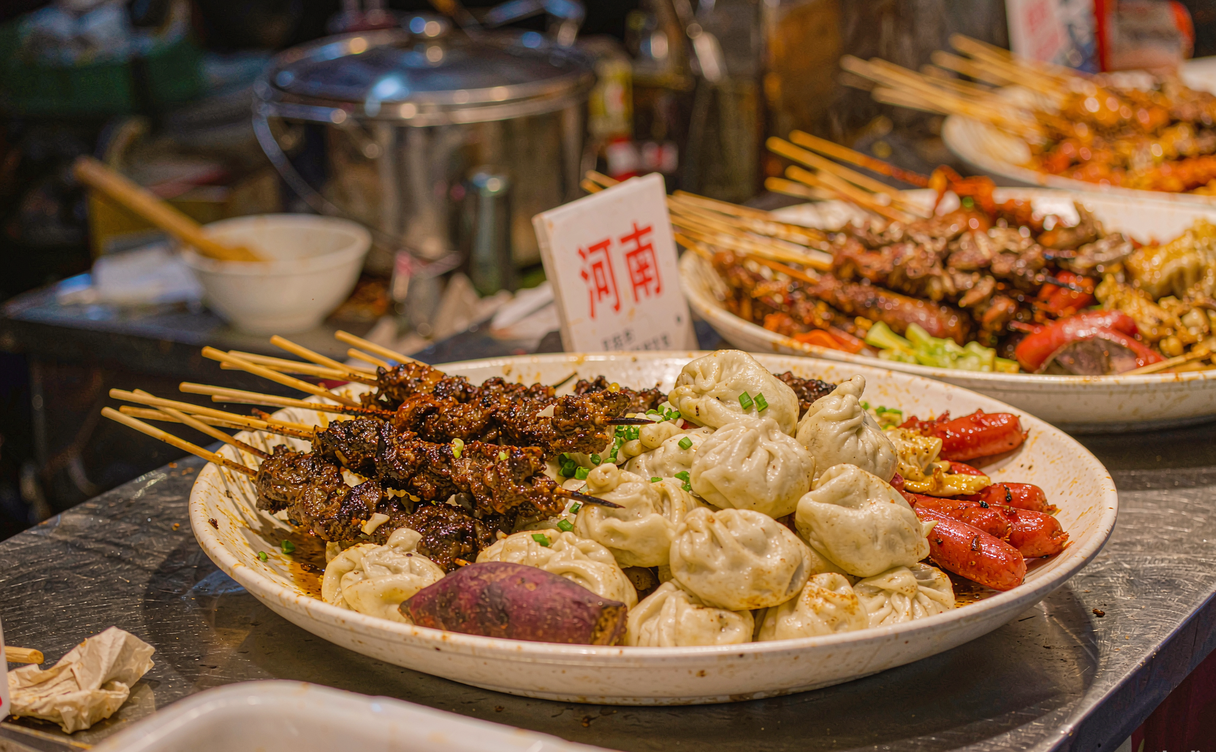
Beyond the famous stalls, look for Kaifeng fried glutinous cake (zhagao) dusted with sugar, ¥5, and almond curd (xingren doufu), a silky cold pudding with a faint bitter-nut edge. The city’s Muslim quarter near the Drum Tower also does a fine hu la tang — a peppery beef-and-thickening soup with knots of gluten that locals drink from a bowl at 7 a.m. before the day heats up.
Zhengzhou Yu cuisine restaurants: refined and regional
For a sit-down “Yu cuisine” (豫菜) experience — the formal name for Henan cooking — Zhengzhou has the best range. Yu cuisine is one of the original regional systems, lighter and less oily than Sichuan, less sweet than Jiangsu. Look for dishes like hu shi geng (a thick “tiger-skin” soup), braised carp with noodles (one fish, two ways), and stir-fried young chicken with lily bulbs.
Good mid-range picks: Yu Pin Xuan (豫品轩) and De Zhuang (德庄) for hotpot-style braised dishes. A three-dish dinner for two runs ¥150–260. For deeper context on how Henan fits the national picture, our Chinese food guide to the 8 cuisines places Yu cuisine among the traditional schools.
Henan sweets, drinks and a three-city eating plan
Henan’s sweet tooth is gentle. Look for si tang (四糖) — a warm barley-and-date sweet soup sold from winter carts, ¥6 — and peanut cake (huasheng gao) from Luoyang’s old streets, crumbly and not too sweet. To drink, the province favours plain hot water and the occasional hua cha (flower tea) of chrysanthemum, which cuts the richness of lamb broth.
If you only have a few days, build the route around the three cities that define the food: start in Zhengzhou for huimian and a formal Yu-cuisine dinner, train 40 minutes to Kaifeng for the night market, then take the high-speed line two hours west to Luoyang for the water banquet and the Longmen Grottoes the next morning. The cities sit on one rail corridor, so you never backtrack. Our Zhengzhou travel guide has the station-to-restaurant transfers mapped out.
Best seasons and a few honest tips
Spring (April–May) and autumn (September–October) are ideal — the wheat harvest in June means fresh flour and the best shaobing. Winters are brutally dry and cold, which is exactly when a bowl of huimian hits hardest.
Practical advice from someone who learned the hard way:
- Where to eat Henan food is rarely the tourist core. Walk two blocks off the main drag and prices drop 30%.
- Portions are huge. A “small” noodle bowl is a full meal.
- Chilli oil is self-serve; taste before you drown the bowl.
- English menus are rare outside top hotels — point, use a translation app, or follow what the table next to you ordered.
- The water banquet is an event, not a quick bite — reserve ahead at Zhen Duo Guan on weekends.
For night-market strategy across the country, our China night markets guide is a useful companion.
Henan cooking is humble, wheat-bound and broth-deep — the kind of food that fed empires and still feeds commuters. For background on the region’s place in Chinese gastronomy, the overview at Wikipedia’s Chinese cuisine page is a solid starting point. Come hungry, leave full, and don’t be afraid to slurp.