

Why I Keep Sending Travelers to Ailao Mountain Yunnan
I have spent three monsoon seasons guiding independent travelers through Yunnan, and the stretch of Ailao Mountain Yunnan between Xinping and the Honghe terrace belt remains one of the most reliable places to show visitors a real forest-and-terrace landscape without the bus-tour crowds you meet at more famous peaks. This Ailao Mountain travel guide draws on those trips: what the roads are actually like, where the sea of clouds shows up, and how to plan a safe overnight without over-planning.
The range runs as a long spine along the Yangtze’s southern bank, and the parts open to visitors mix primeval broadleaf forest with working rice terraces cared for by Hani and Yi farming communities. What I like most is the honesty of it. Nothing is staged for coaches. You hear real chainsaws in the distance, smell woodsmoke, and watch terrace water get redirected by hand.

Getting to Ailao Mountain from Kunming
Most foreign visitors start in the provincial capital, so the route from Ailao to Kunming is the first thing I map out. The drive south from Kunming to the Xinping county town and the Mopan Shan gate area is about 180 km and takes 3 to 3.5 hours by private car in good conditions. The expressway gets you to Yuxi in under two hours, then the final provincial road to Xinping is well paved but has a few switchback climbs.
A charter sedan for the day runs roughly ¥600–900 CNY including fuel; a larger van for four to six people is ¥900–1,300 CNY. I always ask the driver to confirm the mountain road is open after heavy rain, because landslides occasionally close the last stretch for a few hours. Public buses leave Kunming South Bus Station for Xinping roughly every hour, cost ¥65–85 CNY, and take about 3.5 to 4 hours. From Xinping you still need a local car or the park shuttle up to the scenic gate, another 40–70 minutes depending on which entrance you use.
If you want the classic Ailao Mountain sea of clouds viewpoint, base yourself near the Xinping-Mopan Shan visitor center, not the far southern terraces. I usually tell clients to sleep one night on the mountain side rather than commuting, because the cloud show is strictly a dawn event.
The Sea of Clouds and the Forest Trails
The Ailao Mountain sea of clouds is the headline experience, and timing matters more than luck. After a clear, cool night the valley fills with cloud around 6:00–7:30 a.m. in the wet season, and the boardwalk near the Mopan Shan gate gives a safe, railed place to watch it. I have stood there in November with a solid white sea below and the ridge poking through like islands. The ancient tea forests here are part of the same ecosystem that supports the UNESCO-listed Hani rice terraces tradition — you can read about that broader cultural landscape on the UNESCO World Heritage listing.
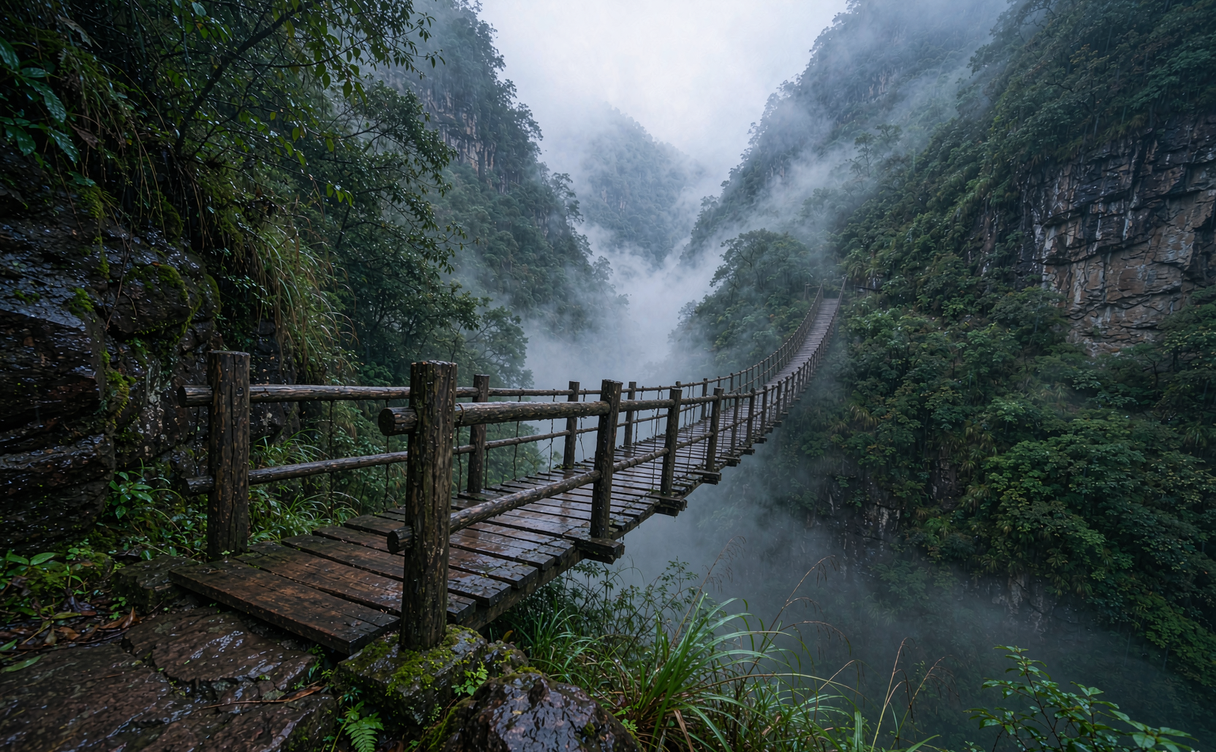
The marked forest loop is about 2.5 km and takes 60–90 minutes at a relaxed pace. Wooden suspension bridges cross the gullies, and the canopy walk is the photo spot most people remember. Bring a polarizer if you care about photography; the mist washes out contrast fast. Mornings after rain are best, but the light flattens by 9 a.m., so I push clients to be at the rail by first light.
Ailao Rice Terraces and the Tea-Horse Footprints
Lower down the western slope, the Ailao rice terraces step down the hills in tight bands, flooded and mirror-like from May to July and gold from September to October. They are smaller and quieter than the headline Hani terraces to the south, which is exactly why I like them for slow travelers. If you want to compare terrace regions, our Jiabang terraces guide covers a very different Guizhou landscape, and the Dali Erhai Lake guide helps if you are looping Yunnan by car.
Old tea-horse road stone paving still surfaces along a few trail sections. I point it out to clients because it explains why these ridges were never isolated — salt, tea and horses moved along them for centuries, and several villages still keep the courtyard inns those traders used. You can taste the local dark tea in a village house for ¥20–40 CNY a pot, which is a far better buy than the airport tins.
Tickets, Opening Hours and Where to Sleep
Entrance to the Mopan Shan section is ¥80–100 CNY in peak season (May–October) and ¥60–80 CNY off-season; the shuttle bus inside the park is ¥30–40 CNY. Opening hours are 8:00 a.m. to 6:00 p.m., with the gate opening earlier (around 6:30 a.m.) for cloud-watchers in autumn. Buy tickets at the visitor center; there is no online foreign-card system I trust, so carry cash or a Chinese payment app as backup.
Accommodation is basic but improving. A clean guesthouse near the gate runs ¥180–320 CNY per night for a double; mid-range mountain lodges with heating run ¥400–700 CNY. I book the lodge in winter because the nights drop near freezing and the thin guesthouses cut heat after 10 p.m. For a wider Yunnan loop including this region, see our Shangri-La Yunnan travel guide and the Stone Forest guide.
Meals on the mountain are simple: terrace rice, river fish, wild greens and cured pork. A filling dinner for two runs ¥80–140 CNY. There are no Western restaurants, and that is part of the point.
Safety: Stay in the Open Scenic Zones
This is the part I never skip. Ailao Mountain is a large, real mountain range with deep gorges, changeable weather, and patches of undeveloped forest. In recent years untrained visitors who left the marked areas have gotten lost or worse. Follow these practical rules:
- Stay inside the designated scenic area and on marked trails at all times. Do not enter undeveloped forest, closed zones, or “no-entry” gullies.
- Hire a licensed local guide for any route beyond the main boardwalk; guides at the visitor center are ¥150–200 CNY for a half day.
- Check weather before you go. Fog and afternoon storms roll in fast; turn back if visibility drops.
- Carry water, a whistle, and a charged phone. There is patchy signal away from the ridges.
- Never travel the back trails alone, and never at night.
These are practical limits, not scare tactics. The open scenic zones are more than enough for a memorable visit, and the rangers do patrol the main loops.
Best Time to Visit Ailao Mountain
The best time Ailao Mountain offers depends on what you want. November to February gives the clearest sea of clouds and cool, dry hiking, though nights are cold. May to October is green and lush with full terraces and active forests, but afternoons bring rain. I send most first-timers in late October or November, when the rice is harvested, the air is crisp, and the cloud odds peak.
Sample 2-Day Itinerary
Day 1: Drive Ailao to Kunming in the morning (3.5 h), arrive Xinping, transfer to the mountain lodge. Afternoon forest boardwalk and tea-horse paving. Dinner at the lodge.
Day 2: Wake at 5:45 a.m., walk to the cloud viewpoint (20 min), photograph the Ailao Mountain sea of clouds, then descend to the Ailao rice terraces for late-morning light. Lunch in the village, drive back to Kunming by mid-afternoon.
Frequently Asked Questions
Do I need a guide for Ailao Mountain Yunnan? For the main boardwalk, no. For any side trail or terrace descent, hire a licensed guide at the gate.
How far is Ailao to Kunming and is it doable in a day? About 180 km and 3.5 hours each way. Yes, a long day trip works if you leave by 7 a.m.
Is the sea of clouds guaranteed? No. You need a clear, cool night followed by a still morning. Autumn gives the best odds.
Can I see the terraces and the clouds in one trip? Yes, with an overnight. The terraces are lower and sunlit after the morning cloud show.
What should I pack? Layers, a rain shell, sturdy shoes, and a headlamp if you aim for sunrise.