

The first time we sent a client to a Chinese seafood market, he came back convinced he had been scammed — the crab he picked from the tank weighed different on the restaurant scale than it did in the market, and the bill was twice what he expected. That story is why this China seafood dining guide exists. We’ve watched travellers overpay, under-order, and miss the best shellfish of their lives because nobody explained the system. Order seafood by weight in China and you unlock some of the freshest, cheapest fine dining on earth — but only if you know the rules.
How the System Works: Market, Then Kitchen
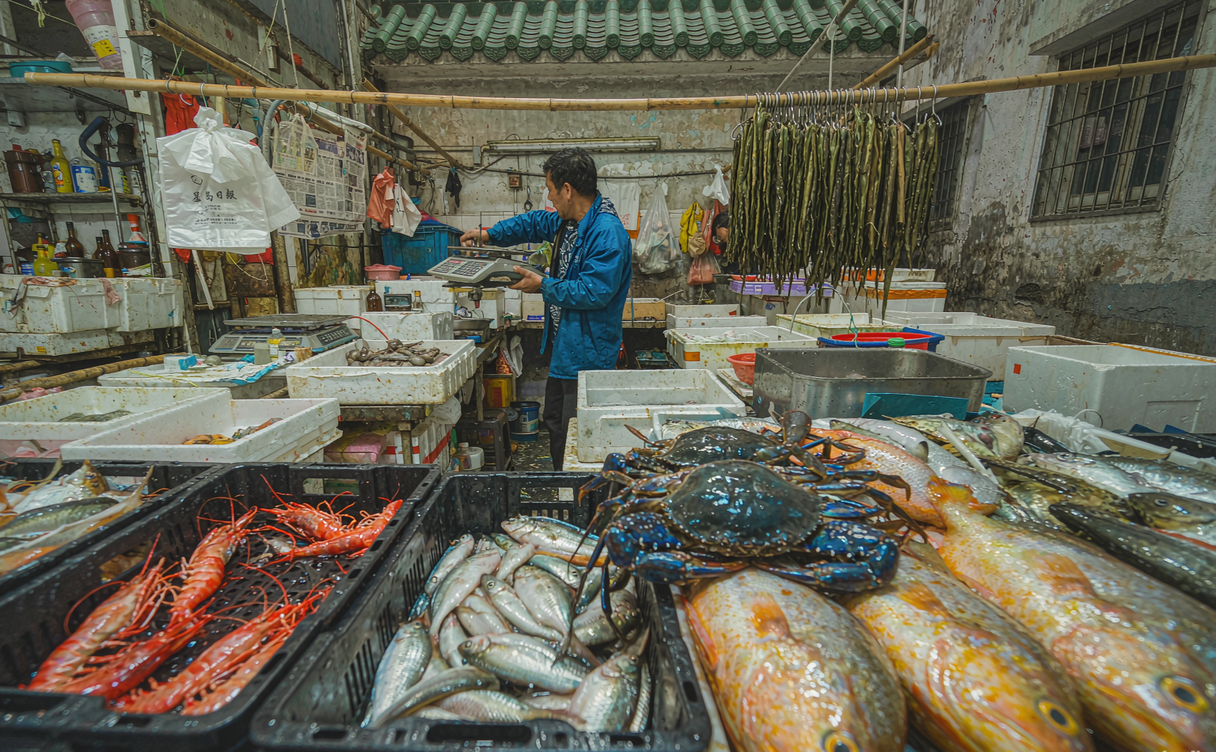
In almost every coastal city the pattern is the same. You walk into a wet market or the ground floor of a seafood restaurant, where live tanks hold swimming crab, prawns, clams, grouper and geoduck. You point, the vendor weighs it on a digital scale showing 斤 (jīn, = 500 g) and the price per jīn, you agree, and then you carry the bag upstairs to the kitchen — or the market cook-for-you counter — where they steam, stir-fry or braise it for a small processing fee (¥10–30 / US$1.40–4.20 per dish).
This “China seafood market cook for you” model is the best value going: you pay wholesale market price for the catch and only a modest fee for cooking. In Qingdao seafood guide we walk through the exact market-to-table walk at营口路; Sanya seafood guide covers the same loop on Hainan island with a tropical species list.
Best Coastal Cities for Seafood in China
Not all coasts are equal. Our clients’ favourites:
- Qingdao (Shandong). Cold Yellow Sea water, fat swimming crab (梭子蟹) in autumn, clams by the bucket, and Tsingtao beer on tap. Best Sept–Nov.
- Ningbo (Zhejiang). The connoisseur’s choice — yellow croaker (黄鱼), mud snails, razor clam, and the famous Ningbo preserved crab. See our Ningbo seafood food guide for the dish list.
- Xiamen (Fujian). Minnan style: steamed grouper, oyster omelette (海蛎煎), and broth-cooked clams. Our Xiamen seafood guide maps the pier restaurants.
- Sanya (Hainan). Year-round warm-water species, lobster, parrotfish, and a strong cook-for-you market culture.
- Dalian, Zhoushan, Beihai. Strong regional scenes; Dalian for cold-water scallops, Zhoushan for the nation’s biggest fishing port.
How to Order Seafood by Weight in China
The mechanics trip up almost everyone. Follow this:
1. Know the unit. Price is per 斤 (jīn) = 500 g. If the sign says ¥40/斤, a 1 kg fish costs ¥80 (US$11). Some southern markets quote per 500 g as “斤” too; Hainan sometimes uses “公斤” (kg) — check the label.
2. Weigh in front of you. Insist the tank vendor weighs with the fish in a net, water drained, on a scale you can see. A honest vendor lifts the catch, lets it drip, then weighs.
3. Confirm the cooking fee before agreeing. Restaurants charge ¥10–30 per dish to cook market-bought seafood. Ask “加工费多少” (processing fee how much).
4. Get the total in writing. Many markets now print a slip with weight and price. Keep it.
5. Match species to method. Delicate fish → steam. Crab/clams → steamed with garlic. Prawns → blanched or salt-and-pepper. Octopus → braised.
We’ve found the single biggest saving comes from buying at the public market and paying a nearby restaurant to cook, rather than ordering from the restaurant’s own (mark-up) tanks.
Avoiding Seafood Overcharging in China
Scams exist; they are avoidable. The common ones:
- The swapped bag. Your live crab goes into the kitchen, a smaller dead one comes out. Solution: tie a string on your chosen crab, or photograph it.
- The “beer fee” / “tea fee”. Some venues add a per-person seating charge. Ask “有服务费吗” (service fee?).
- The elastic scale. Use your phone’s calculator and convert jīn to kg on the spot.
- The tourist menu. Restaurants near scenic piers often have a separate English menu with 50–100% markups. Walk two blocks inland.
Our rule of thumb for avoiding these overcharging problems: eat where locals queue, weigh in front of you, and never hand over seafood without a printed weight. For a guided version, our China food tour guide builds market visits into a wider eating route.
Seafood Season Calendar China
Timing decides quality and price. Roughly, from north to south:
| Month | Peak species | Where |
|—|—|—|
| Mar–May | Razor clam, scallop, yellow croaker | Ningbo, Zhoushan |
| Jun–Aug | Squid, mackerel, warm-water prawns | Dalian, Qingdao (summer) |
| Sep–Nov | Swimming crab (fattest), grouper, oysters | Qingdao, Xiamen, Ningbo |
| Dec–Feb | Hairy crab (Nov–Dec peak), cold-water scallop | Yangtze delta, Dalian |
The autumn window, especially October and November, is when crab is heavy with roe and prices dip after the summer tourist surge. The Yangtze hairy crab deserves its own note — see our China hairy crab guide for the November peak and how to eat it properly.
Signature Dishes to Know
- Steamed swimming crab (清蒸梭子蟹). Minimal, sweet, dipped in vinegar-ginger.
- Garlic vermicelli scallops (蒜蓉粉丝扇贝). The Cantonese-Fujian staple, ¥8–15 each.
- Oyster omelette (海蛎煎). Xiamen street classic, ¥20–35.
- Salt-and-pepper prawns (椒盐虾). Whole prawns, crisp, ¥60–90 per jīn cooked.
- Braised grouper (红烧石斑). Celebration fish, ¥80–160 per fish.
- Clam broth (花蛤汤). Light, ¥25–45.
Etiquette and Practical Notes
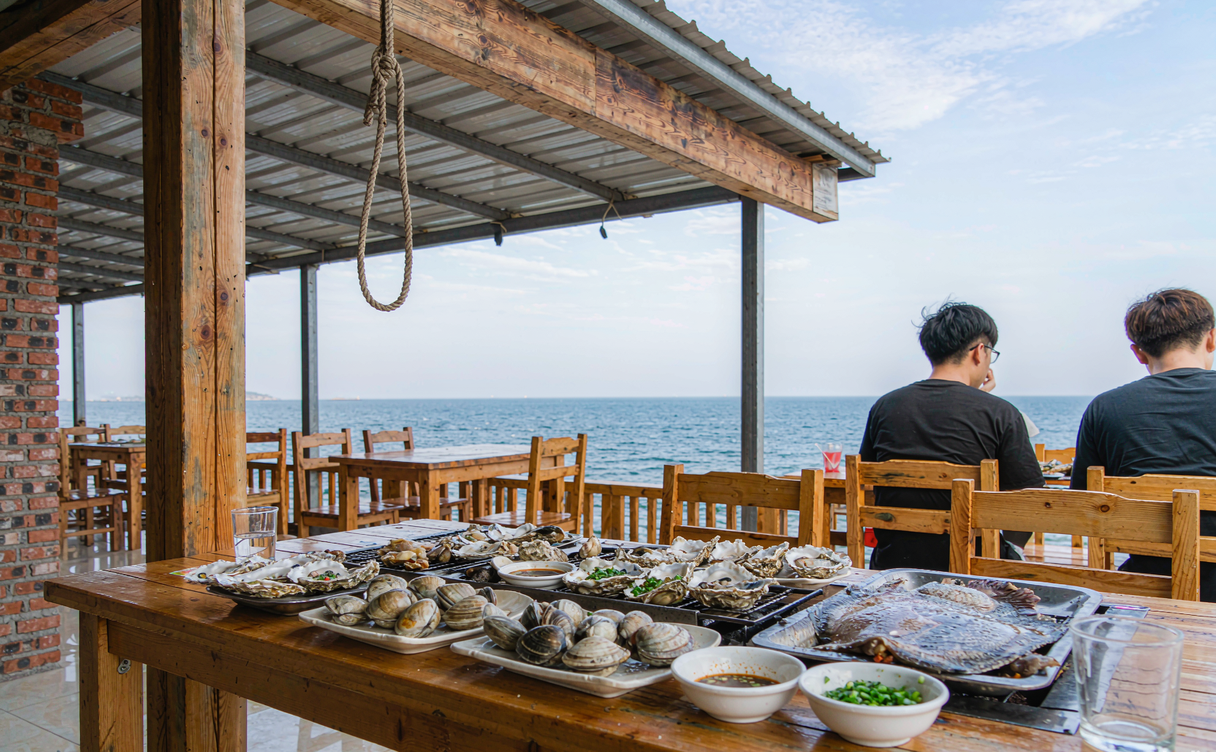
- Chopsticks for shellfish. Crackers and picks are provided for crab; use them, don’t bite the shell.
- Sharing. Seafood is ordered for the table, not per person. A party of two orders 2–3 dishes plus rice.
- Freshness test. Live tanks should be bubbling; gills red, eyes clear. If the tank is murky, leave.
- Payment. Market vendors often take WeChat/Alipay only. Carry ¥200 cash as backup.
- Allergies. Chinese kitchens use plenty of shellfish stock; tell them clearly if you react.
Sample Evening: A Qingdao Market Dinner
- 17:30 Arrive at 营口路 market, pick 2 swimming crabs (¥70/jīn, ~1 kg total ¥140 / US$20)
- 17:50 Pay a nearby restaurant ¥25 (US$3.50) to steam them, add garlic scallops ¥30
- 18:20 Two Tsingtao drafts ¥16 (US$2.20)
- Total ~¥211 (US$30) for two, far below any hotel seafood buffet.
Practical Tips
- Go early. Best stock is 16:00–18:00; by 20:00 the prime crab is gone.
- Learn three phrases. 多少钱一斤 (how much per jīn), 加工费 (processing fee), 不要换 (don’t swap the bag).
- Weigh yourself. A pocket scale or phone calculator ends disputes.
- Inland option. Even non-coastal cities have “seafood self-service” markets now; quality is decent but prices higher.
- Background. The regional breadth of Chinese seafood cookery is well summarized at Wikipedia’s Chinese cuisine page, a useful primer before you travel.
FAQ
Is Chinese seafood safe to eat raw?
Most is cooked. Raw options (geoduck, oyster) exist but carry risk for unacclimated stomachs — we advise visitors to steam or blanch everything on a first trip.
How much does a seafood dinner cost per person?
At a market-cook model, ¥80–150 (US$11–21) per person for a feast. Restaurant-tank dining runs ¥150–300 (US$21–42).
Which city is cheapest?
Coastal secondary cities like Zhoushan and Beihai beat Sanya and Qingdao’s tourist strips. Buying at public markets anywhere is the key saving.
Can I trust the scale?
Usually yes, but always watch the drain and the reading. Printed slips and a phone calculator remove doubt.
When is crab best?
Swimming crab peaks Sept–Nov; Yangtze hairy crab Nov–Dec. Avoid the post-holiday lull when stock thins.
Written by Karl, China Travel Places — updated August 2026.