

Most visitors treat Tianjin as a 35-minute stopover between Beijing and somewhere else, and that habit is exactly why the best hotels in Tianjin are some of the sharpest value in northern China. For what a mid-range business room costs near Beijing’s Wangfujing, our clients here get a corner room in a 1920s British-concession mansion, or a high floor over the Haihe River with the illuminated Tianjin Eye wheel spinning below the window. We’ve booked this city for travellers for years, usually as a two-night breather before or after Beijing, and the pattern holds: rooms run 25–40% cheaper than the capital, and the centre is small enough that one good choice puts everything within a ¥15 taxi ride.
How Tianjin’s Hotel Map Works
Tianjin is huge on paper (13 million people, over 11,000 km²) but the part you care about is a compact patch of Heping and Hexi districts along a bend of the Haihe. Inside that patch sit four distinct lodging zones: the villa streets of the Five Great Avenues, the banking district around Jiefang North Road, the river itself, and the shopping core at Binjiang Dao. Everything else — the Binhai New Area, the exhibition centres, the airport belt — is a satellite you only book for a reason.
Metro Line 1 runs the spine (Xiaobailou, Yingkou Dao, Anshan Dao — the Wudadao stations), Line 3 links Tianjin Station to Tianjin South Railway Station, Line 2 runs out to Binhai International Airport, and Line 6 loops the west. Single fares are ¥2–8. Taxis start at ¥9 and a cross-centre hop rarely tops ¥20 (US$2.80).
Five Great Avenues (Wudadao): The Character Choice
This is where we put anyone who wants Tianjin to feel like Tianjin. The Five Great Avenues is roughly two square kilometres of 1920s–30s concession housing — Machang Dao, Munan Dao, Dali Dao, Changde Dao, Chengdu Dao — plane trees, brick garden walls, and about 2,000 surviving villas. Tianjin Five Great Avenues boutique hotels are mostly conversions of those villas: 15 to 40 rooms, heavy staircases, courtyards, sometimes a former banker’s study turned breakfast room.
- Budget: ¥170–280 (US$24–39). Ji Hotel, Atour and Orange properties on the edges near Anshan Dao metro. Small rooms, reliable heating, English on the app.
- Mid-range: ¥350–600 (US$49–84). Villa boutiques and design conversions on Munan Dao and Changde Dao. Ask specifically for a garden-facing room; street-facing rooms on Machang Dao catch tour-cart noise until about 21:00.
- Splurge: ¥800–1,600 (US$112–224). The heritage grande dames and international five-stars a short walk north, plus a couple of restored mansion hotels with 6–10 suites.
Who it suits: repeat China visitors, couples, photographers, anyone who hates towers. Who it does not: travellers with early trains — you are 15–20 minutes from Tianjin Station in traffic. Before you book, read the architecture so the streets mean something: our Five Great Avenues walking guide maps which blocks are worth the detour.

Jiefang North Road and the Italian Style Town
Jiefang North Road was the concession banking strip and still looks it: granite columns, former Citibank and HSBC buildings, and the city’s most famous historic hotel, opened in 1863 and now carrying a small in-house museum of its own guest list. Rooms here run ¥750–1,400 (US$105–196), and the international luxury flags a block away sit at ¥900–1,900.
Across the river, the Italian Style Town (Yishi Fengqingqu) is a restored 1900s Italian concession of cafés and low pastel buildings, ten minutes’ walk from Tianjin Station. Mid-range hotels here cost ¥300–500 and put you next to both the station and the nightlife, which is a rare combination. The area gets loud on Friday and Saturday — request an inner courtyard room.
Haihe Riverfront: Paying for the View
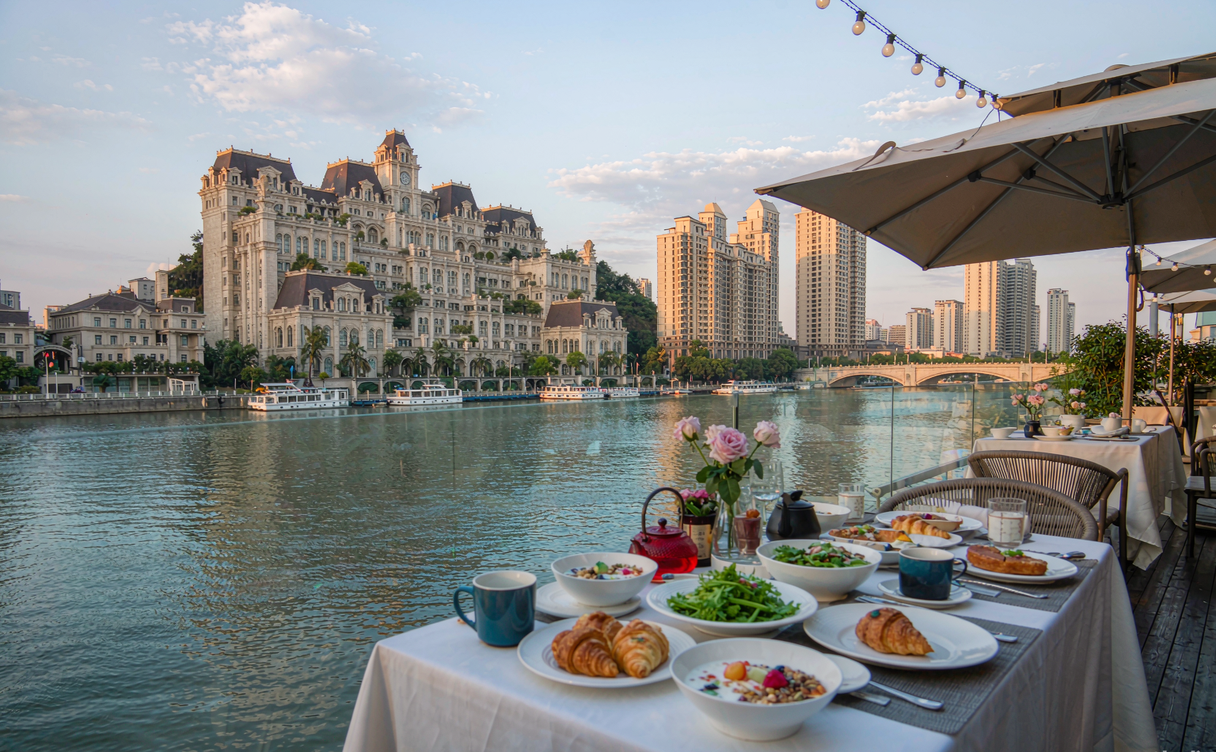
Tianjin riverside hotel views are the one splurge in this city we actively push. The Haihe curves through the centre with lit bridges roughly every 600 metres, and the Tianjin Eye ferris wheel is built into the Yongle Bridge, so a north-facing high floor gives you a moving light show from about 18:30 to 21:30.
- Mid-range: ¥380–650. Domestic four-stars in Hedong and Hexi with partial river views. Confirm “河景房” (river-view room) on the booking, not just “high floor”.
- Splurge: ¥900–1,700. Riverbank five-stars with floor-to-ceiling glass, club lounges and 20-metre pools. Rack rates fall hard midweek — we routinely see Tuesday nights at 60% of the Saturday price.
A practical warning: several river hotels sit on the Hedong bank, which looks close on a map but means crossing a bridge for dinner. If you want to walk to food, stay on the Heping side.
Tianjin Station and West Station: Rail-First Bases
If your trip is built around trains, ignore charm and book proximity. Tianjin hotels near railway station options cluster in three places:
| Station | Serves | Hotel zone | Typical rate |
|—|—|—|—|
| Tianjin Station | C-trains to Beijing South (33–40 min, ¥54.5 second class) | Italian Style Town, Hai He Dong Lu | ¥250–550 |
| Tianjin West | Beijing–Shanghai G-trains, long-distance | Xibei Jiao, Ziya He Dao | ¥180–420 |
| Tianjin South | Beijing–Shanghai high-speed, some Jinan/Nanjing | Metro Line 3 terminus, 20 km out | ¥160–320 |
Tianjin South is the trap. It is far from the centre and the surrounding hotels are business boxes serving nobody in particular — only book there for a pre-dawn departure. For Tianjin hotels for Beijing day trip logistics, anywhere within two Line 3 stops of Tianjin Station works: C-trains leave every 10–20 minutes from roughly 06:20 to 22:30, and you can be at Beijing South before 09:00 and back for a late dinner.
Nanshi, Ancient Culture Street and Binjiang Dao
The old-city side of Tianjin — Ancient Culture Street, the Drum Tower, the Nanshi food street — has fewer good hotels than it should. What exists is mid-range domestic (¥260–480) plus a handful of new courtyard-style properties. Binjiang Dao, the pedestrian shopping strip, is a solid compromise for first-timers: chain hotels at ¥220–400, Line 1 and Line 3 both within walking distance, and food at street level. That is our standard answer for where to stay in Tianjin first time on a normal budget.
Binhai New Area: Only If You Have a Reason
Binhai is 40–60 km east: the airport, the cruise home port at Dongjiang, the exhibition centres, and the much-photographed Binhai Library. Hotels are new and cheap for their class (¥300–700 for four- and five-star), but you are an hour from the concession streets. Book here only for a cruise embarkation, a trade fair, or a 06:00 flight. Airport-adjacent hotels with free shuttles run ¥280–480.
Seasons and What They Do to Prices
April–May and September–October are the good months: 15–26°C, dry, and the villa streets look their best. Rates rise 20–30% and the 1–5 May and 1–7 October holidays sell out the boutiques two to three weeks ahead.
June–August is hot and humid (28–35°C) with July–August rain, but it is also when Beijing families flood Binhai’s beaches, so plan around weekends rather than weekdays.
November–March is the bargain window. It drops to −8°C in January, central heating runs city-wide from mid-November to mid-March, and five-star river rooms fall to ¥600–800. Confirm the hotel is on municipal heating rather than room air-conditioning alone.
Year-round rule: Tianjin is a weekend escape for Beijing residents. Friday and Saturday cost 30–50% more than Monday to Thursday. Shifting two nights midweek is the single biggest saving available here.
Booking Tips for Foreign Visitors
- Licence to host foreigners. Most three-star-and-up properties in Heping, Hexi and Hedong are fine; small lane guesthouses in the old city sometimes are not. Our China hotel booking guide for foreigners explains how to filter for this before you pay.
- Check-in paperwork. Passport for every guest, and the front desk files a registration form the same evening — the process is covered in our hotel registration guide.
- Pay on arrival where possible. Domestic platforms often price cheaper than international ones for the same room; “pay at hotel” rates let you compare on the spot.
- Villa hotels have no lifts. Concession mansions are two or three storeys of narrow stairs. Ask for ground floor if that matters.
- Deposits. Expect ¥200–500 held on a card, refunded in 3–10 working days.
Sample Two-Night Plan
- Night 1 and 2: one hotel, Five Great Avenues or Binjiang Dao. Do not split.
- Day 1: arrive from Beijing mid-morning, walk Jiefang North Road and the Italian Style Town, cross to Ancient Culture Street, evening river cruise (¥80–120).
- Day 2: Wudadao on foot or by rental bike (¥1.5/30 min), lunch at Nanshi food street, Porcelain House (¥50), sunset on the Tianjin Eye (¥70).
- Morning 3: early C-train onward.
Practical Tips
- Bring a plug adaptor and a power bank; villa conversions often have two sockets per room.
- Ride-hailing is easier than taxis at 22:00 in the villa streets, where empty cabs are scarce.
- Concession history context is worth ten minutes before you walk: the Wikipedia entry on the Tianjin concessions explains which country built which street.
- Winter air can be poor in December and January; a hotel with in-room purifiers is a genuine upgrade.
FAQ
Is it better to stay in Tianjin or day-trip from Beijing?
Stay one night at least. Tianjin’s best hours are after dark — lit bridges, the wheel, the food streets — and hotel rates are meaningfully lower than Beijing’s. Comparing the two markets? See our best hotels in Beijing roundup.
How much should I budget per night?
¥180–280 for a clean chain room, ¥350–600 for a boutique villa or good four-star, ¥900–1,700 for river-view or heritage five-star. Add 30–50% for Friday and Saturday.
Do Tianjin hotels have English-speaking staff?
Four-stars and up usually do. Chains rely on translation apps, which works fine. Save your hotel’s Chinese name and address to show a driver.
Which area is quietest?
The inner blocks of the Five Great Avenues, especially around Dali Dao and Munan Dao. Avoid rooms facing the Italian Style Town’s bar streets on weekends.
Are there hostels?
A handful, ¥70–120 per dorm bed, mostly near Binjiang Dao. Confirm foreign-guest registration before booking, as some only accept domestic ID.
Written by Karl, China Travel Places — updated August 2026.