

Most foreign travelers who plan a trip to the Northeast have heard of Harbin or Changchun, but far fewer have put the small city of Siping on their radar. That is a shame, because a Siping travel guide should begin with a simple truth: this unassuming city in southern Jilin Province sits at the exact crossroads of modern Chinese history and the slow, agricultural rhythm of the northern plains. We have sent several readers here as a relaxed day-and-a-half stop between Changchun and Shenyang, and almost all of them came back surprised by how much there was to absorb.
Siping (四平) lies roughly 110 kilometers south of Changchun and about 230 kilometers north of Shenyang, squarely on the traditional gateway between the Northeast’s central plain and the passes heading south. Its name literally means “four flat things,” a folk reference to the level ground where four trade routes once met. The city today is a mid-sized provincial hub of around 1.7 million people spread across its districts, and it wears its history openly. If you want a China that is not polished for tourists, where the most moving sites are trenches, memorial halls, and quiet Manchu fortress towns, then this is a rewarding place to slow down.
How to Get to Siping
The easiest way to reach Siping is by train, and this is where a good Siping travel guide needs to be practical. The city is served by two stations: Siping Station (四平站) in the center for regular services and Siping East Station (四平东站) on the Harbin–Dalian high-speed line. From Changchun, high-speed trains take about 35 to 50 minutes and cost between 35 and 55 RMB for a second-class seat, depending on whether you catch a G- or D-class service. From Shenyang the ride is roughly 50 to 70 minutes and runs 55 to 80 RMB. If you are flying in, the nearest major airport is Changchun Longjia International (CGQ), which is itself a stop on the high-speed line, so you can land, take the airport express train toward the city, and transfer at Changchun to Siping without ever leaving the rail system.
We once arranged a connection for a reader who arrived at Longjia late at night: they slept at an airport hotel, took the 07:10 G-train to Changchun, and were standing in front of the Siping Campaign Memorial by 09:30. The whole transfer was under 90 RMB and completely stress-free. For detailed ticketing, seat classes, and how to book with a foreign passport, our China high-speed train guide for foreigners walks through the entire process step by step. If you would rather build Siping into a bigger Northeast loop, our Changchun travel guide explains how to use the provincial capital as your base.
Best Time to Visit Siping
The best time to visit Siping is late spring through early autumn, specifically May to October. Winters here are long, dry, and brutally cold, with January averages around minus 15°C and wind that cuts across the open plain. Summer, by contrast, is warm and green; July highs sit near 28°C, and the surrounding cornfields stretch to the horizon in a way that feels almost oceanic. We generally steer first-timers toward September, when the harvest is ripening, the mosquitoes have thinned out, and the light over the battlefields is soft and photographic.
A note on seasons: because Siping is flat and exposed, spring can bring dusty winds in April, and the fall color here is subtle compared with the mountains further east. If your main goal is the Harbin Ice Festival, you can still pass through Siping in winter, but dress for serious cold and keep outdoor stops short.
Things to Do in Siping
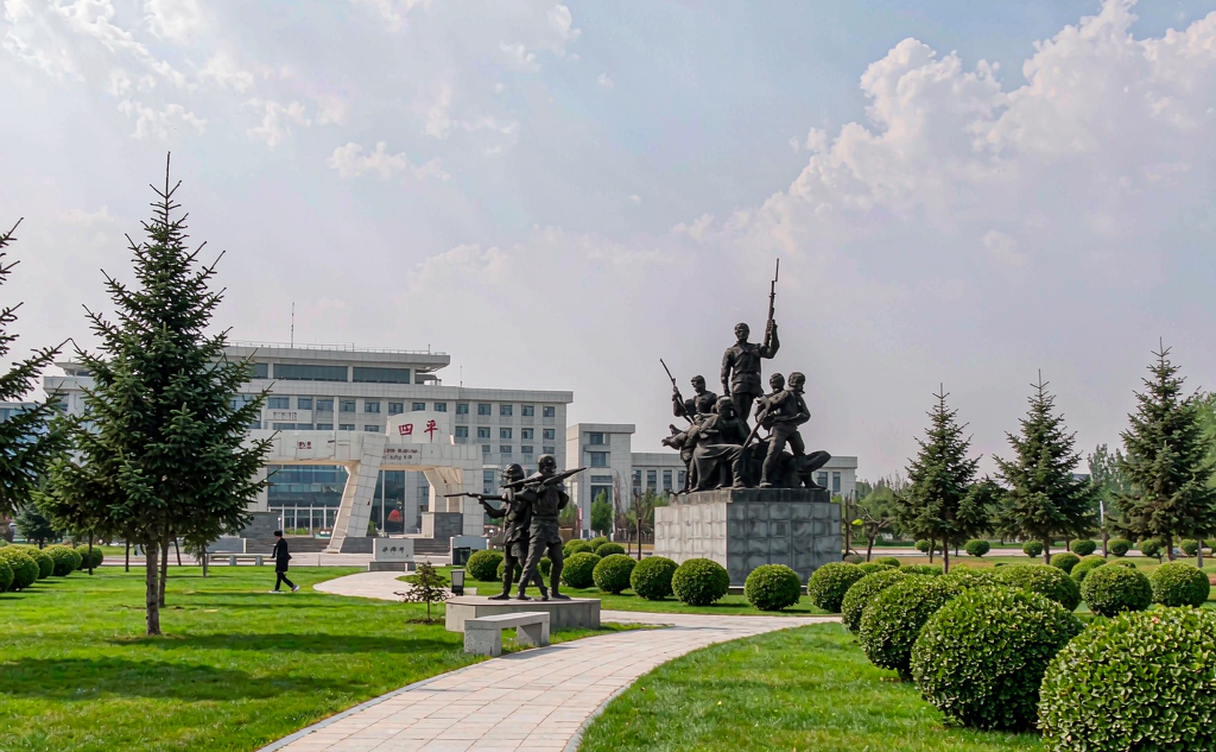
The single most important stop is the Siping Campaign Memorial (四平战役纪念馆), a large museum dedicated to the four battles fought over the city between 1946 and 1948 during the Chinese Civil War. The exhibits are bilingual in places, with maps, uniforms, weapons, and a sober diorama of urban street fighting. Allow two to three hours. The adjacent Martyrs’ Cemetery and the preserved trench lines on nearby hills let you walk the actual ground where the fighting happened; wear sturdy shoes, because the paths are uneven.
The second must-see is Yehe Nara City (叶赫那拉城), about 30 kilometers southeast of the urban core. This reconstructed Manchu fortress town sits on the site associated with the Yehe tribe, and it is tied to the birthplaces of two famous Qing-era empresses. The wooden watchtowers, the clan shrine, and the hillside layout give you a tangible sense of Jurchen and Manchu fortress architecture that you will not find in the concrete center of Siping itself. A taxi or Didi from the city runs about 60 to 90 RMB one way; we recommend going early and hiring the on-site guide for 50 RMB to make sense of the clan history.
Beyond those headline sites, things to do in Siping include the Pedestrian Street (步行街) around Hero Square for local snacks, the Siping Museum for regional folk artifacts, and short trips out to the rural reservoirs where locals fish and picnic in summer. The food scene leans hearty and northern: try the stewed fish with corn cakes, the cold noodle dishes in summer, and the roasted sweet potatoes sold from carts near the station in winter. A solid sit-down meal for two rarely exceeds 90 RMB, and street snacks run 5 to 15 RMB each.
A Suggested Siping Itinerary
For a realistic Siping itinerary, plan one full day plus one relaxed morning. Day one: arrive by late morning, drop bags at your hotel near Siping Station, have lunch, then spend the afternoon at the Siping Campaign Memorial and the Martyrs’ Cemetery. Day two: hire a car or Didi to Yehe Nara City for the morning (three to four hours including travel), return for a late lunch on the Pedestrian Street, and catch a mid-afternoon train onward to Changchun or Shenyang. If you have a third day, add the Siping Museum and a half-day countryside drive to one of the small reservoirs.
We once arranged a custom two-night version for a history teacher who wanted to read every plaque: we built in a quiet evening walk around Hero Square, a dawn visit to the cemetery before the crowds, and a longer Yehe guided tour. He later told us those slower pacing choices made the trip, not the famous stops. That is the kind of tailored detail our China travel guide for first-timers encourages you to build into any Northeast plan.
Where to Stay and What It Costs
Siping is inexpensive. A clean, central business hotel near the station runs 180 to 320 RMB per night, while a recognizable chain like Jinjiang or Home Inn sits around 220 to 380 RMB. Book through the usual Chinese apps or your hotel’s own site; walk-in rates are often negotiable in the low season. Taxis start at 6 RMB, and a cross-town ride is rarely more than 25 RMB. The city is compact enough that you can walk most central sights in 20 to 30 minutes.
For travelers who want a broader picture of the region, our Jilin City travel guide covers the river city to the east, and our roundup of best things to do in China helps you decide whether the Northeast deserves a slot in your overall itinerary.
Practical Notes and a Bit of Background
Siping’s strategic weight comes from geography. Whoever held the city controlled the rail line linking Changchun, Shenyang, and the coal and steel heartlands, which is exactly why four major campaigns converged here in just three years. The city you see today is largely a post-war rebuild, so the emotional core of a visit is the memorial culture rather than old streets. For a neutral historical overview of the city and its setting, the Wikipedia entry on Siping is a reasonable starting point, though nothing replaces the on-site museum for context.
Language can be a mild hurdle. English signage is limited outside the memorial, so download an offline translator and have your hotel write addresses in Chinese characters. Mobile payment via Alipay or WeChat is standard; carry a little cash for tiny snack carts.
Is Siping Worth It?
A Siping travel guide would be dishonest if it sold the city as a theme-park destination. It is not. What it offers is genuine, unvarnished history and a slice of ordinary northern Chinese life at a price that barely dents a travel budget. If you are the kind of traveler who values the story behind a place more than its selfie potential, Siping repays the detour many times over. Pair it with Changchun and a winter swing up to Harbin, and you get a Northeast route that is both efficient and memorably human.