

Most travellers who picture China’s deserts think of camel trains and endless flat sand. This Badain Jaran desert guide is here to change that picture entirely. Tucked into the Alxa Plateau of western Inner Mongolia, the Badain Jaran Desert holds some of the tallest stationary sand dunes on the planet, several of them higher than 400 metres. Between the ridgelines sit dozens of permanent freshwater and saltwater lakes, and on clear nights the sky turns into a bowl of stars so dense it feels close enough to touch. It is remote, a little harsh, and completely unforgettable.
Why Badain Jaran is different from other Chinese deserts
The thing that sets this place apart is the combination of scale and water. Elsewhere in China you might ride a dune slope and call it a day. Here the dunes are mountains of sand, and the famous Bilutu Peak (also called the “Holy Mountain”) rises roughly 500 metres from base to crest, making it one of the tallest dunes anywhere in the world. The local Mongolian name for the desert roughly translates to “mysterious lakes,” and that is the second surprise: more than 140 lakes are scattered through the sand sea, some sweet, some bitter, some ringed with reeds and birds.
That mix is why a proper Badain Jaran desert guide spends as much time talking about the lakes as the dunes. You climb a mega dune, sand squeaking under your boots, and look down to see a mirror of blue water cradled in a bowl of red-orange sand. It is a sight that does not compute until you stand there.
The tallest sand dunes you will ever climb
If heights make your legs shake, start with a smaller dune and work up. The big ones near the lake cluster take a real effort: sand gives way with every step, so 100 vertical metres can feel like a staircase that keeps moving. The payoff is the view. On a clear morning the dune shadows stretch for miles, and you can pick out individual lakes like dropped coins. The Badain Jaran tallest sand dunes are best photographed in the first two hours after sunrise, when the light rakes across the ripples and the colours go from pink to gold.
A practical note: there is no shade up there. Bring more water than you think you need, a hat, and sunglasses. The desert heat in summer is no joke, while winter brings a fierce dry cold. Either way, the climb rewards you.
Desert lakes of Inner Mongolia
The desert lakes of Inner Mongolia inside Badain Jaran fall into two families. The freshwater lakes, like Nuo’er Lake and Yinderitu, support reeds, waterbirds and the occasional grazing camel. The saltwater lakes, often tinted by algae and minerals, sit in dramatic crimson basins and smell faintly of the earth. Local drivers know which lakes are full and which have shrunk in a dry year, so let them pick the route.
One of the quiet joys of the place is simply sitting at a lake edge at dusk. The wind drops, the water goes still, and the dunes behind you turn purple. It is the kind of silence that city travellers have forgotten exists. If you plan to explore more quiet corners of the country, our China off-the-beaten-path guide has other destinations that deliver the same sense of discovery.
How to get to Badain Jaran
Getting here is half the adventure, and a Badain Jaran desert guide would be dishonest if it pretended otherwise. The desert sits far from any major airport. Most visitors first reach a gateway town and then transfer to a 4×4. The usual entry points are Alxa Right Banner, which has a small airport with limited flights, or the city of Zhangye and the town of Wuwei to the south. Our Wuwei travel guide breaks down train and bus connections that can get you close before you arrange a driver.
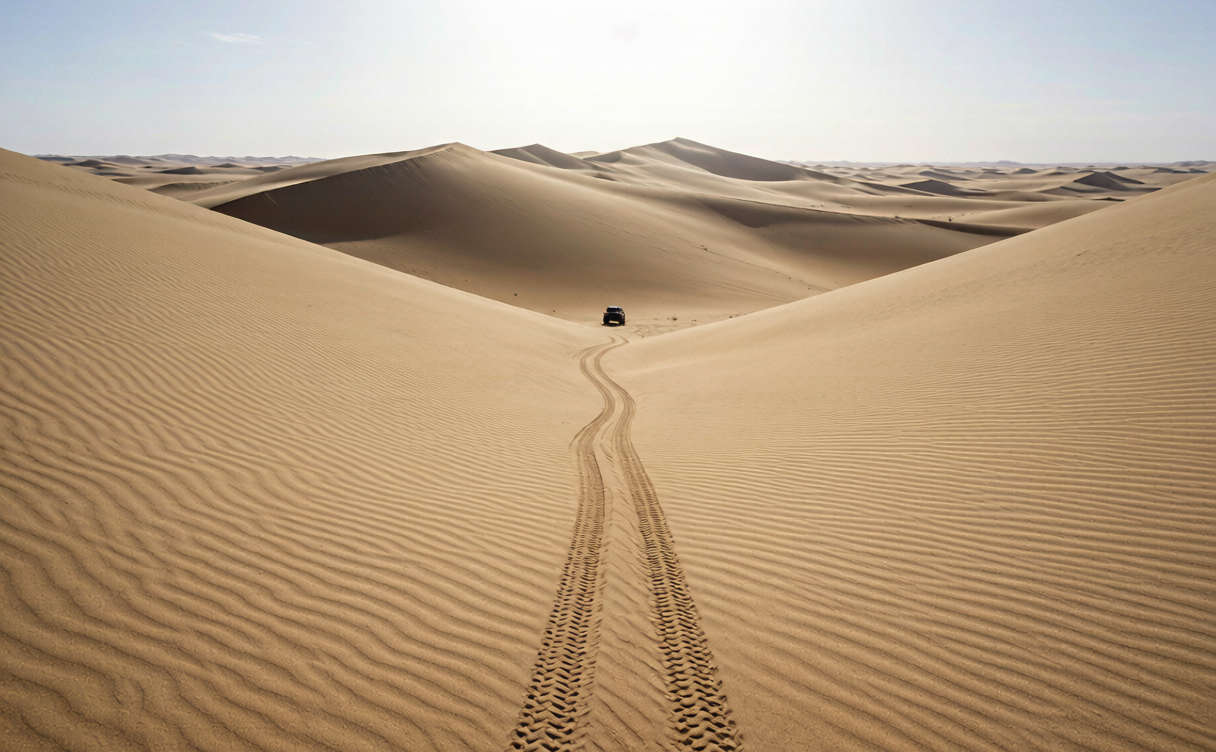
From the desert edge, private 4×4 vehicles are the only realistic way in. The sand tracks are not signed for outsiders, and you will sink a normal car within minutes. Book your jeep and driver through a guesthouse or a tour operator in Alxa Right Banner before you arrive; showing up and hoping to bargain on the spot rarely works in peak season.
Badain Jaran jeep tour cost
The question everyone asks is the Badain Jaran jeep tour cost. Prices shift with the season and fuel, but as a rough 2026 baseline, a shared 4×4 for a full day inside the desert runs around 600 to 900 RMB per person when four people split a vehicle, while a private car for two costs roughly 1,800 to 2,400 RMB for the day including the park entry fee. Multi-day trips with overnight camping cost more, naturally, because the operator carries fuel, food and water deep into the sand.
Always confirm what is included. Some quotes cover the scenic area ticket but not the mandatory shuttle or the lake protection fee. Ask for the total in writing before you hand over a deposit. Cheaper is not always better here: a driver who knows the hidden lakes and the safe sand crossings is worth the premium.
Badain Jaran camping overnight
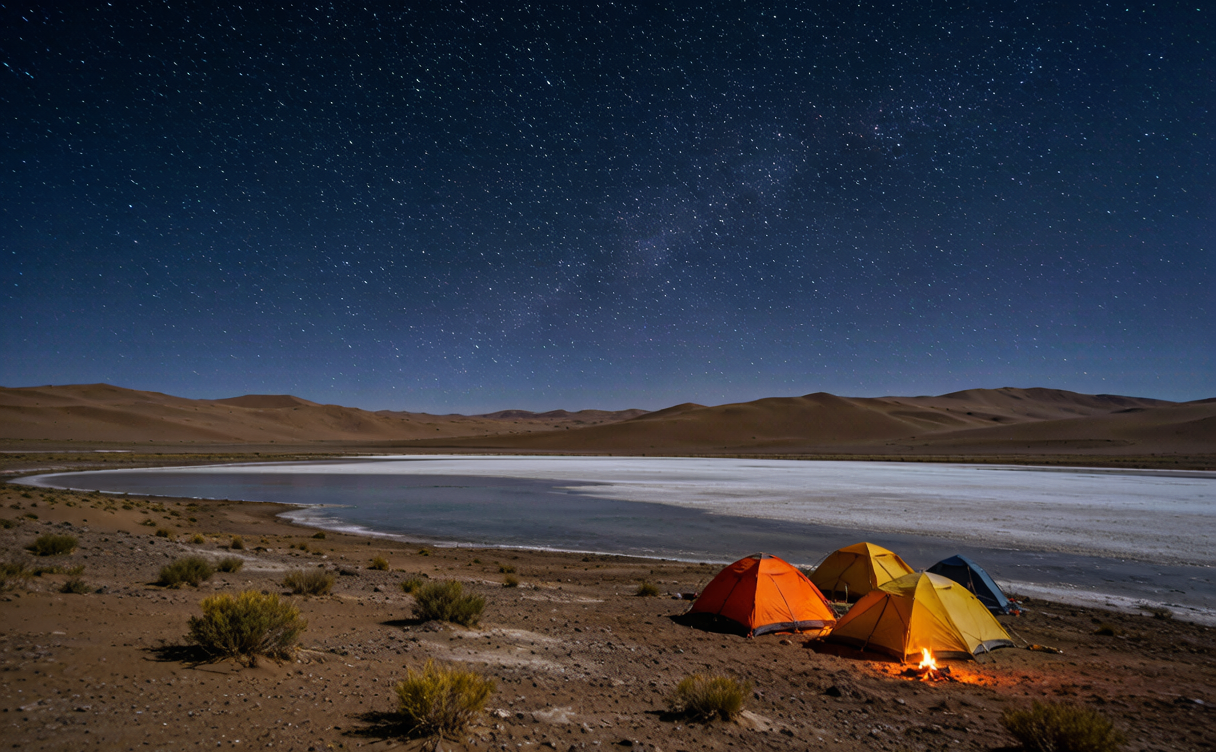
Sleeping in the desert is the reason many people make the trip. A Badain Jaran camping overnight near one of the lakes means dinner cooked over a small stove, a tent that glows from inside, and a sky so full of stars it casts a faint shadow on the sand. The best camp spots are run by local operators who pack out their trash and respect the lakes. Bring a warm layer even in summer; the temperature drops hard after midnight.
For planning your gear and campsite etiquette, our China glamping and camping guide covers what to pack for a night under the stars. And if dark skies are the draw, the China stargazing and dark sky guide lists other low-light destinations worth combining with this one.
When to visit and what to pack
Spring (May to early June) and autumn (September to October) are the sweet spots. Summer is brutally hot by day though the nights are fine, and winter is beautiful but bitter, with some access roads closed by cold. Wind is a constant, so a buff or scarf for your face is smart.
Pack light but smart: sturdy closed shoes (sand gets in everything), a refillable bottle, sunscreen, a headlamp, and a power bank because you will be taking a lot of photos. Cash in small bills helps at the few stalls near the gateway towns.
A note on the landscape’s status
The desert’s dune-and-lake system is recognised internationally for its value. It appears on the UNESCO World Heritage tentative list, which is worth knowing if you want the deeper geological story behind those towering ridges. You can read the official description on the UNESCO World Heritage Centre tentative list. It will not change how you experience the sand, but it adds a layer of appreciation.
How it compares with easier desert stops
If the logistics of Badain Jaran sound like too much for your trip, there are gentler introductions to China’s sand. The Shapotou desert guide covers a well-developed desert park with cable cars and river views, while the Ejina poplar forest guide shows the golden autumn trees that grow on the desert’s northern edge. Both are easier to reach and pair naturally with a longer Inner Mongolia route.
Final thoughts
A Badain Jaran desert guide can list dunes and lakes all day, but none of it prepares you for the moment you stand alone on a 400-metre ridge with a blue lake at your feet and no other human in sight. It is remote, it is a little demanding, and it is one of the few places left in China where the landscape still feels bigger than the map. Go prepared, go with a good driver, and leave the desert as quiet as you found it.