

Deep in the west of Inner Mongolia, China, the Ejina Poplar Forest turns the desert gold for barely three weeks a year. For photographers and autumn lovers it is one of the most breathtaking sights in the country — ancient euphrates poplars blazing yellow against red dunes and blue sky. This Ejina poplar forest guide covers the season dates, how to get to Ejina Banner, the best photography spots, where to stay, and how to fit it into a wider northwest China trip. Although remote, the groves reward the long journey more than almost any other autumn destination in the country.
What the Ejina poplar forest is
The Ejina Poplar Forest, or Ejina Qi, protects groves of Populus euphratica, a desert poplar that can live for a thousand years and survives on almost no water. In autumn the leaves turn a luminous gold, and where the trees stand in shallow desert water the reflection doubles the colour. It is a landscape of extremes: living gold, dead silver trunks, and the rippled dunes of the Badain Jaran desert behind.
Because the colour lasts only a short window, the Ejina poplar forest guide you read matters as much as the destination itself. Time it wrong and you arrive to bare branches; time it right and you join a brief, beautiful rush of visitors.
Ejina Qi golden populus season dates
The Ejina Qi golden populus season dates are tight. The leaves typically peak between early and late October, with the exact week moving a little each year with the weather. As a rule, the first week of October shows green-gold, the middle two weeks are the famous peak, and by early November the leaves are falling fast.
This is why the question of the best time to visit Ejina poplar forest has such a specific answer: plan for the middle two weeks of October. The Chinese National Day holiday at the start of the month brings the biggest crowds, so if you can travel in the second or third week you get better light, fewer people, and still-full colour.
How to get to Ejina Banner
Knowing how to get to Ejina Banner is the trickiest part of the trip, because the town is remote. The nearest airports with regular flights are in Jiayuguan and Jiuquan, and there are also trains and long-distance buses from Hohhot and Ordos in Inner Mongolia, China, though the journey is long. Many visitors join a guided tour that handles the final transfer into the reserve.
Once in Ejina Banner town, the poplar areas are a short drive north, and a dedicated sightseeing road links the main groves and the desert lake of Juyanhai. A private car or tour is the practical way to move between spots at the right light.
Ejina photography spots
The Ejina photography spots reward an early start and a patient sunset:
- Erdaoqiao to Sidaoqiao are the classic groves, with the oldest and most gnarled trees reflected in seasonal pools.
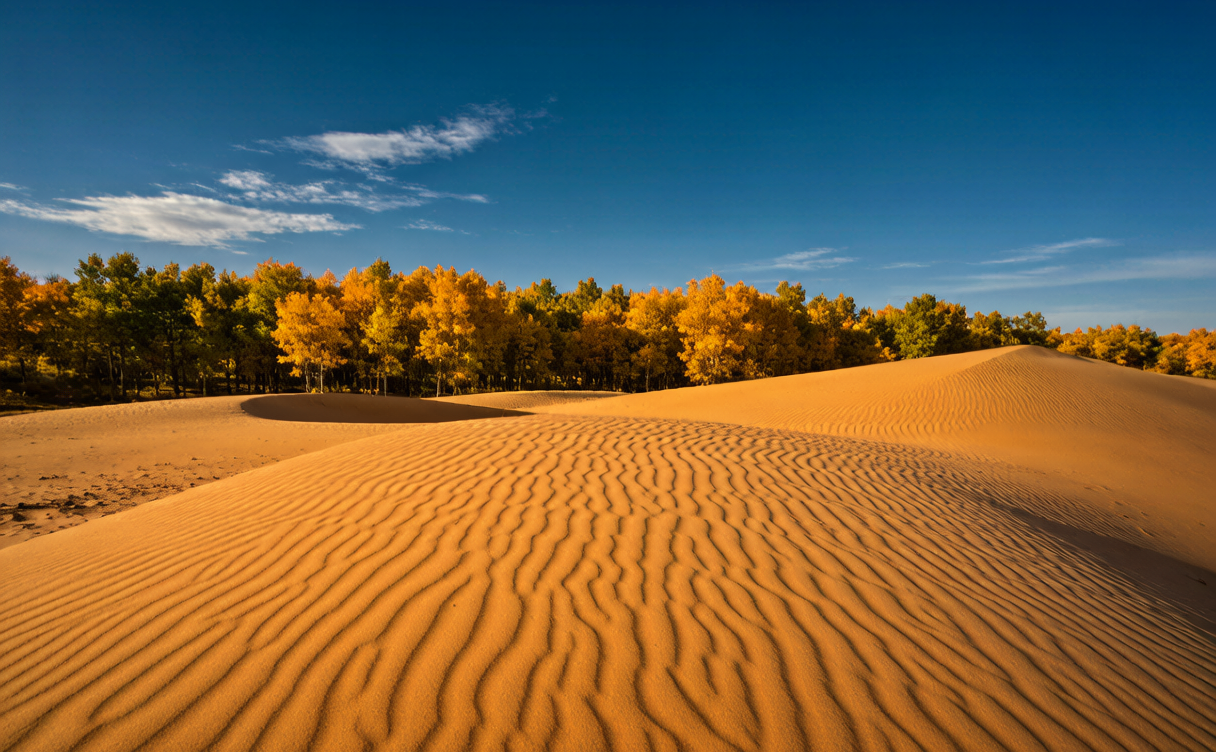
- Badanjilin dune edge gives you gold forest meeting orange sand under a deep blue sky.
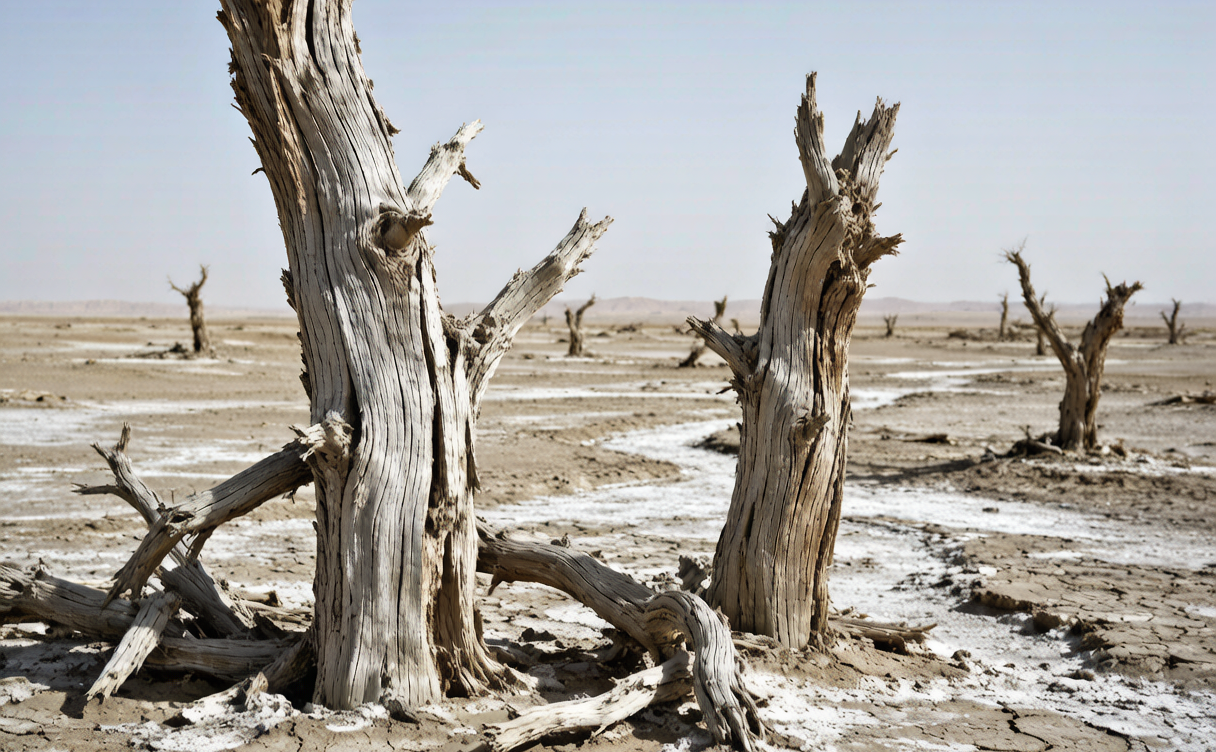
- The “death valley” of black poplars — fallen dead trunks silvered by wind — is a haunting contrast to the living gold and a favourite for moody shots.
- Juyanhai lake at sunrise, where the poplars frame a mirror of water and sky.
A best-autumn-destinations-in-China plan often pairs Ejina with the Gansu corridor for a full golden-season loop.
The history beneath the forest
Ejina is not only about colour. The area was a vital link on the Han dynasty’s northwestern frontier, and the dry climate has preserved remains of beacon towers, relay posts and the lost city of Juyan. The poplars themselves shaded the oasis settlements that fed travellers on the desert edge for two thousand years. When you stand among the living gold and the silver dead trunks, you are looking at a landscape that has marked the seasons for caravans, soldiers and herders across millennia.
The legend of the poplar
Locals say a euphrates poplar lives for a thousand years: three hundred years growing, three hundred standing, three hundred falling but not rotting. The truth is only slightly less remarkable — these trees survive extreme drought and, once dead, resist decay for decades, which is why the black ghost forest of bare trunks stands alongside the living gold. It is a rare place where death and life are equally photogenic.
Photographing the light
The desert light at Ejina is famously clean. Mornings favour the lakeside groves at Juyanhai, where the sun rises behind the poplars, while late afternoon sets the dunes alight behind the forest. A polariser deepens the blue sky, and a tripod lets you blend a sharp trunk with a silky reflection in the still pools. Most photographers shoot two sessions a day and rest at midday.
Ejina where to stay
For Ejina where to stay, the simple advice is book early and expect basics. During the peak the small town of Ejina Banner fills up, and many visitors stay in tented camps or guesthouses near the groves. Prices rise and availability falls in mid-October, so reserve through an operator months ahead if possible.
Staying close to the forest lets you reach the best light before the day-trippers arrive. Even a simple room pays off when you are out shooting at sunrise and back at dusk.
Beyond the poplars
Ejina sits at the edge of the Gansu corridor, so it pairs naturally with Silk Road highlights. The Jiayuguan Fort guards the western end of the Great Wall, the Zhangye Danxia rainbow mountains offer striped geology just east, and the Mogao Caves of Dunhuang hold some of the finest Buddhist art in the world. Together they make a sweeping autumn circuit across northwest China. Most visitors spend two or three nights in the area to allow for changing light and a rest day between the long drives in and out.
Best time to visit and what to pack
The best time to visit Ejina poplar forest is, as noted, the middle two weeks of October. Days are cool and clear; nights are cold, so pack a warm layer. The desert light is strong and the wind can whip up dust, so bring a hat, goggles or sunglasses, and a cloth for your camera gear.
A Silk Road extension
Because Ejina is so close to Gansu, many travellers continue to Dunhuang for the Mogao Caves and the singing sand dunes. It is a natural next stop that adds culture to the colour.
Plan a golden-season circuit
If autumn colour is your aim, Ejina is the centrepiece of a wider plan that can also take in the Zhangye Danxia and the Ordos plateau. Build in buffer days, because the poplar window waits for no one.
Sources:
- Inner Mongolia Autonomous Region Government: https://www.nmg.gov.cn