

Fifty minutes out of Beijing West on a southbound bullet train, the North China Plain is still what it always is: wheat, maize, power lines, low grey towns. Then the fields stop. Water appears on both sides of the track, cut into corridors by walls of reed three metres high, and somewhere out in that green maze a man in a flat-bottomed punt is checking fish traps he set at dawn. This is Baiyangdian, the largest freshwater wetland on the North China Plain, and it is the strangest day trip within easy reach of the capital. This Baiyangdian travel guide covers when to come, how to reach the docks, what a boat actually costs and what you will see once you are out on the water.
Why Visit Baiyangdian
Baiyangdian is not one lake. It is a shallow basin of roughly 366 square kilometres holding 143 interconnected pools — dian in the local dialect — stitched together by some 3,700 kilometres of navigable channels through reed beds. The water averages only two to three metres deep, so villages sit on low islands with no road access at all; the school run, the vegetable delivery and the wedding party all happen by boat.
For a first-time visitor who has done the Great Wall and the Forbidden City, the appeal is contrast: a working rural water landscape rather than a restored one, plenty of birdlife, lotus fields that in high summer run to the horizon, and almost no other foreign faces. It sits inside Xiong’an New Area, the planned city south of Beijing, which has spent heavily on cleaning the water since 2017. If you are assembling a capital-region itinerary, it slots in beside our first-timer’s guide to Beijing and pairs well with the imperial retreat at Chengde.
Best Time to Visit Baiyangdian
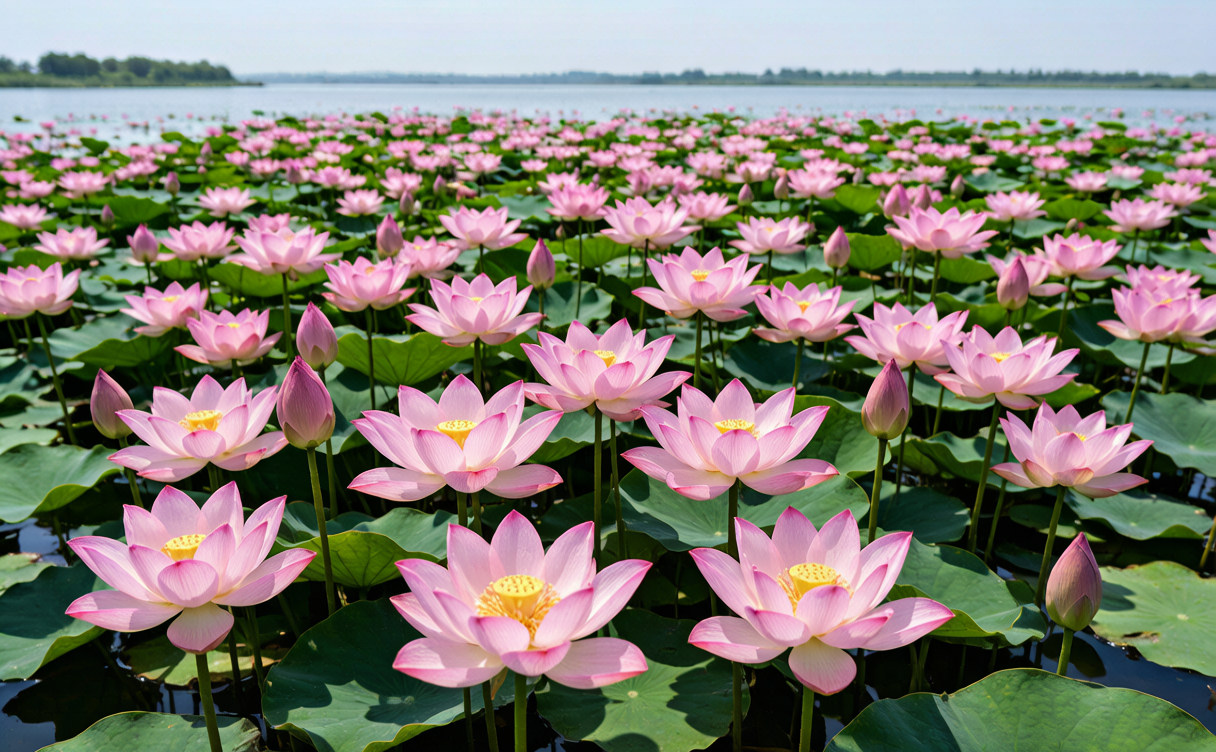
July and August — lotus season. The headline act. Tens of thousands of lotus plants flower across the shallows, the reeds are at full height, and boat traffic peaks. Expect 28–34°C, high humidity and afternoon thunderstorms. Book a boat before 09:00 to beat both heat and crowds.
Late September to early November — the connoisseur’s window. The best time to visit Baiyangdian if you dislike crowds. Reeds turn straw-gold, light goes long and clear, temperatures sit at 12–24°C, and migrating waterbirds move through. Crab and fish are at their best on local menus.
April to June. Green-up. Reeds are short so sightlines are wide, birdlife is active, and prices are lower. Water levels can be modest after a dry winter.
December to March. The lake freezes solid for much of this period and boat services stop entirely. Villagers historically crossed on ice sledges, and a little of that survives, but as a visitor you would be looking at a white plain in a hard wind. Skip it unless you are specifically curious.
How to Get to Baiyangdian
Almost everyone enters through Anxin County (安新县), where the main wharf and ticket office sit. Two high-speed stations serve the area, and the one you want depends on your train, not on distance.
| From | Mode | Typical duration | Approx. cost |
|—|—|—|—|
| Beijing West → Baiyangdian Station | High-speed rail | 45–60 min | ¥60–80 (US$8–11) |
| Beijing West → Xiong’an Station | Intercity rail | around 50 min | ¥50–60 (US$7–8) |
| Beijing Daxing Airport → Xiong’an Station | Intercity rail | 20–30 min | ¥30–40 (US$4–6) |
| Baiyangdian or Xiong’an Station → Anxin wharf | Taxi / ride-hail | 35–50 min | ¥70–110 (US$10–15) |
| Beijing city centre → Anxin | Private car | 2 hr – 2 hr 30 min | ¥600–900 return (US$85–125) |
| Baoding → Anxin | Bus or car | around 1 hr | ¥25–60 (US$3.50–8.50) |
A Baiyangdian day trip from Beijing is entirely realistic: catch a 07:00–08:00 train, be on the water by 10:00, and be back in the capital for dinner. If you would rather not juggle taxis at the far end, hiring a car with driver for the day is the low-stress option, and it lets you stop at village docks the tour boats ignore. Rail tickets are issued against your passport number, so carry the physical passport, not a photocopy.
What to See on the Water
The Lotus Gardens
The Lotus Grand View Garden (荷花大观园) is the single most photographed corner of the lake: raised boardwalks threading through cultivated lotus beds, with pavilions and a small museum of lotus varieties. It is managed and a little theme-parky, but in late July it is spectacular, and it is the easiest place to see the flowers close up rather than from a moving boat.
Wangjiazhai Water Village
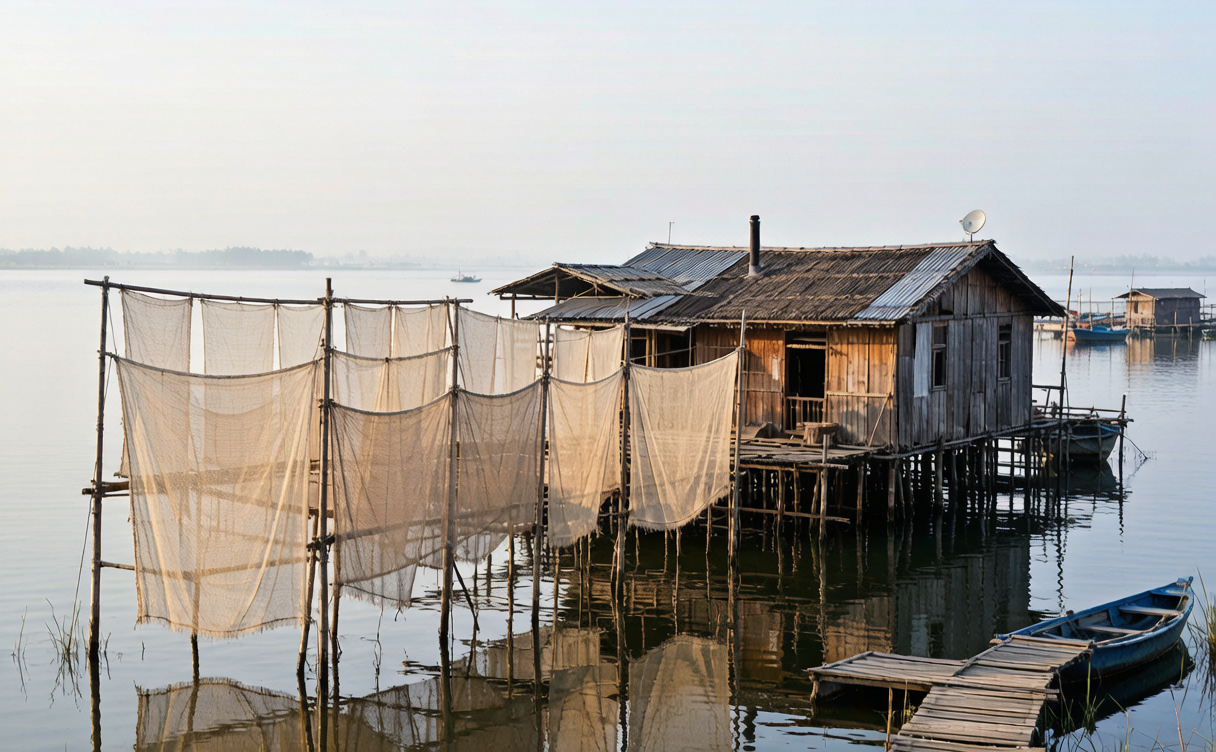
Wangjiazhai (王家寨) is the classic island settlement: no road in, houses on raised platforms, nets drying on poles, ducks everywhere. Several families run simple homestays and cook whatever came out of the water that morning. It is the best stop for understanding how people actually live here rather than how the brochure says they do.
Yuanyang Island and the Reed Maze
Yuanyang Island (鸳鸯岛) functions as the lake’s central hub, with restaurants, a viewing tower and boat connections. From there, boats push into the reed corridors, which are the real attraction — narrow green tunnels where the sky shrinks to a strip and you lose all sense of direction within two minutes.
Boat Routes and How Long They Take
Everything runs from the Anxin wharf, and you choose your vessel:
- Electric tour boat (电动船). Quiet, covered, seats six to eight. Two to three hours through reed channels with one or two island stops. Roughly ¥250–450 per boat, not per person.
- Speedboat (快艇). Loud and fast, four to six seats, good if you want to cover distance to outlying villages. ¥300–600 depending on route.
- Wooden punt (木船). Poled or paddled, one hour, slow and lovely, best at dawn or late afternoon. ¥120–200.
A sensible half-day: punt or electric boat out at 09:00, lotus garden, lunch at a village, reed corridors on the return, back at the wharf by 14:00. There is very little walking involved — the “trails” here are boardwalks inside the scenic zones, rarely more than a kilometre or two. Travellers hunting quiet corners of the country will find this fits the brief in our off-the-beaten-path China guide, and the golden-reed season is a genuine highlight for anyone following our China photography tour guide.
Where to Stay Nearby
Anxin county town — ¥140–320 (US$20–45). Ordinary Chinese chain hotels five minutes from the wharf. Clean, functional, reliably able to register foreign passports. The safe choice.
Island homestays — ¥180–400 (US$25–56). Family guesthouses at Wangjiazhai and Shaozhuangzi. Basic rooms, superb fish dinners, and the sound of water all night. Confirm in advance that they can register foreign guests; many small operators cannot, so have an Anxin fallback.
Xiong’an and Baoding — ¥250–600 (US$35–84). Newer business hotels 40–60 minutes away, better if you have a car.
Most visitors do not stay at all. One night buys you sunrise on the water, when the lake is at its best.
Baiyangdian Tickets and Opening Hours
Pricing here confuses people because there are two layers. A scenic-area entrance ticket runs roughly ¥40 (US$5.60), and individual island attractions such as the Lotus Grand View Garden charge a further ¥30–60 each. Combined passes bundling entry, a boat and two or three islands are typically ¥120–220 per person (US$17–31), and are usually the better deal.
Baiyangdian tickets and opening hours follow the season closely. Ticket windows generally open 07:30–08:00 and close at 17:00–18:00 from April to October, with the last boats leaving around 16:00; hours contract to roughly 08:30–16:30 in the shoulder months. Boat operations suspend when the lake ices over, broadly December to March. Verify current pricing on the Xiong’an New Area official portal or by asking your hotel to phone ahead, as rates are adjusted between peak and low season.
Agree your boat price and route before boarding, and confirm whether island entrance fees are included. This is the single most common source of friction for foreign visitors.
Practical Tips
- Bring your passport. Required for train tickets and scenic-area entry.
- Pay with Alipay or WeChat Pay. Both accept foreign Visa and Mastercard. Keep ¥200–300 cash for homestays and boatmen.
- Sun and mosquitoes. No shade on open water. Hat, sunscreen and repellent from May onwards.
- Life jackets. Ask for one; not all operators offer them unprompted.
- Almost no English. Save the wharf address in characters and use a translation app.
- Eat the fish. Braised crucian carp, lotus root, wild duck and, in October, freshwater crab. Lunch for two runs ¥100–180.
- Drones. Xiong’an has airspace restrictions. Do not fly without checking locally.
FAQ
Is Baiyangdian worth visiting?
Yes, if you want a landscape unlike anywhere else in China and are content with something low-key and rural. It is not a headline sight in the way the Great Wall is — it is half a day of reeds, water and village life an hour from Beijing, which for repeat visitors is exactly the point.
How do I do a Baiyangdian day trip from Beijing?
Take an early high-speed train from Beijing West to Baiyangdian or Xiong’an station (45–60 minutes), taxi 35–50 minutes to the Anxin wharf, hire a boat for three hours, eat lunch on an island, and catch an afternoon train back. Budget ¥400–700 per person all in.
When do the lotus flowers bloom?
Mid-July to late August, peaking in the first two weeks of August. Late June sometimes produces early flowers in a warm year.
Can I visit in winter?
You can reach the lake, but boats do not run once the ice forms, roughly December to March. There is no meaningful way to get out onto the water in that period.
Do I need a guide?
Not strictly, but it helps. Nothing is in English and boat pricing is negotiated. A Mandarin-speaking driver-guide (¥600–900 a day) removes every friction point. See our three-day Beijing itinerary for how to slot the lake around the capital’s big sights.
Written by Karl, China Travel Places — updated August 2026.