

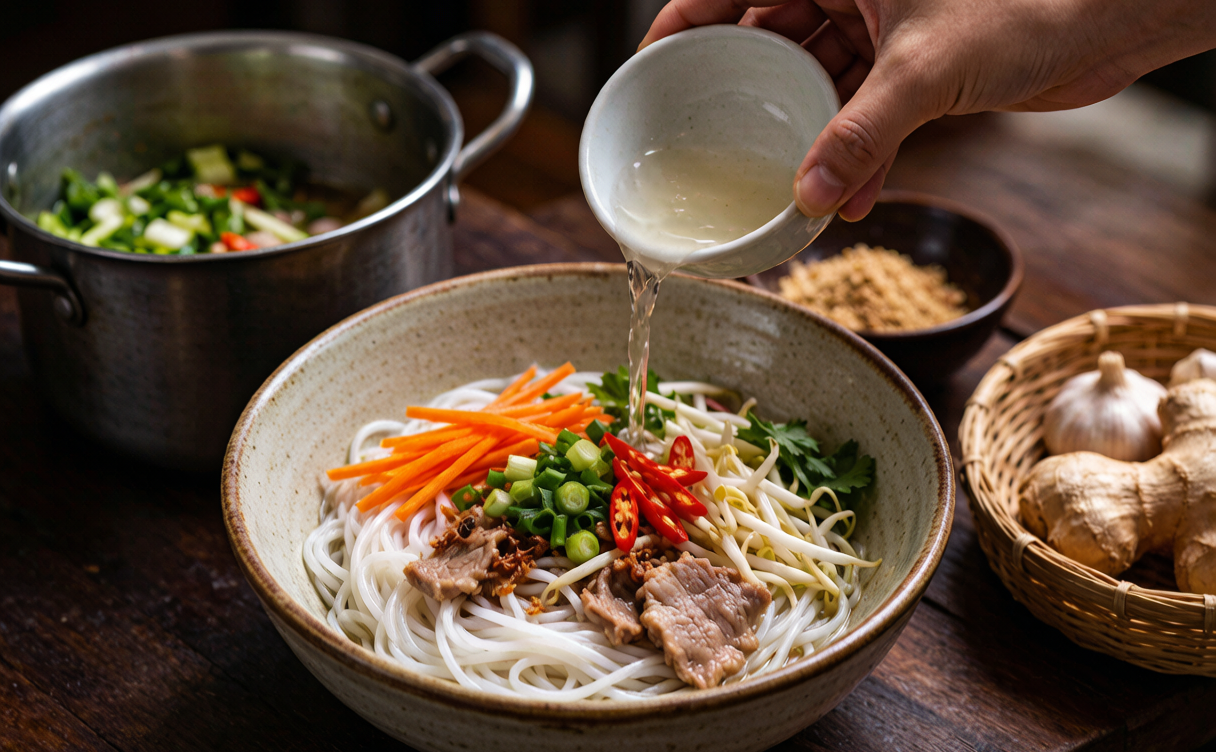
The bowl arrives and it is enormous, and it appears to contain nothing but soup. No steam rises off it, which is the first trap. Around it the waiter sets down eight or nine little saucers: paper-thin raw pork, a slick of chicken, translucent shavings of cured ham, a quail egg, chives, bean sprouts, tofu skin, chrysanthemum petals. Then a separate bowl of white rice noodles. You are expected to build the dish yourself, in the right order, in the next ninety seconds — and if you get it wrong you will eat raw pork and cold noodles. This crossing the bridge noodles guide explains the mechanics, the order, the regional variations and where in Yunnan to eat the real thing rather than the tourist version.
What the Dish Actually Is
Guoqiao mixian (过桥米线) is not a soup with things in it. It is a delivery system for heat. The broth is simmered for hours from chicken, pork bone and Xuanwei ham, then sealed under a layer of rendered fat that traps the heat beneath it — which is why the surface looks placid at 90°C or more. Everything else is raw or barely cooked, and the soup does the cooking at the table.
The noodles themselves matter more than most visitors realise. Suanjiang mixian (酸浆米线) are made from rice fermented for days before milling; they are soft, slightly sour and the traditional choice. Ganjiang mixian (干浆米线) are dried and reconstituted, chewier and springier. Any decent shop will ask which you want. Say suanjiang the first time.
The Legend, and What Probably Happened
Every restaurant tells the story. A scholar in Mengzi shut himself away on an island in the South Lake to prepare for the imperial exams; his wife carried lunch across the bridge each day and found the soup cold by the time she arrived. One day she carried a fat-capped chicken broth and the ingredients separately, assembled it on arrival, and the dish was born.
It is a good story and almost certainly a later invention. What is documented is that the assembled-at-table style was established in Mengzi, in Honghe prefecture, by the nineteenth century, and spread from there across Yunnan. The prefecture is better known internationally for the Honghe Hani Rice Terraces UNESCO World Heritage site — the rice grown on those hillsides is the same crop the noodles are milled from.
How to Assemble the Bowl
Order matters, and getting it right is genuinely satisfying.
1. Raw meats first. Slide in the pork, chicken and fish while the broth is at its hottest. Stir. They turn opaque in about fifteen seconds.
2. Quail egg next, cracked straight in and left alone so it sets.
3. Ham, tofu skin and firm vegetables — anything that needs a little time.
4. Leafy things and chrysanthemum petals, which need almost none.
5. Noodles last. Add them all at once, push them under, wait thirty seconds.
Do not add chilli oil until you have tasted the broth. A good one is delicate, and drowning it is the single most common mistake foreign diners make.
Best Time to Visit
Kunming’s nickname is the Spring City, and it earns it: 15–25°C for most of the year, at 1,890 m elevation.
March to May is the best window: dry, sunny, 20–26°C by day, and the whole city eats outdoors.
June to August is the rainy season, but it rarely rains all day — heavy afternoon downpours, clear mornings, and a merciful 19–25°C while the rest of China roasts.
September to November brings the clearest skies of the year at 15–23°C, and mushroom season, which in Yunnan is a serious event.
December to February drops to 5–18°C, cold at night and sunny by day, with red-billed gulls on Green Lake from November to March.
Avoid the first week of October and Spring Festival week. For a wider seasonal plan, see our guide to the best time to visit China.
How to Get There
Kunming is the base for everything in this article. Changshui International Airport (KMG) connects to most Chinese cities and to Bangkok, Singapore and Kuala Lumpur; Kunming South (昆明南站) is the high-speed rail hub.
| From | Mode | Duration | Typical fare |
|—|—|—|—|
| Guangzhou South | High-speed rail to Kunming South | 4 hr 30 min – 6 hr | ¥490 (US$69) |
| Chengdu East | High-speed rail | 6 hr – 7 hr 30 min | ¥450 (US$63) |
| Shanghai Hongqiao | Direct flight to KMG | 3 hr 30 min | ¥900–1,600 (US$126–225) |
| Changshui Airport (KMG) | Metro Line 6 to city centre | 50 min | ¥5 (US$0.70) |
| Kunming South | Metro Line 1 to city centre | 40 min | ¥7 (US$1) |
| Mengzi North | High-speed rail from Kunming South | 1 hr 20 min – 1 hr 50 min | ¥85 (US$12) |
Inside Kunming, the metro covers the centre and both stations, flat fares of ¥2–7, running roughly 06:20–22:30. Taxis start at ¥8.
Crossing the Bridge Noodles Guide: Where to Eat in Kunming
Jianxinyuan (建新园) is the institution — trading since 1906, now with branches across the city. The Baoshan Street original is the one to hit. The ¥28 (US$4) standard set is more than enough food; the ¥58 (US$8) set adds better ham and more meats. Unglamorous, brightly lit, always busy, consistently good.
Qiaoxiangyuan (桥香园) is the big modern chain — comfortable, slightly bland, English picture menus. A soft landing.
Wenlin Street (文林街), beside Yunnan University, is where I would actually send you: student-priced shops at ¥12–20 (US$2–3) a bowl and half a dozen alternatives within a block.
Guandu Ancient Town (官渡古镇), 40 minutes out on Metro Line 1 plus a bus, pairs a noodle lunch with the town’s baked baba flatbreads and its Yuan and Ming pagodas.
Skip anything with a doorman waving a laminated menu at foreigners on Nanping Street. The markup is triple and the broth is powder-based.
Mengzi, the Home Town
Ninety minutes south by high-speed rail, Mengzi is where the dish comes from, and the local version is distinct: more chrysanthemum, a lighter broth, and a habit of serving it as a formal multi-plate spread rather than a quick meal. Restaurants cluster around the South Lake (南湖), the same lake the legend is set on, and a good sit-down set runs ¥40–70 (US$6–10).
It is a pleasant small city — lakeside willows, old railway buildings from the Yunnan–Vietnam line, almost no foreign visitors. It works as a day trip, and better as an overnight stop en route to the Hani terraces.
Other Yunnan Rice Noodles Worth Your Breakfasts
Crossing-the-bridge is the famous one, but locals eat it less often than you would think.
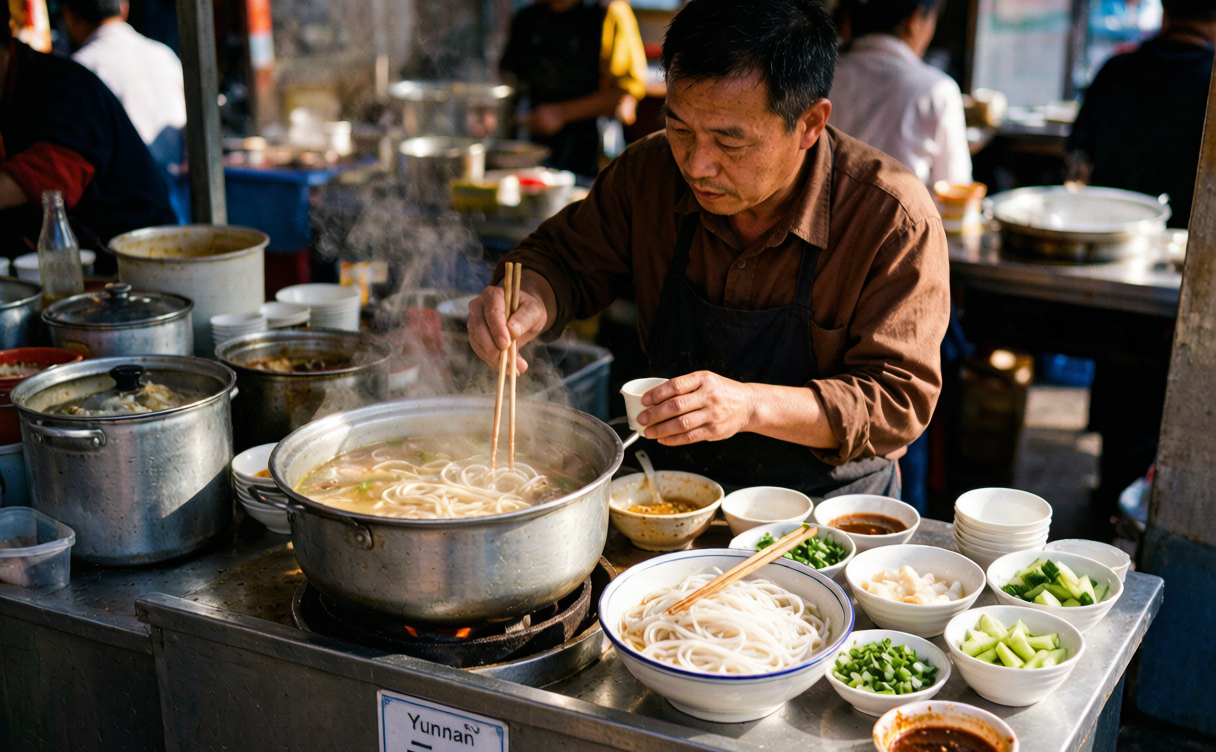
- Xiaoguo mixian (小锅米线) — the real Kunming breakfast. Cooked to order in a single small copper pot with minced pork, pickled greens and chives. ¥10–15 (US$1.50–2). Fuhuayuan is the classic address.
- Douhua mixian (豆花米线) — noodles under a mound of silken tofu with sesame, peanut and chilli, mixed at the table. Cheap and excellent.
- Liang mixian (凉米线) — cold noodles dressed with vinegar, chilli and herbs. Summer only.
- Xiaoli mixian / Dai-style bowls in Xishuangbanna, sharper and more herbal, closer to Southeast Asia.
Where to Stay
Budget (¥90–180 / US$13–25). Hostels and small guesthouses around Green Lake (翠湖) and Wenlin Street. Walkable to the best cheap noodle shops and the university district.
Mid-range (¥250–450 / US$35–63). Business hotels near Nanping Street or on Metro Line 1, close to both stations and to the main restaurant clusters. The practical choice.
Splurge (¥700–1,400 / US$98–197). International brands in the CBD around Beichen and the lakefront boutique properties near Green Lake. In Mengzi, expect ¥200–400 (US$28–56) for the best rooms in town.
Sample Itinerary: A Day of Noodles in Kunming
07:30 — Xiaoguo mixian for breakfast near Green Lake. Watch the copper pot; it is a one-bowl-at-a-time operation.
08:30 — Walk Green Lake Park. Gulls if it is winter, tai chi and saxophone practice year-round.
11:30 — Metro to Baoshan Street for the main event at Jianxinyuan. Order the ¥28 set, take the assembly slowly.
14:00 — Yunnan Provincial Museum, or the Dounan flower market for something odder.
16:30 — Douhua mixian on Wenlin Street.
18:30 — Grilled skewers and Dai food around Wenhua Lane, Yunnan coffee afterwards.
Add a second day for Guandu, or take the 08:00 train to Mengzi.
Prices and Practical Tips
- What to pay. ¥12–20 (US$2–3) for a neighbourhood bowl; ¥28–58 (US$4–8) for a proper crossing-the-bridge set; ¥88–188 (US$12–26) for premium sets with abalone or aged ham. Anything above that is a tourist tax.
- Say your noodle type. Suanjiang for soft and sour, ganjiang for chewy.
- The broth is dangerously hot. No steam does not mean not scalding. Wait two minutes before your first spoonful.
- Portions are large. A standard set defeats most people; do not order extras on the first attempt.
- Payment. Alipay and WeChat Pay everywhere, including street stalls.
- Altitude. Kunming sits at 1,890 m. Fly in from sea level and your first day should be a gentle one.
FAQ
Is crossing-the-bridge noodle soup spicy?
Not inherently. The broth is savoury and mild; chilli oil, pickled chilli and fermented bean paste are served on the side so you control the heat. Taste first, then add.
Is it safe to cook the raw meat in the broth myself?
Yes, when the broth is properly hot — the slices are cut deliberately thin for that reason. Add them immediately on arrival, stir, and check that the pork has turned fully white before eating. If a bowl arrives lukewarm, send it back.
Can vegetarians eat it?
The classic version cannot be made vegetarian; the broth is chicken and pork. Some Kunming shops offer a mushroom broth version, and douhua mixian with tofu is a reliable meat-free alternative. Say wo chi su (我吃素) and check the base.
Do I have to go to Mengzi to eat the real thing?
No. Kunming’s best shops are excellent and far more convenient. Mengzi is worth the trip only if you are curious about the origin version or already heading south toward the rice terraces. Budget ¥12–20 for an everyday bowl either way.