

Climb the steps of Beigu Mountain at seven in the morning and the Yangtze below you is a sheet of grey tin, barges sliding downstream in single file, the pavilion roof still dripping from the night’s damp. Behind you the city is waking up and it smells faintly sour — the malt-and-rice breath of the vinegar works drifting over the rooftops. Zhenjiang is the point where China’s greatest river crosses its greatest canal, where three temple-topped hills rise straight out of the water, and where the local condiment is famous enough to sit on kitchen shelves in Sydney and San Francisco. Most foreign visitors blow past it on the train between Nanjing and Shanghai. This Zhenjiang travel guide argues that a day here beats a third afternoon in either.
Zhenjiang Travel Guide: Is It Worth the Stop?
Be honest with yourself first. Zhenjiang is a working city of three million with the usual ring roads and tile-clad apartment blocks. There is no metro, no old quarter the size of Pingyao’s, and English signage thins out fast once you leave the parks. What it has is density: three riverside hills loaded with poetry and Three Kingdoms legend, one lovely surviving street, a vinegar industry you can walk through, and a noodle bowl worth crossing the province for — all in an area you can cover in a single day.
If you have ten days in China, skip it. If you have three weeks and you are already in Jiangsu, it is one of the best-value days on the Yangtze delta.
Best Time to Visit
Zhenjiang has a humid subtropical climate with four sharply different seasons and one miserable one.
Spring (late March to May) is the pick. Highs run 15–25°C, the hills are green, and blossom around Jinshan Lake peaks in late March. Book weekdays — Nanjing day-trippers flood in on Saturdays.
Autumn (late September to mid-November) is nearly as good: 12–24°C, dry, clear river views, and October osmanthus scenting the whole of Beigu Mountain.
Summer (June to August) is the season to avoid. The plum rains (梅雨, meiyu) soak late June into early July, then July and August sit at 30–35°C with brutal humidity. The hill climbs turn unpleasant by 10am.
Winter (December to February) hovers at 0–9°C, damp and grey with no indoor heating in older buildings, but the hills are empty and rates drop by a third.
Avoid the first week of October and the Qingming weekend entirely. For how Jiangsu fits into a wider seasonal plan, see our guide to the best time to visit China.
How to Get There
Two stations matter. Zhenjiang South (镇江南站) handles most Beijing–Shanghai high-speed services; Zhenjiang Station (镇江站) in the centre takes Nanjing–Shanghai intercity trains and is far handier, fifteen minutes’ walk from Xijindu. Check your ticket before booking a hotel.
| From | Mode | Duration | Typical fare |
|—|—|—|—|
| Nanjing South | High-speed rail | 20–30 min | ¥40 (US$6) |
| Shanghai Hongqiao | High-speed rail | 1 hr 20 min – 2 hr | ¥130–190 (US$18–27) |
| Suzhou | High-speed rail | 55 min – 1 hr 15 min | ¥100 (US$14) |
| Beijing South | High-speed rail | 4 hr 20 min – 5 hr | ¥520 (US$73) |
| Yangzhou | Bus over the Runyang Bridge | 45–60 min | ¥22 (US$3); taxi ¥150 (US$21) |
| Nanjing Lukou Airport (NKG) | Airport coach | 1 hr 30 min | ¥68 (US$10) |
Around town, city buses cost ¥2 and cover everything — bus 2 runs from the centre out to Jinshan Park, bus 4 links the centre with Beigu Mountain and Jiaoshan. Taxis start at ¥9 and almost no cross-town ride costs more than ¥25 (US$3.50). Didi works with an international card.
The Three Hills
Jinshan (金山, Golden Hill) is the headline act. The temple does not sit beside the hill — it wraps around it, halls stacked up the slope until the Cishou Pagoda pops out of the top like a candle on a cake. This is the setting of the Legend of the White Snake, in which the heroine floods the temple to free her husband from the monk Fahai; half the Chinese visitors here are here because of it. Entry ¥65 (US$9), 07:00–17:30, two hours including the pagoda climb.
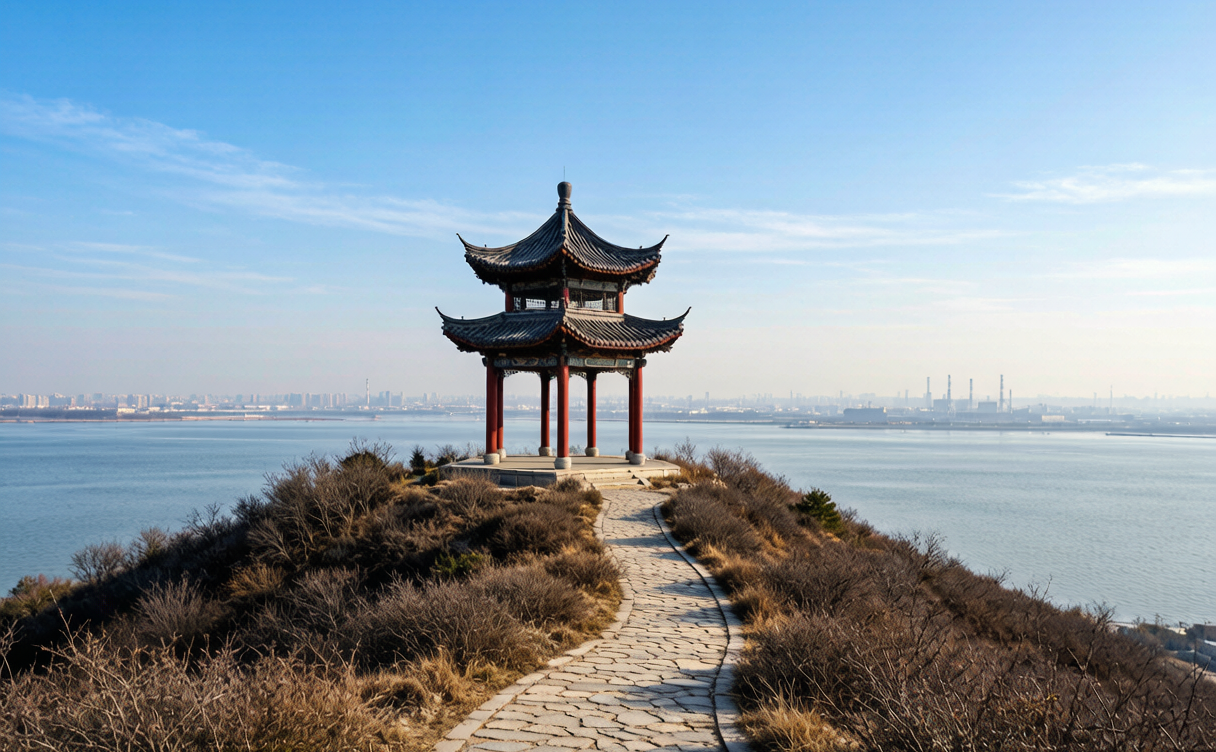
Beigu (北固山, North Fixed Hill) is smaller, quieter and my favourite. It juts into the river with Ganlu Temple on its shoulder and a rebuilt pavilion at the summit where, in the Three Kingdoms tales, Liu Bei was married off to Sun Quan’s sister. Entry ¥40 (US$6), 08:00–17:30, one hour is plenty.
Jiaoshan (焦山) was an island until the river silted up; you still reach it by a short ferry included in the ¥65 (US$9) ticket. Come for the Forest of Steles, a corridor of Six Dynasties and Tang calligraphy cut into rock. This is the one to drop if time is short. A combined three-hill ticket runs about ¥120 (US$17).
Xijindu Ancient Street
Xijindu (西津渡) was the ferry crossing that made the city: for over a thousand years, anyone travelling between north and south China stepped off a boat here. The stone-paved lane climbing away from the old waterfront still has its Yuan-dynasty Zhaoguan stone pagoda standing directly over the road — you walk under it — plus Republican-era shopfronts, a Song rescue-boat office, and the former British consulate buildings that now hold the free Zhenjiang Museum (09:00–17:00, closed Mondays).
The street is free and open around the clock. Go before 09:30 or after 19:00; between those hours it fills with tour flags. The cart ruts worn into the paving are marked by a small plaque most people walk straight over.
Vinegar, and Why It Matters Here
Zhenjiang black vinegar (镇江香醋, Zhenjiang xiangcu) is one of China’s four great vinegars and the standard dip for soup dumplings and crab nationwide. It is brewed from glutinous rice, fermented in open jars, then aged — the good stuff three years or more — until it turns nearly black and tastes of malt, smoke and dried fruit.
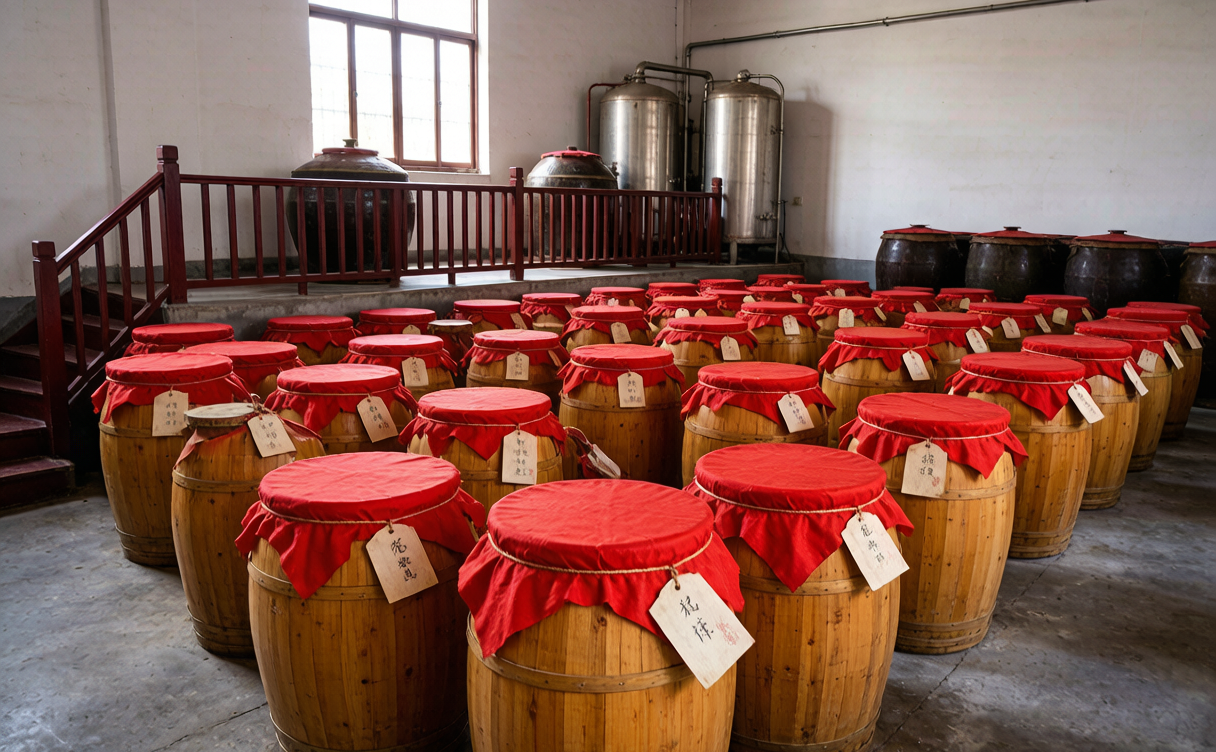
The Hengshun Vinegar Culture Museum on Zhongshan West Road walks you past rows of aging jars under straw hats to a tasting counter. Entry about ¥50 (US$7), 08:30–17:00, one hour. A six-year bottle costs ¥40–70 (US$6–10) here and three times that abroad; it travels fine in checked luggage if you tape the cap.
What to Eat
Locals recite three oddities about the city: the vinegar never spoils, the aspic pork is not treated as a dish, and they boil a pot lid inside the noodle pot.
- Pot-lid noodles (锅盖面, guogai mian) — the city’s obsession. A small wooden lid floats in the boiling water, supposedly keeping the noodles springy. Order it with yaorou or long fish. ¥12–20 (US$2–3) at any morning shop.
- Crystal pork aspic (肴肉, yao rou) — pressed, cured pork shank set in its own jelly, eaten cold at breakfast with shredded ginger and vinegar. Strange at 7am, excellent by day three.
- Crab-roe soup dumplings (蟹黄汤包, xiehuang tangbao) — huge, fragile, drunk through a straw. Autumn season, ¥40–60 (US$6–8) a basket.
- Long fish noodles (长鱼面) — eel simmered with soy and pepper.
Head to the lanes behind Dashikou (大市口) for breakfast, or the food street below Xijindu for evening skewers.
Where to Stay
Budget (¥130–230 / US$18–32). Chains — Hanting, Home Inn, 7 Days — cluster around Zhenjiang Station and Zhongshan Road. Tiny, clean, fifteen minutes’ walk from Xijindu.
Mid-range (¥300–500 / US$42–70). Business hotels around Dashikou, the central junction, sit within a ¥15 taxi ride of all three hills and next to the best breakfast streets. This is where I stay.
Splurge (¥600–1,100 / US$85–155). International brands on the Jinshan Lake waterfront, with lake views and proper gyms. Quiet, slightly isolated.
Most mid-range and up hotels accept foreign guests, but confirm when booking — some budget properties still do not.
Sample Itinerary: One Full Day
07:30 — Pot-lid noodles and a slice of yao rou behind Dashikou. Expect to point at things.
08:30 — Taxi to Jinshan Park (¥15). Beat the tour buses to the pagoda; the river view is best in early light.
10:45 — Bus or taxi to Xijindu. Walk the old street, duck under the stone pagoda, forty minutes in the Zhenjiang Museum.
12:30 — Lunch on the old street: soup dumplings in autumn, otherwise braised river fish.
14:00 — Beigu Mountain. An hour up and around, plus twenty minutes at the summit pavilion watching container barges.
15:30 — Hengshun Vinegar Culture Museum. Taste, buy, pack.
17:00 — Jinshan Lake at sunset, or the ferry to Jiaoshan if you have the energy.
19:00 — Dinner at the Xijindu food street, then the last train to Nanjing around 21:00.
With two days, add Jiaoshan properly, the childhood home of the novelist Pearl S. Buck, and a half-day across the Runyang Bridge to Yangzhou.
Practical Tips
- The Grand Canal, which meets the Yangtze here, is inscribed on the UNESCO World Heritage list — the Zhenjiang section is one of its junction points, and there is a short walkable stretch north of the centre.
- Alipay and WeChat Pay run everything, including the ¥2 bus fare. Bind a foreign card before you arrive.
- Almost nobody in the parks speaks English. Screenshot the Chinese names of your destinations for taxi drivers.
- The hills involve 200–400 steps each. Wear proper shoes, and note that ticket offices close 30–60 minutes before the parks do.
FAQ
How many days do I need in Zhenjiang?
One full day covers the three hills, Xijindu and the vinegar museum at a brisk pace. Two days lets you slow down, add Yangzhou across the river, and eat properly.
Can I visit Zhenjiang as a day trip from Shanghai?
Yes, but it is a long day — roughly 90 minutes each way by high-speed rail. From Nanjing it is far more sensible at 20–30 minutes each way, and you can leave after breakfast and be back for dinner.
Is Zhenjiang foreigner-friendly?
Practically, yes: safe, cheap, easy to move around. Linguistically, no. English menus are rare outside hotels and museum labelling is patchy. Bring translation tools and patience.
What should I buy here?
Aged black vinegar — six-year bottles from the Hengshun museum shop are the benchmark. Bring your passport for attraction gates; it doubles as your ticket ID.