

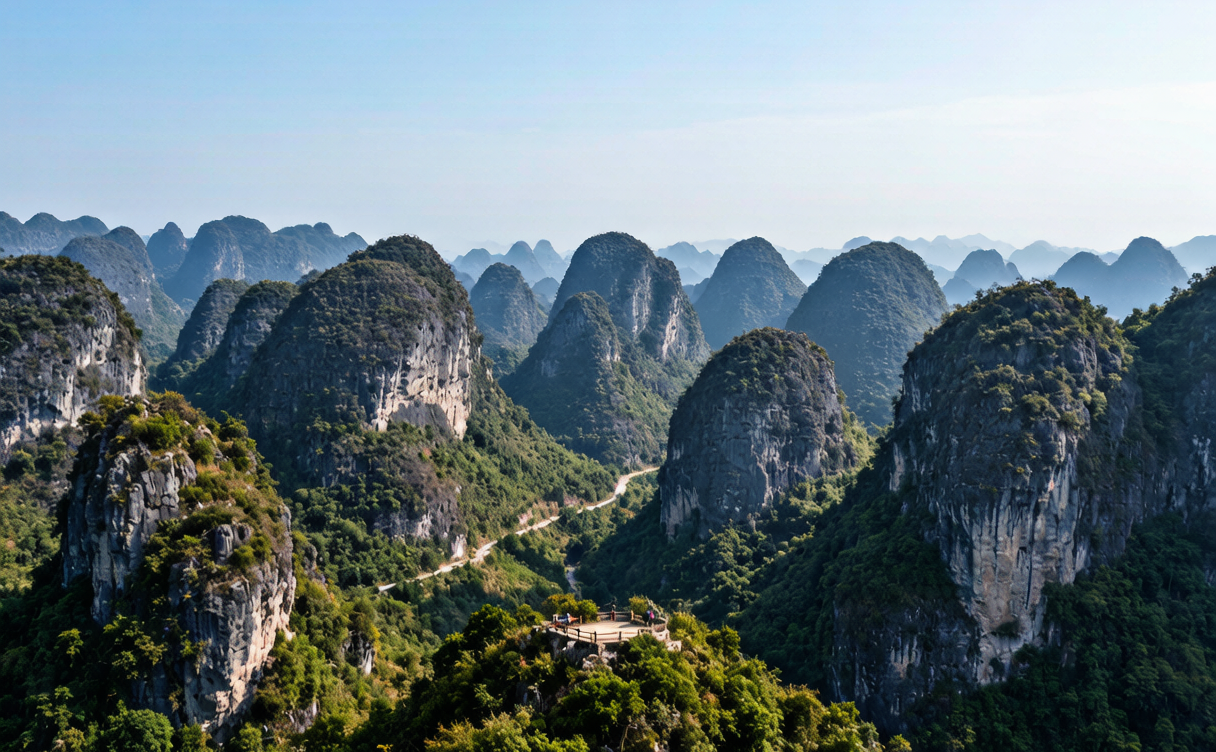
Climb the ridge road south of Xingyi at eight in the morning and the valley below looks like a mistake in the landscape: several thousand near-identical green cones, each a hundred metres high, standing in flat farmland with rice paddies and villages threaded between them. This is Wanfenglin, the Forest of Ten Thousand Peaks, and it is the reason to come. Twenty minutes north of the same city, a river has cut a slot 200 metres deep through the plateau and hung it with waterfalls. This Xingyi travel guide covers both, plus the practicalities of reaching a corner of southwestern Guizhou that most itineraries skip entirely.
Why Xingyi Beats the Karst You Have Already Seen
If you have been to Yangshuo, you have seen Chinese karst at its most famous. Xingyi’s version is different in shape and in tone. Yangshuo’s peaks are jagged towers rising from a river; Wanfenglin’s are rounded cones, hundreds of them at once, sitting in cultivated land that people still farm by hand. There is no bar street, no Western breakfast, and on a weekday in spring you can cycle the valley road for an hour and pass three tour groups.
The whole region belongs to the same limestone system recognised in the UNESCO World Heritage listing for South China Karst, and Xingyi’s peak-cluster landscape is one of the textbook examples of the form. It also anchors the western half of any Guizhou route in our off-the-beaten-path China guide.
Best Time to Visit
Xingyi sits at about 1,200 metres, which gives it one of the mildest climates in China — the annual average hovers near 17°C, and locals market the city on that fact.
Late February to April is the postcard season. Rapeseed flowers turn the flat land between the peaks bright yellow, usually peaking in the first three weeks of March, with days at 14–24°C. It is also the busiest domestic period; go midweek.
May to August brings 20–29°C and the rainy season, with roughly two-thirds of the year’s rain falling in these months. Afternoon storms are normal, mornings are often clear, and the paddies are a startling green. Maling Gorge’s waterfalls are at full strength — this is the best time for the gorge and the worst for guaranteed views.
September to November is the all-round best window: 15–26°C, dry, stable light, golden rice in late September, and small crowds after the first week of October.
December to February runs 3–12°C, dry and sunny more often than not, with cold mornings and occasional freezing fog on the plateau. Comfortable for walking, bare in the fields. Set it against the national picture in our best time to visit China guide.
How to Get There
Xingyi is the awkward part of the trip, and worth planning properly. The city has its own airport, Xingyi Wanfenglin (ACX), about 5 km from the centre, plus rail connections toward Kunming and Nanning and a steady stream of express buses from Guiyang.
| From | Mode | Duration | Approx. fare |
|—|—|—|—|
| Guiyang | Flight to Xingyi (ACX) | 50 min | ¥450–800 (US$63–113) |
| Guiyang | Express bus from Jinyang station | 4 hr 30 min | ¥140 (US$20) |
| Kunming | Train to Xingyi | 3 hr 30 min – 4 hr | ¥70–130 (US$10–18) |
| Nanning | Train to Xingyi | 6 hr – 7 hr | ¥120–180 (US$17–25) |
| Guangzhou | Flight to Xingyi (ACX) | 1 hr 40 min | ¥600–1,100 (US$85–155) |
| Xingyi airport | Taxi to city centre | 15 min | ¥25 (US$4) |
| Xingyi centre | Bus 301 / 302 to Wanfenglin | 40 min | ¥3 (US$0.40) |
Rail services here change frequently as new lines open, so check current timetables rather than relying on any published schedule, including this one. City buses cost ¥2–3 and ride-hailing across town runs ¥10–20 (US$1.50–3). For the gorge and the outlying viewpoints, a car with driver at ¥400–500 (US$56–70) a day is the efficient choice.
What to See and Do
Wanfenglin (万峰林). The scenic area splits into an eastern and a western section; the west is the one with the classic viewpoints. Entry is around ¥80 (US$11) with an optional sightseeing shuttle at roughly ¥60 (US$8), open about 08:00–18:00. Do not simply ride the shuttle between platforms. Rent a bicycle or an electric scooter at the entrance for ¥40–80 (US$6–11) and take the flat valley road through Xianahui (下纳灰) and Shangnahui (上纳灰) villages, where the peaks stand directly behind farmhouses and the eight-terraced “Bagua Field” sits in the middle of a hamlet. Allow four hours minimum; the best light is before 10:00.
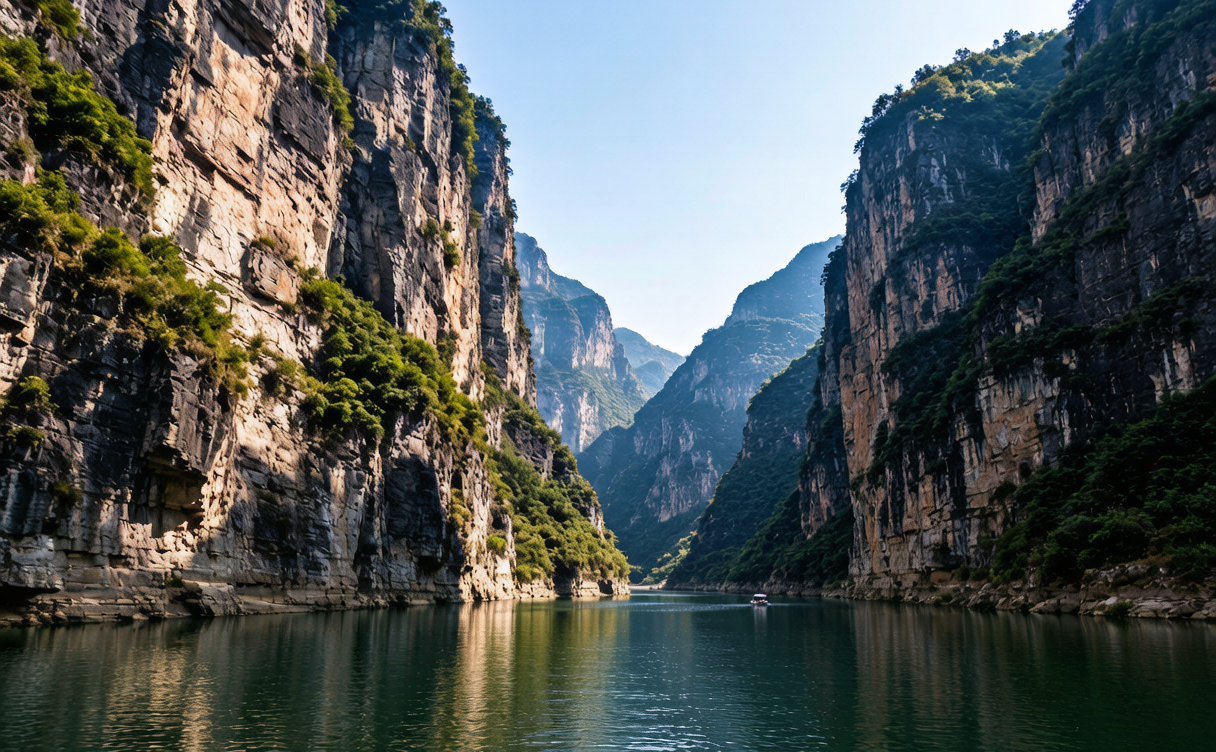
Maling Gorge (马岭河峡谷). A 15 km slot canyon cut by the Maling River, 6 km northeast of the city. A staircase-and-walkway route runs along the wall behind a series of waterfalls, so you walk through spray for much of it — take a poncho. Tickets are about ¥80 (US$11), with a glass-fronted lift down and back for roughly ¥30 (US$4) that saves a punishing climb. Two to three hours. Whitewater rafting operates in the upper gorge in the wet season for around ¥260 (US$37).
Wanfeng Lake (万峰湖). A reservoir south of the city where the peaks continue straight into the water, giving a drowned-karst effect. Boat trips run ¥80–150 (US$11–21) and take two to three hours. Pleasant rather than essential.
The Twenty-Four Turns (二十四道拐). A hairpin road cut into a mountainside at Qinglong, two hours northeast, famous as a wartime supply route. Worth it only if you have a car and a spare half-day.
Nizhu Stone Forest (泥凼石林). An hour south, a small, almost unvisited limestone forest with village paths through it, around ¥40 (US$6).
Where to Stay
Budget — central Xingyi. Chain hotels around Ruijin Road and Shajing Street run ¥110–190 (US$16–27) for a clean modern double. Convenient for buses and the night market, forty minutes from the peaks.
Mid-range — Wanfenglin village guesthouses. ¥220–450 (US$31–63) puts you in a courtyard guesthouse in Xianahui or a neighbouring hamlet inside the scenic area, with peaks out of the window. This is where I would stay: you get the valley at dawn and dusk, when the day visitors are gone.
Splurge — resort hotels near the west gate. ¥550–1,000 (US$78–141) for a boutique or resort property with terraces facing the peak cluster. Rates spike in March during the rapeseed bloom, so book six to eight weeks out for that window.
What to Eat
Southwestern Guizhou cooks with sour, chilli and a lot of dried-chilli dipping powder, and Xingyi has a couple of genuinely local specialities.
- Xingyi mutton rice noodles (兴义羊肉粉, Xìngyì yángròu fěn) — the city’s breakfast, a clear mutton broth over rice noodles with a chilli oil and coriander finish. Around ¥15 (US$2). Locals eat it before 09:00.
- Shuabatou (刷把头) — steamed open-topped dumplings shaped like a bamboo brush head, filled with bamboo shoot and pork, dipped in sour-spicy sauce. ¥12–18 (US$2–3) a basket.
- Chicken tangyuan (鸡肉汤圆, jīròu tāngyuán) — glutinous rice balls with a savoury chicken filling in broth, which sounds wrong and tastes excellent.
- Gangzi noodles (杠子面) — dough pressed with a wooden pole, giving a springy noodle usually served dry with minced pork.
Sample Itinerary
Day 1 — Wanfenglin
- 07:00 — Mutton rice noodles in the city.
- 08:00 — Taxi or bus 301 to the west gate; ticket and bike rental.
- 08:40 — Cycle the valley road; stop at the Bagua Field and the village lanes.
- 10:30 — Climb to the main viewing platform for the peak-cluster panorama.
- 12:30 — Farmhouse lunch in Xianahui.
- 14:30 — Eastern section, or a long slow loop back through the paddies.
- 18:00 — Sunset from the ridge road above the valley.
Day 2 — Maling Gorge and the lake
- 08:30 — Car to Maling Gorge; take the lift down and walk the waterfall walkway.
- 11:30 — Back up for lunch in the city; shuabatou and chicken tangyuan.
- 14:00 — Boat trip on Wanfeng Lake, or the Nizhu Stone Forest if you prefer walking.
- 19:00 — Night market on Shajing Street.
Practical Xingyi Travel Guide Tips
- Do the peaks first thing. Haze builds through the day in spring and summer, and the cone silhouettes flatten out by noon.
- Wear grippy shoes and a poncho in Maling Gorge. The walkway is permanently wet and the spray comes sideways.
- Cycling Wanfenglin is flat and easy — one of the few karst landscapes in China you can ride through comfortably.
- Ticket and shuttle arrangements change at both scenic areas; confirm at the gate.
- Very little English. Have your hotel write destinations in Chinese and keep offline maps loaded.
FAQ
Is Xingyi better than Yangshuo?
Different, not better. Yangshuo has the river, the climbing scene and the infrastructure; Xingyi has denser, rounder peaks, working farmland and almost no foreign visitors. If you want karst without a tourist economy built around it, come here.
How many days do I need in Xingyi?
Two full days covers Wanfenglin and Maling Gorge properly. A third lets you add Wanfeng Lake or the Twenty-Four Turns without rushing.
When do the rapeseed flowers bloom at Wanfenglin?
Usually from late February through March, with the peak in the first half of the month. Exact timing shifts with the weather each year, so build in a few days of flexibility if this is your reason for visiting.
Can I do Xingyi as a day trip from Guiyang?
No. It is four and a half hours each way by road, or a flight plus transfers. Give it two nights minimum.
Where should I sleep, the city or the valley?
The valley, if you can. A guesthouse inside Wanfenglin gives you dawn and dusk among the peaks, which is when the landscape actually performs. Use the city only if you need an early flight. Note that Maling Gorge is poorly suited to anyone with mobility issues — even with the lift there are long, wet staircases — whereas Wanfenglin is flat and rideable.