

At half past six on a warm evening the whole street starts to smoke at once. Every table has its own small charcoal grill sunk into the middle, and on every grill sit skewers of lamb going from raw to blistered while the people around them drink cheap beer and argue about football. Then comes the part that makes this city different: you lift the meat off the stick with a thin flour pancake, drop in a raw spring onion, add a smear of sweet bean sauce, roll it, eat it. Three years ago this ritual turned a mid-sized industrial city into the most talked-about weekend destination in China. This Zibo travel guide covers what survived the frenzy — and the two-and-a-half-thousand-year-old capital sitting quietly on the other side of town.
Zibo Travel Guide: What You Are Actually Coming For
Zibo is not pretty. It is a sprawl of districts stitched together by an industrial economy of ceramics, glass and petrochemicals. Nobody comes for the skyline.
You come for three things: the barbecue, a genuinely distinctive regional style rather than an internet fad; Linzi district, capital of the ancient state of Qi and home to one of the most startling archaeological sites in eastern China; and Zhoucun, a Qing merchant town that has somehow avoided being scrubbed into a theme park.
Two days is right. One is possible if you are ruthless.
Best Time to Visit
Shandong’s inland climate means real seasons, and barbecue is an outdoor sport.
April to early June is the sweet spot. Days climb from 18°C to 28°C, evenings are warm enough to sit outside, and the mountains south of the city are green. Late April also brings the annual barbecue festival, which is either a reason to come or a reason to stay away depending on your tolerance for crowds.
September and October are just as good — 15–26°C, dry, with the clearest skies of the year, and the best conditions for hiking Yuanshan forest park.
July and August hit 30–35°C with heavy afternoon storms. Grilling in that heat is punishing, though the southern hills stay several degrees cooler.
Winter (December to February) drops to −6°C to 4°C. Barbecue moves indoors and loses half its charm, but the Boshan glass workshops are a good cold-weather draw and rates bottom out.
Weekends are considerably busier than weekdays at every barbecue street. Plan your seasonal route with our guide to the best time to visit China.
How to Get There
Zibo sits on the Jinan–Qingdao high-speed line, which makes it absurdly easy to reach. Zibo North (淄博北站) takes the fast G-trains and is about 20 minutes from the centre by bus or taxi; Zibo Station (淄博站) downtown handles slower services and is walkable to the main hotel cluster.
| From | Mode | Duration | Typical fare |
|—|—|—|—|
| Jinan East | High-speed rail to Zibo North | 25–35 min | ¥50 (US$7) |
| Qingdao North | High-speed rail to Zibo North | 1 hr 30 min – 2 hr | ¥150 (US$21) |
| Beijing South | High-speed rail | 2 hr 30 min – 3 hr | ¥330 (US$46) |
| Shanghai Hongqiao | High-speed rail | 4 hr 30 min | ¥600 (US$84) |
| Jinan Yaoqiang Airport (TNA) | Airport coach | 1 hr 30 min | ¥60 (US$8) |
| Zhoucun / Boshan (local) | City bus or intercity coach | 40–70 min | ¥5–12 (US$1–2) |
There is no metro. Zibo runs a BRT network of dedicated-lane buses linking the districts — BRT lines from the centre reach Zhoucun and Linzi for ¥2–4 — plus ordinary buses at ¥2. Taxis start at ¥8 and a cross-city run to Linzi costs about ¥80 (US$11). Didi works fine.
The Barbecue, Properly Explained
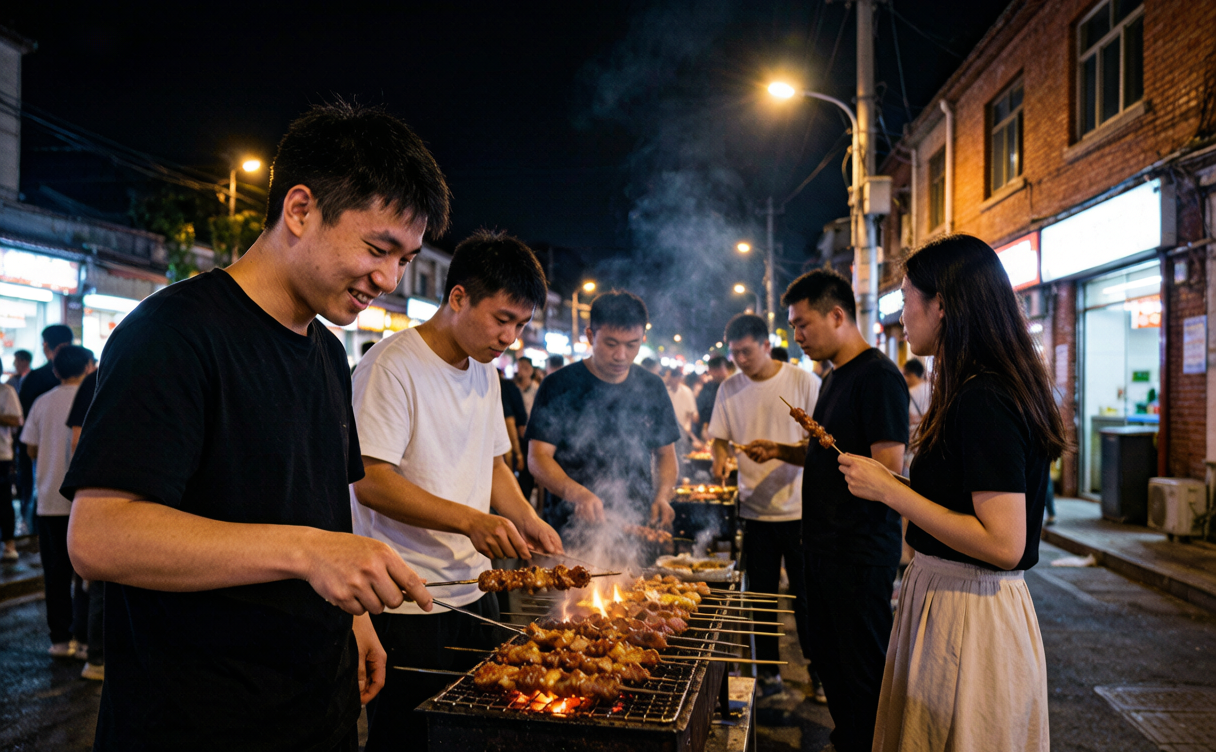
Zibo shaokao (淄博烧烤) works on what locals call the soul trinity: skewer, pancake, scallion (小饼, 撸串, 蘸料). You are given raw or half-cooked skewers and finish them yourself over a small clay-lined charcoal brazier at your own table. Beside it sits a stack of warm flour pancakes the size of your palm, a bundle of raw spring onion batons, and a dish of dark bean-and-sesame dip.
The technique matters. Grill until the fat crackles, lay a pancake over the meat, clamp and pull the skewer out sideways, add onion and sauce, roll tight. Doing it wrong is a conversation-starter and someone at the next table will show you.
Order lamb (羊肉串) first — it is the benchmark. Then lamb fat cubes, chicken hearts, five-flower pork belly, grilled leeks, corn, and mushroom caps. Skewers run ¥2–4 each (US$0.30–0.55), pancakes ¥1, beer ¥5–8. A serious dinner for two comes to ¥120–180 (US$17–25) and involves about forty skewers.
Where to go: Badaju Market (八大局便民市场) is the famous one, a converted neighbourhood market that became a national phenomenon and now sells barbecue, stir-fried glutinous rice cake (炒锅饼) and boiled-then-fried dishes to a heavy weekend crowd. It is fun and it is a scrum. Muyangcun (牧羊村) and the barbecue clusters along Liuquan Road are calmer and, in my experience, grill better meat. Arrive by 17:30 or expect to queue past 19:00.
Linzi: The Capital of Qi
Thirty kilometres east of the centre, Linzi district was for six hundred years the seat of the state of Qi, the richest of the Warring States powers. What remains is more interesting than most reconstructed ancient towns.
The Museum of Royal Chariots (中国古车博物馆) is built directly over an excavated burial pit containing ten chariots and the horses that pulled them, left in place exactly as they were found. Entry is around ¥60 (US$8), 08:30–17:00. Nearby, the sacrificial horse pit attached to the tomb of Duke Jing of Qi holds the skeletons of hundreds of horses arranged in rows — sobering, and unlike anything else you will see in China.
Linzi is also recognised as the birthplace of cuju (蹴鞠), the kicking game that FIFA acknowledges as an ancestor of football. The Football Museum on the site is modest but worth twenty minutes if the sport means anything to you. Combined tickets across the Linzi sites run about ¥100 (US$14).
Getting there: BRT or intercity bus from Zibo centre, roughly 50 minutes, or a ¥80 taxi. The sites are spread out — hire a car for the day if you can.
Zhoucun and Boshan
Zhoucun Ancient Commercial City (周村古商城) is a surviving Qing merchant quarter of low grey-brick shophouses, silk warehouses and pawnbroker courtyards. The streets are free to walk; a combined ticket to the interior museums costs about ¥50 (US$7). Buy the paper-thin Zhoucun sesame flatbread (周村烧饼), still baked by hand and slapped onto the inside of a drum oven.
Boshan district, an hour south, is the reason Zibo has a ceramics and glassblowing reputation. Workshops turn out liuli coloured glass, and you can watch the furnaces at work. Boshan also has its own cuisine — order sujuguo (酥锅), a slow-braised layered pot of pork, fish, kelp and lotus root eaten cold, and Boshan-style four-dish banquet fare that is far more refined than the barbecue suggests. The southern hills here hold the Tanxishan glass skywalk and Yuanshan National Forest Park, both good half-days in shoulder season.
Where to Stay
Budget (¥120–200 / US$17–28). Domestic chains — Hanting, Home Inn, Jinjiang — around Zibo Station and along Zhongxin Road. Basic, spotless, and within a short bus ride of the barbecue streets.
Mid-range (¥280–480 / US$39–67). Business hotels in the Zhangdian district centre near Liuquan Road put you walking distance from several grill clusters and on the BRT line for Linzi. Best all-round base.
Splurge (¥600–900 / US$85–126). A handful of international-brand and top domestic properties sit near the new CBD and Zibo North station, with proper gyms and reliable English at reception.
Book ahead for weekends in April, May, September and October — the barbecue boom permanently reset local demand, and Friday nights still sell out.
Sample Itinerary: Two Days
Day 1 — City and grill
- 09:00 Zibo Ceramics Museum or the Qi Culture Museum for context
- 11:30 Bus to Zhoucun; walk the old street, buy sesame flatbread
- 14:00 Lunch in Zhoucun, then back to the centre
- 16:00 Rest — you need an appetite
- 17:30 Barbecue at Muyangcun or Liuquan Road; forty skewers, two beers
- 20:30 Badaju Market for snacks and people-watching
Day 2 — Ancient Qi
- 08:30 BRT or taxi to Linzi
- 09:30 Museum of Royal Chariots
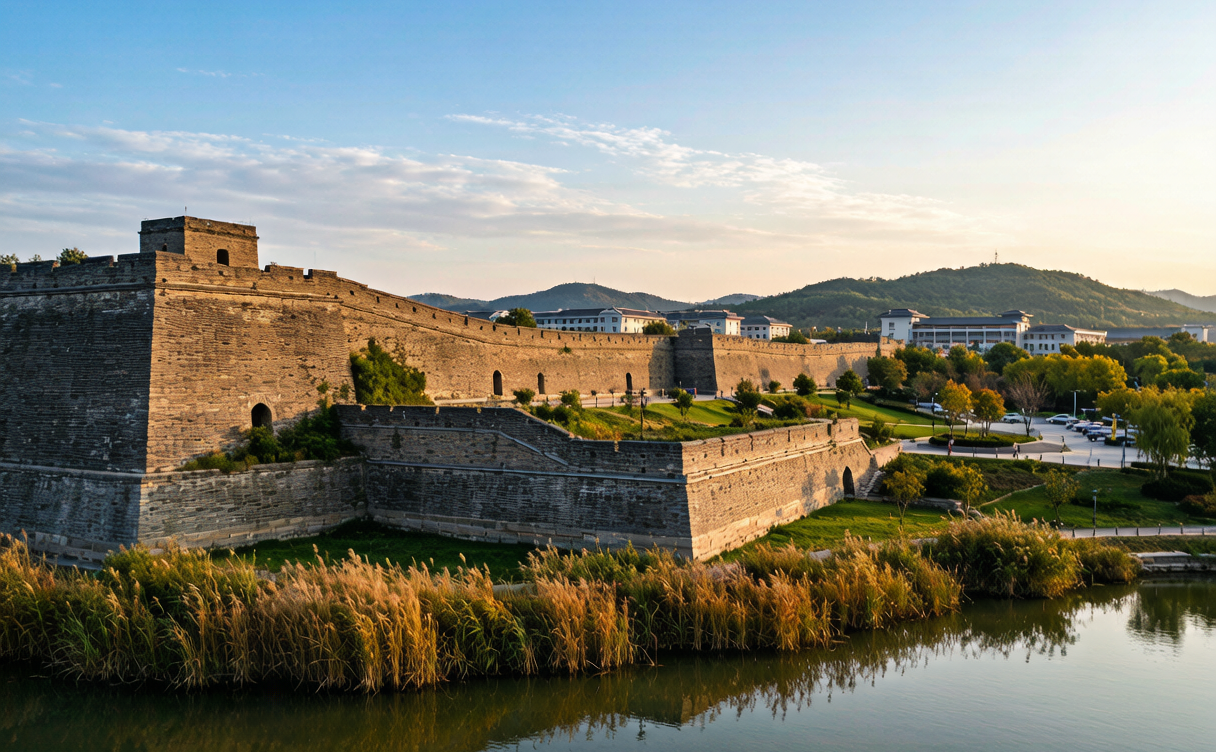
- 11:00 Sacrificial horse pit and the Qi Ancient City walls
- 13:00 Lunch in Linzi town
- 14:30 Football Museum, then return to the city
- 17:00 Train onward to Jinan or Qingdao
If you have a third day, take it in Boshan for glass workshops and sujuguo.
Practical Tips
- Barbecue restaurants rarely have English menus. Photograph the skewer trays and point, or use a translation app on the wall board.
- Grills are charcoal and genuinely hot. Do not wear anything you care about; the smoke gets into everything.
- Alipay and WeChat Pay are universal, including BRT fares. Cash works but exact change is scarce.
- Shandong drinking culture is enthusiastic. Toasts come fast; “I’m driving” is an accepted refusal.
- For broader background on the Qi capital and the region’s history, the Britannica entry on Zibo is a solid starting point.
FAQ
Is the Zibo barbecue hype still worth it?
Yes, though the mania has cooled. Queues are shorter than in 2023 and quality has stabilised. It remains one of the few Chinese food scenes where the eating technique itself is the attraction.
How many days do I need in Zibo?
Two. Day one for the city, Zhoucun and a barbecue dinner; day two for Linzi’s Qi sites. Add a third for Boshan if ceramics or hiking appeal.
Can I visit Zibo as a day trip from Jinan?
Easily — 25 to 35 minutes each way by high-speed rail. Go mid-afternoon, do a barbecue dinner and take a late train back. You will miss Linzi, but it makes a good evening.
Do I need to book barbecue restaurants in advance?
Not usually, but arrive before 17:30 on weekends. Popular places issue numbered tickets and hour-long waits are normal after 18:30 in peak season. Vegetarians do fine, incidentally — grilled aubergine, mushrooms, corn, leek and tofu skin are standard, though shared grills make strict avoidance hard.