

Tea in China is not a drink so much as a landscape, a calendar and a social code. Follow it and you end up in terraced hills above West Lake in early April, on a bamboo raft below the cliffs of the Wuyi Mountains, or in an ancient tea forest in Yunnan where the trees are taller than the pickers. This China tea tour guide maps the great tea regions, explains when each one harvests, shows you how to behave in a proper teahouse, and tells you how to buy good leaf at a fair price — plus how to sidestep the teahouse scam that still catches visitors in Beijing and Shanghai every week.
Why Build a Trip Around Tea
Tea travel solves a problem many second-time visitors have: what to do beyond the headline sights. Tea regions are rural, scenic, cheap and almost free of foreign tour groups, with built-in activities — picking, pan-firing, tasting — and some of China’s best food. Traditional Chinese tea processing joined UNESCO’s intangible heritage list in 2022, and several tea landscapes are World Heritage sites, including the plantations in the UNESCO listing for the West Lake Cultural Landscape.
Best Time to Visit: The Harvest Calendar
Timing matters more on a tea tour than on almost any other kind of trip.
Pre-Qingming (明前), roughly 20 March – 5 April. The premium window for green teas. Leaves picked before the Qingming festival are the smallest and sweetest of the year — Longjing from this period can cost ten times the summer grade. Hangzhou sits at 10–18°C with misty mornings; hotel rates climb.
Yuqian (雨前), 5–20 April. Larger leaves, better value, still excellent — my pick for a first tea trip, with picking in full swing.
Late April to late May. Oolong season. Anxi Tieguanyin is picked from late April, Wuyi rock tea in early May. Fujian runs 20–28°C and humid.
March–April in Yunnan. Spring Pu’er picking in Xishuangbanna and Lincang, days at 22–30°C under dry-season skies.
September–October. Autumn Tieguanyin, prized for aroma, plus 18–26°C nationwide and thinner crowds. See our best time to visit China guide for how tea season fits everything else. Avoid the Qingming holiday itself and the first week of October.
Regional Access at a Glance
| Region | Nearest city / airport | Best season | Approx. cost |
|—|—|—|—|
| West Lake Longjing, Zhejiang | Hangzhou / Xiaoshan (HGH) | Late Mar–mid Apr | Free–¥80 (US$0–11); day tour ¥250 (US$35) |
| Wuyi Mountains, Fujian | Wuyishan (WUS); HSR to Wuyishan East | Late Apr–May | ¥140–220 (US$20–31); raft ¥130 (US$18) |
| Anxi, Fujian | Xiamen (XMN), 2 hr by road | Late Apr–May; Sep–Oct | Free–¥60 (US$0–8); tastings free |
| Pu’er & Xishuangbanna, Yunnan | Jinghong (JHG) / Pu’er (SYM) | Mar–Apr | ¥60–120 (US$8–17); guided forest ¥300 (US$42) |
| Huangshan, Anhui | Tunxi (TXN); HSR to Huangshan North | Late Mar–Apr | ¥90–190 (US$13–27) |
| Mengding Mountain, Sichuan | Chengdu (CTU), 2 hr to Ya’an | Mar–Apr | ¥50 (US$7); Chengdu teahouse ¥15–40 |
All six are reachable by high-speed rail or a short flight plus a one- to three-hour road transfer. Chartered cars with a driver run ¥500–800 (US$70–113) per day.
The Six Great Tea Regions
Hangzhou: Longjing and the West Lake hills
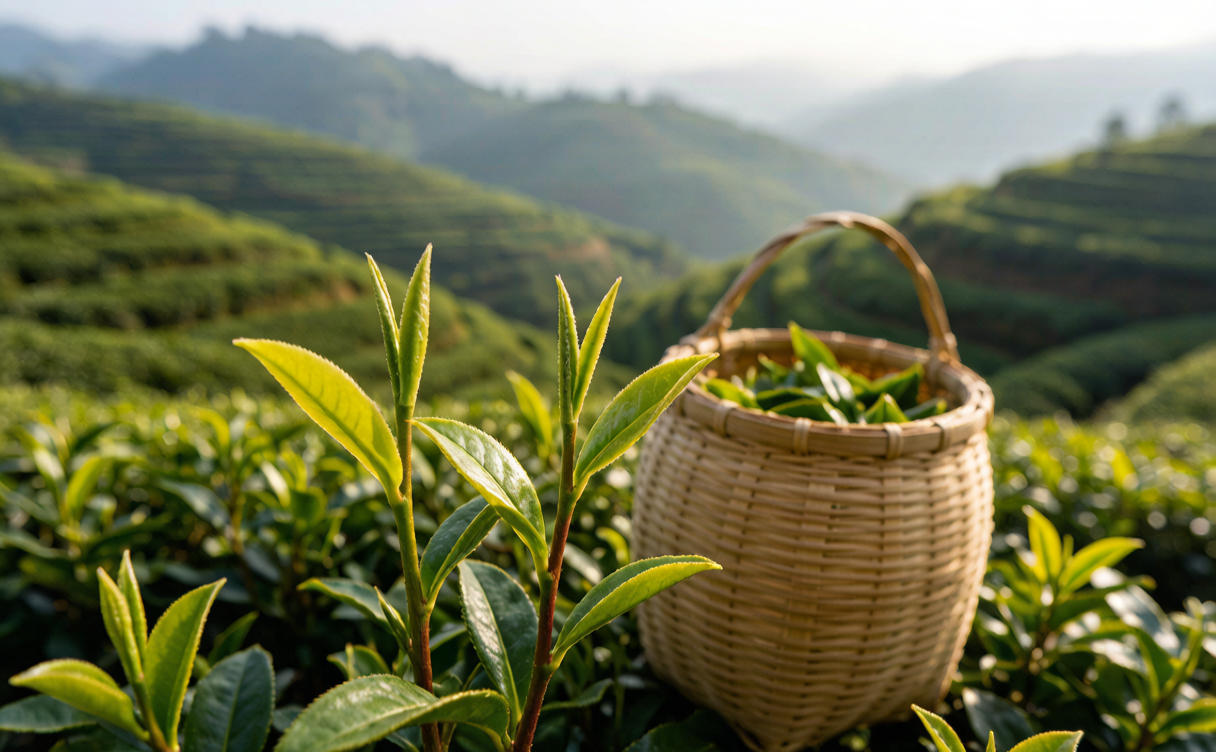
The most accessible tea country in China. Southwest of West Lake the hills fold into terraced plantations around Meijiawu and Longjing Village, both a 25-minute taxi ride from the centre. Meijiawu is better organised: family teahouses line the valley, most let you taste several grades free, and many offer picking-and-pan-firing sessions for ¥100–200 (US$14–28). The free China National Tea Museum has two branches, and the walk from Longjing Village to the Dragon Well spring and on to Nine Creeks is a lovely half-day.
Wuyi Mountains, Fujian: rock tea
Mount Wuyi is a UNESCO site for good reason: sheer red-rock cliffs, gorges, and the Nine-Bend River, descended on a bamboo raft poled by two boatmen. Tea grown in the crevices between those rocks — yancha, or rock tea — has a mineral, roasted character unlike anything else. Da Hong Pao is the famous name; the original mother bushes still cling to the cliff and are no longer picked. Nearby Tongmu village is the birthplace of Lapsang Souchong.
Anxi, Fujian: Tieguanyin
Two hours inland from Xiamen, Anxi county produces China’s best-known oolong across hills terraced to the ridgelines. Many workshops welcome visitors during the harvest, when leaves are withered, tumbled, rolled into tight pellets and roasted. Anxi is a working county rather than a scenic area, so hire a car and treat it as a day trip.
Yunnan: Pu’er and the ancient tea forests
Yunnan grows tea on trees, not bushes — some centuries old. The Jingmai Mountain old tea forests became a World Heritage cultural landscape in 2023, and villages such as Nannuo Mountain, Yiwu and Bulang Mountain let you walk among ancient trees with the Bulang and Dai communities who tend them. Base in Jinghong or Menghai.
Huangshan, Anhui: Maofeng and Keemun
The Yellow Mountains supply Huangshan Maofeng, a delicate green tea, while neighbouring Qimen county produces Keemun black tea, the backbone of English breakfast blends. The whitewashed Huizhou villages of Hongcun and Xidi are within an hour.
Sichuan: Mengding Mountain and Chengdu teahouses
Mengding Mountain near Ya’an is credited as the place where tea was first cultivated two thousand years ago, and the warm Sichuan basin gives it China’s earliest spring picking, often mid-March. Pair it with Chengdu’s teahouse culture: bamboo chairs under old trees, ¥15–40 for a bottomless glass of jasmine, ear-cleaners and card games.
Teahouse Etiquette and the Gongfu Ceremony
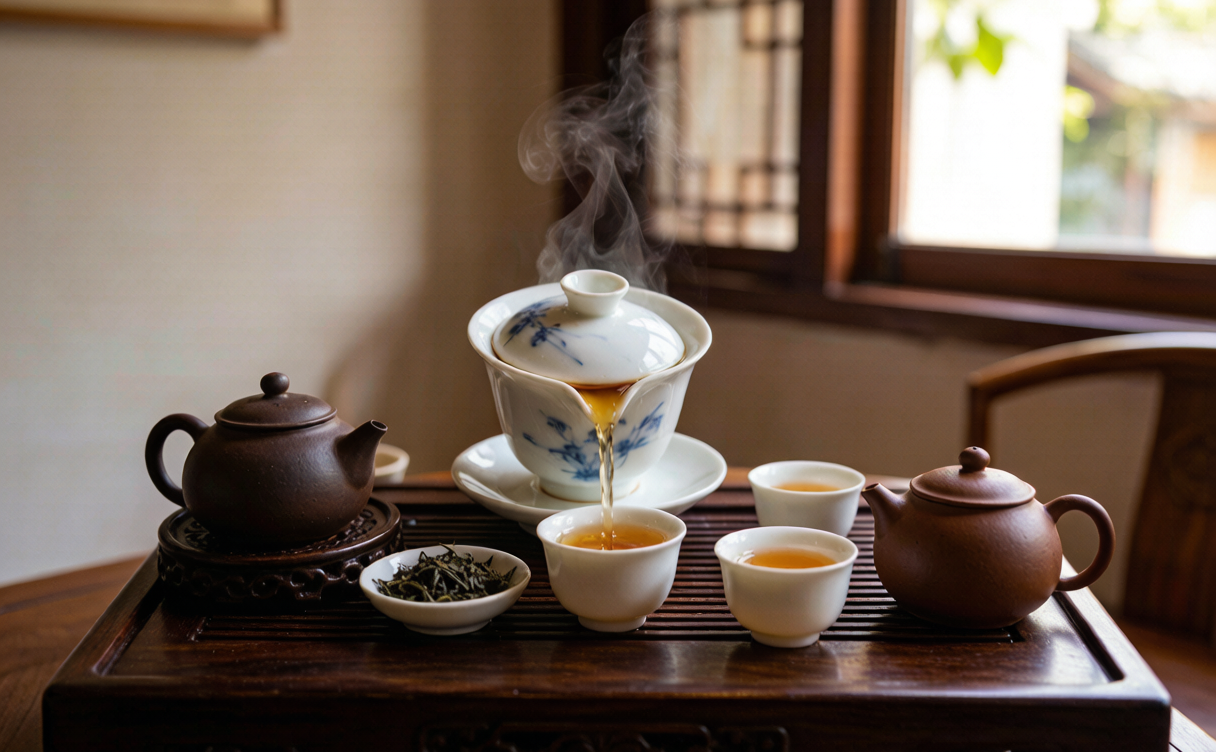
A formal tasting follows gongfu cha: small vessels, short infusions, many rounds. A few conventions:
- The first infusion is usually a rinse, poured away to wake the leaves. Do not drink it.
- Cups are small on purpose. Take three sips, and smell the empty cup — that is part of the ritual.
- When someone pours for you, tap two fingers on the table twice. It means thank you.
- Serve others first, refill the most senior person first, and never fill a cup to the brim.
- Ten to fifteen infusions from one leaf is normal for oolong and Pu’er; staying for all of them is a compliment.
Village tastings are often free if you buy tea; a structured ceremony costs ¥80–200 (US$11–28) per person.
Where to Stay
Tea-village guesthouses (Meijiawu, Longjing, Nannuo, Anxi) — ¥200–450 (US$28–63) per night, family-run, often with breakfast and unlimited tea. The most atmospheric option.
Scenic-area resorts (Wuyishan, Huangshan, Jingmai) — ¥500–1,200 (US$70–169) for mountain views, more in picking season.
City bases (Hangzhou, Xiamen, Chengdu, Jinghong) — ¥250–600 (US$35–85) mid-range, budget chains from ¥150 (US$21).
What to Eat on a Tea Tour
Tea country eats well, and several dishes use the leaf directly.
- Longjing shrimp (龙井虾仁) — river shrimp stir-fried with fresh green tea leaves, the signature Hangzhou dish.
- Tea-smoked duck (樟茶鸭) — Sichuan’s camphor-and-tea-smoked classic.
- Huizhou stinky mandarin fish (臭鳜鱼) and Mao tofu — pungent and superb around Huangshan.
- Wuyi mountain fare — bamboo-shoot stews, smoked river fish, wild mushroom soups.
- Dai food in Xishuangbanna — lemongrass-grilled fish, pineapple rice, food streets selling tea-leaf salad.
Sample Itinerary: Eight Days, Two Regions
Days 1–3 — Hangzhou
- Day 1: arrive; afternoon around West Lake; evening teahouse
- Day 2: 08:00 to Meijiawu for picking and pan-firing; Longjing shrimp for lunch; afternoon at the China National Tea Museum
- Day 3: 09:00 Longjing Village to Nine Creeks walk; 15:00 tea shopping; evening train to Fujian
Days 4–6 — Wuyi Mountains
- Day 4: arrive Wuyishan East; afternoon rock-tea tasting and roastery visit
- Day 5: 07:30 bamboo raft down the Nine-Bend River; 11:00 Tianyou Peak; 15:00 Da Hong Pao rock trail
- Day 6: Tongmu village for Lapsang Souchong
Days 7–8 — Xiamen and Anxi
- Day 7: transfer to Xiamen; Anxi day trip for Tieguanyin processing
- Day 8: Xiamen seafood, Gulangyu, departure
Practical Tips: Buying Tea Without Being Overcharged
- Always taste before you buy. Any legitimate shop will brew several grades at no charge. If they will not, walk out.
- Know rough prices. Everyday Longjing runs ¥300–800 per 500g; genuine pre-Qingming from a named village starts near ¥1,500. Drinking-grade Tieguanyin is ¥200–600 per 500g; a ripe Pu’er cake (357g) ¥150–500. Anything sold as “Da Hong Pao from the mother bushes” is not.
- Buy in tea country or at a wholesale market — Hangzhou, Guangzhou’s Fangcun or Beijing’s Maliandao — never at airports, hotel lobbies or scenic-area gift shops, where markups of 200–400% are standard.
- Check the packing date on sealed green tea; it fades within a year. Pu’er improves with age.
- Beware the teahouse scam. In tourist areas of Beijing (around Wangfujing) and Shanghai (Nanjing Road and the Bund), friendly English-speaking “students” invite you to a tea ceremony nearby. The tea is ordinary and the bill arrives at ¥2,000–5,000 with intimidation to follow. The rule: never go to a teahouse, bar or gallery with someone who approached you first on the street.
- Payment and shipping: Alipay and WeChat Pay work everywhere including village shops, and reputable sellers vacuum-seal and ship internationally — check your import rules.
FAQ
When exactly is the best time for a China tea tour?
Late March to mid-April for green teas in Zhejiang, Anhui and Sichuan; late April to May for Fujian oolongs; March to April for Yunnan Pu’er. September and October offer autumn oolong with fewer crowds.
Can I pick tea myself?
Yes. Family plantations around Meijiawu, Anxi and Nannuo run picking sessions during the harvest for ¥100–250 (US$14–35), usually including a pan-firing demonstration and tasting.
Do I need a guide or an organised tea tour?
Not for Hangzhou, Wuyishan or Chengdu, which are easy independently. For Yunnan’s ancient tea forests a local guide is genuinely useful — villages are scattered and roads rough. Budget ¥400–800 (US$56–113) per day.
How do I avoid fake tea?
Buy in the producing region, taste first, ask which village and picking date the leaf comes from, and be suspicious of famous names at bargain prices. Genuine Da Hong Pao, Lao Banzhang and pre-Qingming Longjing are expensive for structural reasons.
Written by Karl, last updated August 4, 2026.