

China is far more navigable for wheelchair users and travelers with limited mobility than its reputation suggests. The country’s vast high-speed rail network, rebuilt airport terminals, and a growing number of step-free tourist sites mean that with a little planning, accessible travel in China is genuinely achievable rather than aspirational. This guide collects practical, on-the-ground details — how to book wheelchair assistance on a Fuxing train, which Beijing and Shanghai sites have ramped routes, and what to expect from hotel bathrooms — drawn from the routes foreign visitors actually use. If you are still deciding when to come, our best time to visit China guide helps you dodge the worst heat and the National Day crowds, both of which complicate mobility.
Trains — Step-Free Rail Travel
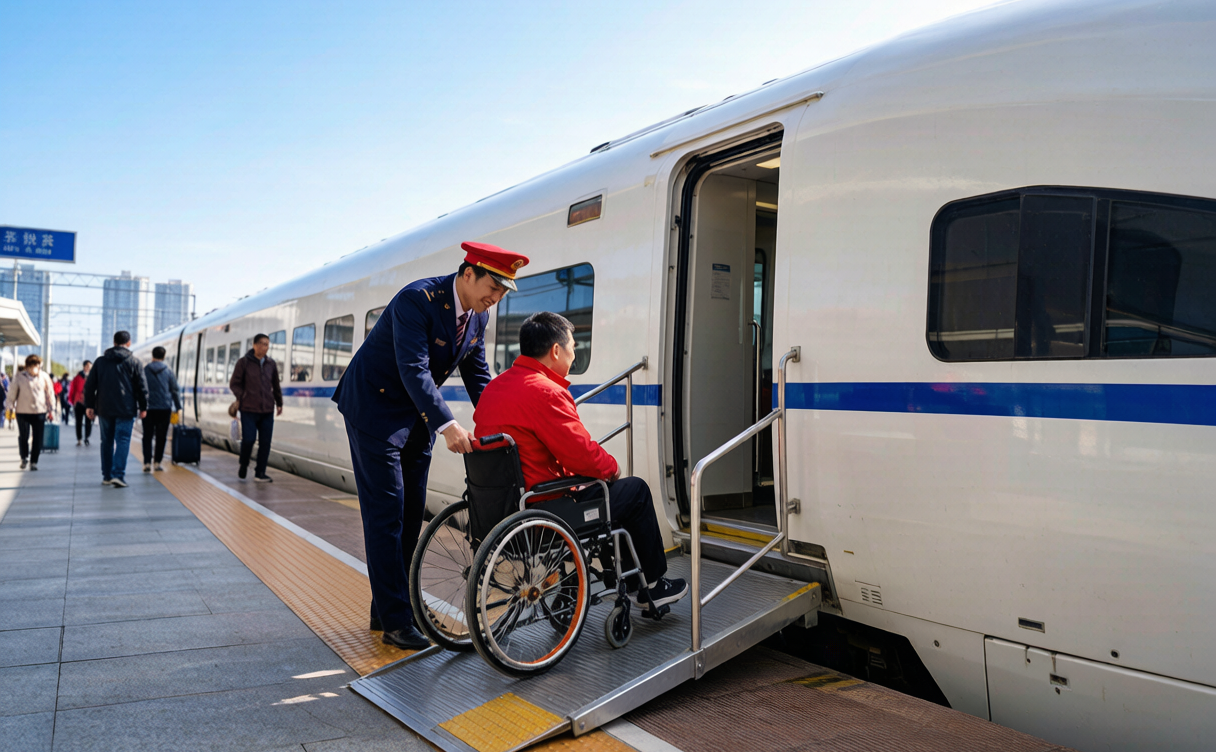
China Railway’s “Fuxing” (复兴号) and “Hexie” (和谐号) high-speed trains are the backbone of accessible travel China tips that actually work. Every Fuxing bullet train has a designated wheelchair bay with a securement point and an adjacent accessible toilet — wider door, grab bars, lowered sink — almost always in the middle car, typically Car 4 or Car 8, marked at the platform with a blue accessibility symbol. You do not pay extra for the service. The trick is booking it: when you reserve through 12306 or a travel agent, select the “priority seat / wheelchair” option and add a note; station staff meet you at the designated accessibility entrance and escort you via lift to the platform. At major hubs — Beijing South, Shanghai Hongqiao, Guangzhou South, Xi’an North — there are staffed assistance desks with loan wheelchairs and ramped boarding bridges. At smaller county stations, call ahead (the 12306 hotline, +86 12306) so a ramp and porter are ready; this works smoothly in places like Guilin and Lijiang. One honest caveat: the gap between platform and train is usually 10–15 cm with a small step, so a companion or staff lift is needed. Our things to know before visiting China guide covers the passport, app, and document steps that make train booking smooth.
Airports — Getting Through Terminals
China’s major airports are among the easiest places to move with a wheelchair. Beijing Daxing (PKX), Beijing Capital (PEK), Shanghai Pudong (PVG), Shanghai Hongqiao (SHA), and Chengdu Tianfu (TFU) all run free meet-and-assist wheelchair service: request it from your airline at least 48 hours before departure, and a staff member collects you at the curb, takes you through a dedicated security lane, and delivers you to the aircraft door (or to your seat on board). The Civil Aviation Administration of China publishes the accessibility service standards carriers must follow, and you can review the official framework at the CAAC website. Terminal design helps too — Daxing’s single-terminal radial layout means shorter indoor distances and plentiful elevators, while Pudong’s satellite concourse connects by step-free train. Battery rules for powered wheelchairs: airlines permit them if the battery is gel or dry-cell and under 300 Wh; wet-cell batteries are generally not accepted, so confirm with the carrier when you book.
Hotels — Finding Step-Free Rooms
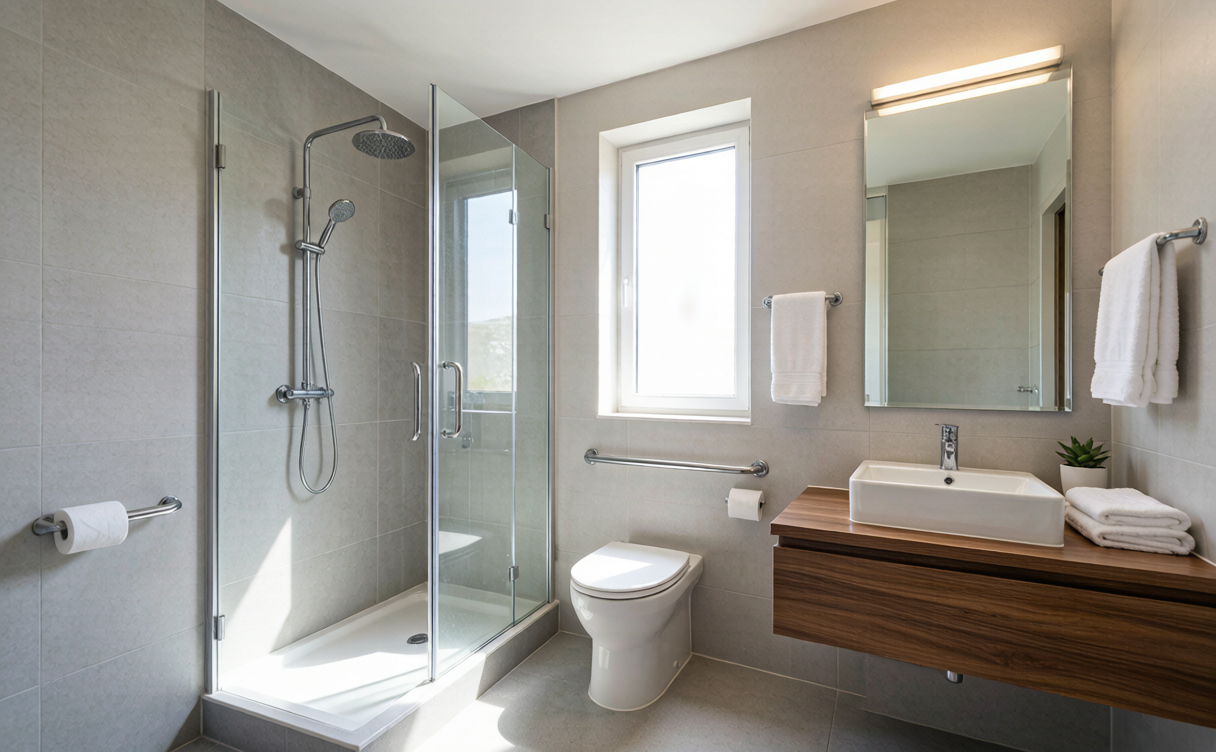
The gap between international-brand hotels and local budget properties is the single biggest variable in your trip. In Beijing, Shanghai, Guangzhou, Chengdu and Hangzhou, Marriott, Hilton, InterContinental and Shangri-La properties reliably offer “accessible rooms” with roll-in showers, lowered vanities, and widened doorways — book that room type explicitly and reconfirm by phone, because “accessible” is not always auto-assigned. Mid-range Chinese chains (Atour, Narada) in new buildings often have one or two step-free rooms but rarely advertise them, so call the property directly. Older, family-run guesthouses — common in places like Fenghuang or the hutongs — almost always have steps at the entrance and no elevator, and should be avoided if step-free is essential. A practical workaround: stay in a modern mall-hotel complex (common in tier-1 and tier-2 cities) where the lobby, restaurant and metro are all on one elevator network. For families traveling with both wheels and kids, our China family travel guide has stroller-and-wheelchair overlap tips.
Attractions — What’s Actually Wheelchair Friendly
Big-ticket sites vary enormously. Below is a realistic snapshot based on current conditions:
| Attraction | City | Wheelchair access | Practical notes |
|—|—|—|—|
| Forbidden City | Beijing | Good | Free wheelchair loan at entrance; main axis is flat, but watch threshold stones and cobbles |
| The Bund & Riverside | Shanghai | Excellent | Fully flat promenade; step-free Metro exits at East Nanjing Rd |
| West Lake loop | Hangzhou | Good | Paved lakefront road; some sightseeing boats have ramp boarding |
| Terracotta Army | Xi’an | Good | Ramped exhibition pits; reserved viewing platforms at Pit 1 |
| Li River cruise | Guilin | Partial | Ramped boarding dock; open upper deck reachable, lower cabin has steps |
| Zhangjiajie cable cars | Zhangjiajie | Partial | Cable cars step-free; summit viewpoints mix ramps and stairs |
The pattern: imperial and revolutionary sites (Forbidden City, the Xi’an walls’ elevator-equipped sections) and waterfront promenades are easiest, while mountain and karst scenery (Zhangjiajie, Huangshan, Guilin’s peaks) is partial at best — cable cars and lifts open the core, but summit boardwalks are often stepped. National parks with electric shuttle buses (Jiuzhaigou, Huanglong) let you ride most of the route and walk only the flat boardwalk segments.
Practical Tips for Accessible Travel in China
- Carry a small foldable ramp (30–40 cm) if you use a rigid wheelchair; it solves the train-step and curb gaps that staff may not have equipment for.
- Download the 12306 app and a translation app with “I need wheelchair assistance” saved in Chinese (我需要轮椅协助) — showing the phrase at any info desk gets fast help.
- Book airport assistance at the same time as your flight, not at check-in; last-minute requests are honored but slower.
- Metro step-freeness is improving but uneven: tier-1 lines built after 2010 have elevators, while pre-2000 stations often do not. The Baidu Maps app marks elevator exits (search 无障碍 / barrier-free) more reliably than Google.
- Taxis and DiDi rarely have ramps; for door-to-door needs, pre-book an accessible van transfer through your hotel or a tour operator.
- Travel insurance that covers mobility equipment is worth it — replacement wheels and batteries are hard to source same-day outside Beijing and Shanghai.
FAQ
Is high-speed rail truly wheelchair accessible, or just “tolerated”?
Genuinely accessible. Fuxing trains have a fixed wheelchair bay with tie-downs and an adjacent accessible toilet, and station staff provide ramp boarding if you request assistance when booking. It is one of the most reliable parts of accessible travel China offers.
Do I pay extra for wheelchair help on trains or planes?
No. Both the train wheelchair bay and airport meet-and-assist are free; you only pay your normal ticket fare.
Will my hotel actually have a roll-in shower, or just claim “accessible”?
International brands in major cities deliver on this consistently if you book the accessible room type and reconfirm. Local budget and heritage properties often cannot — verify by phone rather than trusting the listing.
Can I bring a powered wheelchair on a plane to China?
Yes, with conditions: gel or dry-cell batteries under 300 Wh are accepted; notify the airline 48 hours ahead and arrive early for battery inspection.
Is the Metro usable, or should I budget for cars?
Mixed. Newer lines in Beijing, Shanghai, Chengdu and Hangzhou have elevators at most stations; older lines may not. Budget for DiDi or pre-booked vans for at least some legs.
Are tourist sites staffed to help, or am I on my own?
Large sites (Forbidden City, Terracotta Army, West Lake) have assistance desks and loan wheelchairs. Smaller county attractions usually are not — plan those around a companion.
Written by Karl Huang, updated August 2026.