

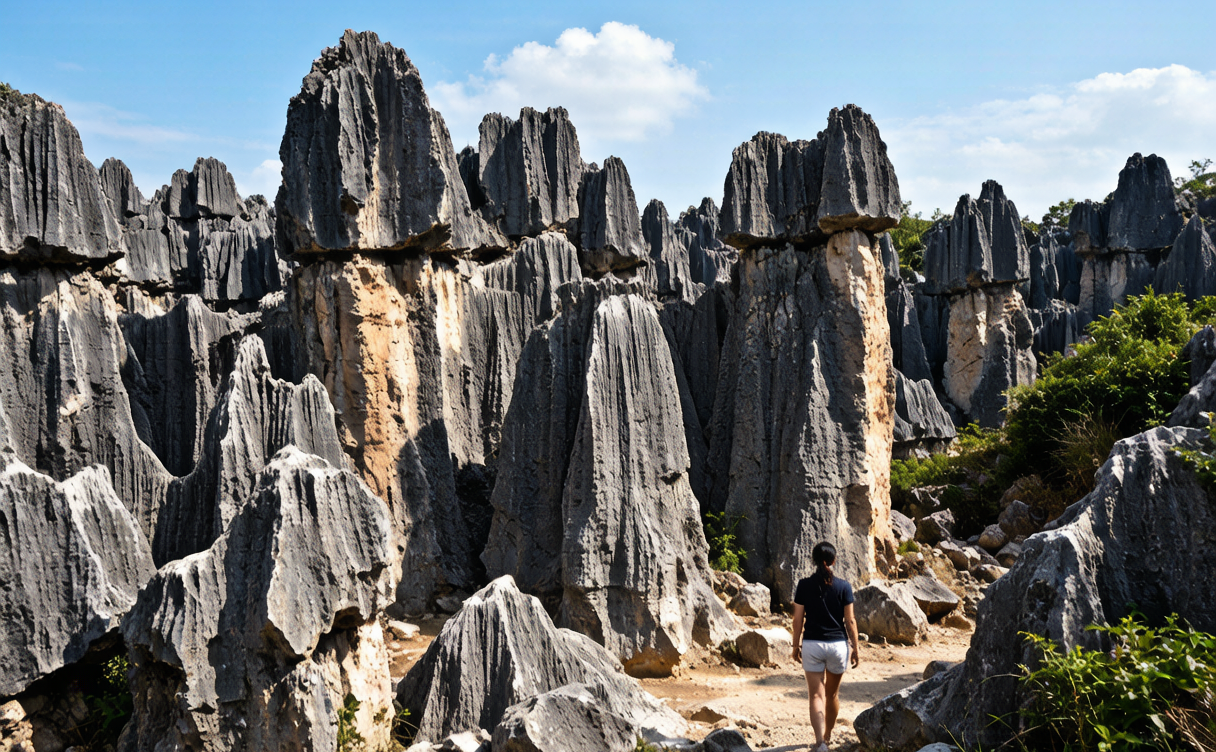
Imagine a forest where every tree is a limestone blade, some rising 30 meters, packed so tightly that paths squeeze between them like alleys in an old city. That is Shilin — literally “stone forest” — about 90 kilometers southeast of Kunming in Yunnan Province. The pinnacles here began forming some 270 million years ago on an ancient seabed, and today they make up the most visited section of the South China Karst World Heritage area. This Shilin Stone Forest guide explains how to get to Shilin from Kunming, how the ticket and shuttle system works, which zones reward slow walking, and how to dodge the tour-group tide that washes through at midday.
What Makes the Stone Forest Special
Plenty of places have karst scenery; almost nowhere has pinnacle karst this dense. Geologists treat Shilin as the world’s reference example of the formation — sword-like, blade-like and mushroom-shaped pillars separated by slot canyons barely a shoulder wide. The scenic area covers a huge territory, but the visitor core divides into the Major Stone Forest (the famous, sculpted, sometimes crowded heart), the Minor Stone Forest (open lawns, gentler formations, space to breathe) and the Naigu Stone Forest (a darker, more rugged annex several kilometers away that most tour buses skip). Interwoven with the geology is the culture of the Sani people, a branch of the Yi minority whose embroidery, torch festival and legend of Ashima — a girl said to have turned to stone here — give the rocks their local mythology. The UNESCO listing for the South China Karst covers Shilin alongside Libo and Wulong, and explains the science behind the spectacle.
Best Time to Visit Shilin
Kunming is nicknamed the Spring City, and Shilin shares its forgiving climate. The best time to visit Shilin is March to May and September to November: dry-ish, sunny, 15–25°C. June to August brings the rainy season — usually short afternoon bursts rather than washouts, and the surrounding countryside turns intensely green. Winter days are often clear and mild (10–15°C) though mornings are cold. Two timing notes matter more than the season. First, arrive at opening (typically around 8am) or after 3pm; tour groups from Kunming dominate 10am–2pm. Second, if you can, catch the Torch Festival in late July or early August, when Sani wrestling, bullfighting and evening torch parades take over the area — spectacular, but book rooms early. Our overview of the best months to travel in China helps you slot Yunnan into a longer route.
How to Get to Shilin
Shilin is one of the easiest day trips in Yunnan thanks to a dedicated high-speed rail stop.
| Route | Option | Time | Approx. Cost |
|—|—|—|—|
| Kunming → Shilin West | High-speed train | 20–30 min | RMB 25–40 (US$4–6) |
| Shilin West Station → park gate | Shuttle bus / taxi | 15–20 min | RMB 5–25 (US$1–4) |
| Kunming East Bus Station → Shilin | Direct bus | 1.5–2 hours | RMB 30–40 (US$4–6) |
| Kunming hotel pickup | Organized day tour | Full day | RMB 250–400 (US$35–56) |
| Kunming → Shilin | Private car/DiDi | 1.5 hours | RMB 250–350 one way |
The train is the clear winner: frequent departures, 30 minutes or less, and the connecting shuttle is signposted in English. Buy tickets on the 12306 app or at the station with your passport — first-timers can lean on our China high-speed train guide for foreigners for the booking walkthrough.
Tickets, Shuttles and Park Layout
Entry costs around RMB 130 (US$18), with discounts for students and seniors; children under 1.2 m typically enter free. An electric shuttle cart (about RMB 25) runs the 2–3 km from the visitor center to the core scenic zone — worth it inbound to save your legs for the labyrinth, optional outbound. The park typically opens around 8am and admits visitors until late afternoon. Tickets are sold at the gate and via WeChat mini-program; carry your passport either way.
Once inside, paths split constantly. The Major Stone Forest holds the icons: Sword Peak Pond, where grey blades rise straight from green water; the Ashima Rock, the stone silhouette of the Sani heroine; and a viewing pavilion on top of a pinnacle cluster with a panorama over the whole grey sea. The Minor Stone Forest, five minutes’ walk away, swaps drama for meadows and picnic space. Naigu Stone Forest requires a separate shuttle connection and feels almost private on weekdays.
Top Experiences and Walking Routes
The Classic Loop (2–3 hours)
Shuttle to the core, then walk Sword Peak Pond → Lotus Peak viewing pavilion → the narrow slot passages of the Major Stone Forest → Ashima Rock → out through the Minor Stone Forest lawns. This covers the postcard views and the fun claustrophobic corridors where you turn sideways to pass.
The Quiet Extension (add 2 hours)
Continue to Naigu Stone Forest, whose darker, more jagged dolomite pillars see a fraction of the crowds. Trails are rougher and the mood is wilder — bring water and decent shoes.
Sani Culture
Sani women in embroidered dress work as guides throughout the park, and scheduled song-and-dance performances run near the Minor Stone Forest most days. It’s touristy, but rooted in a living community; the Torch Festival period shows the culture at full volume. Embroidered bags and wall hangings at village stalls outside the gate are better value than inside.
Photography Timing
Shoot early or late. Low sun rakes across the pinnacles and gives them depth; midday light flattens the grey stone into a single tone and fills every corridor with tour umbrellas. The pavilion panorama works best in the morning; Sword Peak Pond’s reflections are calmest right after opening. Overcast days are actually kind to the stone — the textures read beautifully without harsh shadow.
Where to Stay
Most travelers day-trip from Kunming, which has the full spread of hostels, international chains and old-town boutiques — see our Kunming travel guide for neighborhoods and hotel picks. Sleeping in Shilin county town (RMB 150–300 for a clean business hotel) buys you an 8am start with empty paths, and a handful of guesthouses sit within walking distance of the gate. There’s no in-park accommodation.

What to Eat
Shilin county is famous across Yunnan for roast duck (Yiliang-style, crisp-skinned, ordered by the half). Inside and around the park you’ll find rice-noodle shops serving guoqiao mixian (“crossing-the-bridge noodles”), Yunnan’s DIY hot-broth classic, plus grilled goat cheese (rushan) sold on sticks — a Sani and Bai specialty worth trying once. Back in Kunming, wild-mushroom hotpot restaurants are the summer event meal. Food inside the scenic area is limited and marked up; eat a proper lunch in the county town or carry snacks.
Sample Itinerary: 1 Day from Kunming
- 7:30am — High-speed train from Kunming Station to Shilin West (about 25 minutes).
- 8:15am — Shuttle to the park gate; buy tickets, ride the cart to the core zone.
- 8:30–11:30am — Classic loop through Major and Minor Stone Forests before the group surge.
- 11:30am–1pm — Roast-duck lunch in Shilin county town.
- 1–3pm — Naigu Stone Forest extension, or return for the panorama pavilion in changing light.
- 4pm — Train back to Kunming in time for dinner.
Overnighting? Do the core zone at 8am, Naigu mid-morning, and spend the afternoon in a Sani village outside the gates.
Practical Tips
- Paths are stone and mostly flat, but slot passages have steps and low overhangs — fine for kids, harder for strollers and wheelchairs beyond the main plaza.
- Sun protection matters at 1,700 m elevation; the stone reflects a lot of light.
- QR-code payments rule; load Alipay or WeChat Pay before the trip.
- Keep your passport handy for both train and park tickets.
- Freelance “guides” at the gate vary in quality; the official Sani guides inside are licensed and worthwhile if you want the legends explained.
- Last shuttles back to Shilin West station run late afternoon — confirm the time when you arrive rather than assuming an evening service.
FAQ
Is the Stone Forest worth it, or is it a tourist trap?
It’s genuinely one of the world’s great karst landscapes. The trick is timing: at 8am it feels primeval; at noon it feels like a theme park. Go early.
How long do I need?
Three hours covers the core. A full day adds Naigu and the quieter corners, which is where things to do in Shilin multiply.
Can I visit without a tour?
Easily. The train-plus-shuttle combination is straightforward, and signage is bilingual throughout.
Is Shilin doable with children?
Yes — the maze-like corridors are a hit with kids, and the shuttle carts shorten the walking. Watch small children near pond edges and drop-offs.
How high is Shilin? Will altitude affect me?
About 1,700–1,900 m, similar to Kunming. Most people feel nothing beyond slightly quicker breathlessness on stairs.
Does it rain a lot?
June–August afternoons often bring showers. Mornings are usually clear, which is one more argument for an early start.
Written by Karl Huang, updated July 2026.