

Most write-ups treat Jiuzhaigou as one place. On the ground it’s three: a Y-shaped system of valleys in northern Sichuan where the Shuzheng, Rize and Zechawa branches each have their own character, lake chemistry and crowd rhythm. Understanding that Y — and how the shuttle buses run along it — is the difference between a day spent queueing and a day spent walking empty boardwalks past water in shades of blue that look faked. This Jiuzhaigou guide is deliberately narrow: it maps the three valley branches lake by lake, lays out a shuttle strategy that beats the tour flow, pins down seasonal color timing, and updates the post-earthquake picture. For the broader basics — history, regional context, combined trips with Huanglong — start with our general Jiuzhaigou travel guide and come back here to plan the day itself.
The Y-Shape: How Jiuzhaigou Is Actually Laid Out
From the entrance, the Shuzheng Valley runs 14 km up to Nuorilang, where the road forks. The right branch (facing uphill) is Rize Valley, climbing 18 km to the Primeval Forest; the left branch is Zechawa Valley, running 18 km up to Long Lake, the park’s highest point at about 3,100 m. Shuttle buses ply all three arms; boardwalks parallel the road for almost the entire Shuzheng and Rize sections. That geography dictates strategy: the crowds move as a wave, and you can surf ahead of it or drown in it.
Rize Valley: the masterpiece branch
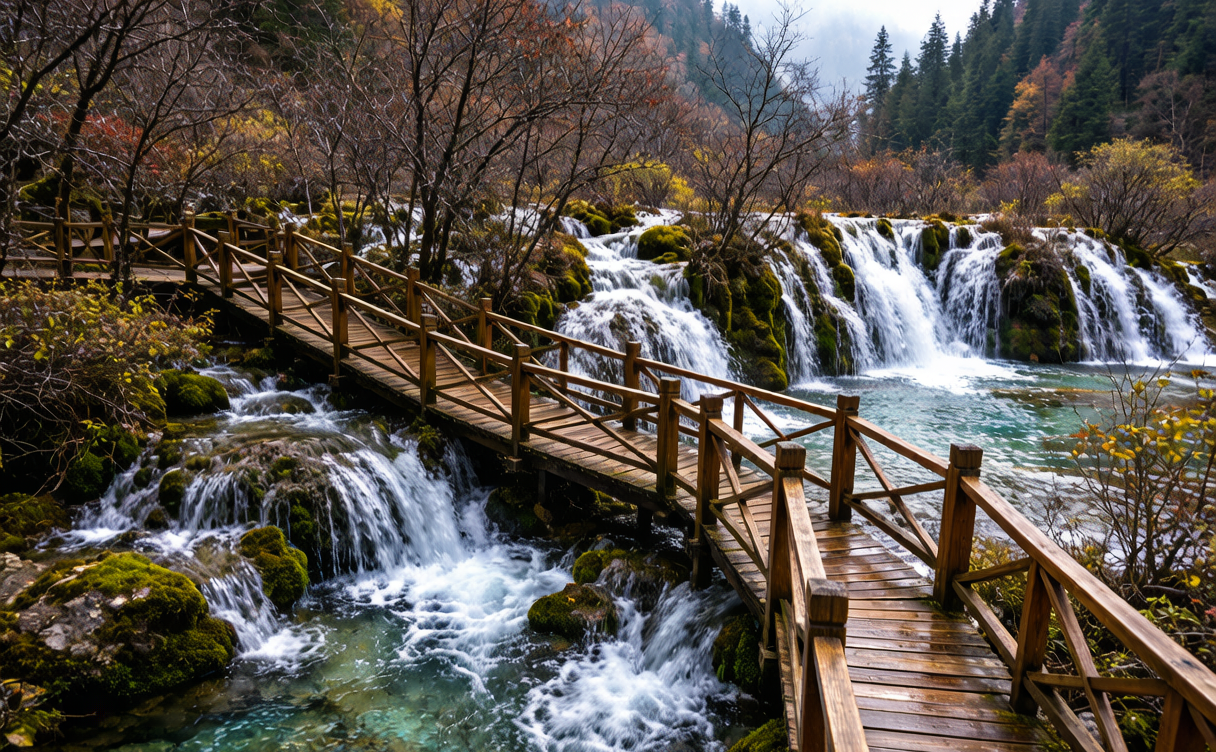
If Jiuzhaigou has a greatest-hits reel, it’s Rize. From the top: the Primeval Forest (quiet spruce woods, often skippable if time is tight), Swan Lake, Grass Lake, then the sequence that fills camera rolls — Arrow Bamboo Lake, Panda Lake and its multi-tier waterfall, Five Flower Lake, and Pearl Shoal with its wide, glassy waterfall. Five Flower Lake is the park’s single most photographed spot: a shallow, mineral-rich basin where sunken tree trunks lie preserved under turquoise-and-amber water. The walk from Arrow Bamboo Lake down to Mirror Lake (about 5–6 km of boardwalk, almost all gently downhill) is the best half day in the park.
Shuzheng Valley: the lake staircase
The lower branch stacks 19 lakes behind natural travertine dams like a giant’s rice terraces. Highlights climb from Bonsai Shoal and the Reed Lake wetlands through the Shuzheng Lakes cluster and Shuzheng Falls to Rhinoceros Lake — big, deep and famous for morning reflections — and Nuorilang Falls, a 320-meter-wide travertine curtain that is China’s widest highland waterfall. Because every bus passes through Shuzheng, it’s busiest mid-morning; walk it in late afternoon when tour groups have retreated toward the exit.
Zechawa Valley: altitude and silence
Zechawa trades lake density for scale. Its stars are the Five-Color Pond — small, intensely saturated, arguably the deepest color in the park — and Long Lake, a 7-km alpine ribbon under snow peaks. There’s little boardwalk between them worth walking; ride the shuttle up to Long Lake, walk the rim viewpoint, then bus down to Five-Color Pond. Air is noticeably thinner here; take stairs slowly.
Shuttle Strategy: Beating the Wave
Park shuttles (included in the roughly RMB 90 bus ticket, on top of the RMB 80–190 seasonal entry fee) run from the gate starting when the park typically opens around 8am. Nearly everyone rides to Nuorilang first, and most tours then push up Rize. Use one of these patterns:
1. Classic contrarian: first bus all the way up Zechawa to Long Lake while the masses fill Rize. See Long Lake and Five-Color Pond by 10am, then walk Rize downhill from Arrow Bamboo Lake in the late-morning gap, and finish with Shuzheng’s lakes after 3pm.
2. Photographer’s order: straight to Five Flower Lake at opening for still water and first light through the trees, then up to the top of Rize, then Zechawa after lunch, Shuzheng last.
3. One-way walker: bus to the Primeval Forest and walk essentially the whole Rize branch down — 18 km, boardwalked, downhill — hopping buses only across dull stretches.
Buses are frequent (every few minutes on main segments) and stops are bilingual. The key rule: never queue uphill at Nuorilang mid-morning; that junction is the park’s one true bottleneck.
Seasonal Color Timing
The best time to visit Jiuzhaigou depends on which show you want:
- Mid-October to early November is the legendary window: birch and maple turn gold and crimson against turquoise water, peaking usually in the last ten days of October. It’s also peak demand — book entry tickets (daily visitor caps apply) and rooms weeks ahead, and avoid the Oct 1–7 holiday entirely.
- April–May brings snowmelt-fed waterfalls at full power and fresh green forest, with light crowds.
- June–September is lush and warm but includes the rainy stretch; lakes stay vividly colored even under cloud because the hue comes from dissolved minerals and lakebed algae, not sky reflection.
- December–March is the quiet secret: partially frozen falls, snow-dusted pines, discounted tickets, though some upper sections may close in deep winter.
Slot the valley into a wider route with our month-by-month China timing guide.
Post-Earthquake Status: What’s Changed
The magnitude-7.0 earthquake of August 2017 hit the park hard — Sparkling Lake drained, Nuorilang Falls cracked, and Jiuzhaigou closed for extended restoration. The park has since fully reopened in stages, with daily visitor caps and a rebuilt boardwalk network. Two honest notes: Sparkling Lake is gone as it was, now a marshy basin returning to wetland, and a few minor viewpoints remain fenced during ongoing slope stabilization. Nuorilang Falls was repaired using natural travertine material and flows again. The upside of reconstruction is real — newer boardwalks, better signage, a smoother reservation system — and the core lakes (Five Flower, Five-Color Pond, Long Lake, the Shuzheng chain) look as impossible as ever. Check the official notices via the park’s channels or the UNESCO listing for Jiuzhaigou Valley Scenic and Historic Interest Area for current conditions.
How to Get to Jiuzhaigou
| Route | Option | Time | Approx. Cost |
|—|—|—|—|
| Chengdu → Jiuzhai Valley (Huanglong) Airport | Flight | ~1 hour + 1.5 hr drive | RMB 600–1,200 (US$85–170) |
| Chengdu → Zhenjiangguan/Chuanzhusi Station | Train (Chengdu–Lanzhou line) + bus | ~2 hrs rail + 1.5–2 hr bus | RMB 150–250 combined |
| Chengdu Chadianzi → Jiuzhaigou | Long-distance bus | 8–10 hours | RMB 150–170 (US$21–24) |
| Chengdu → Jiuzhaigou | Private car / small-group transfer | 7–8 hours | RMB 1,500–2,500 per vehicle |
| Songpan/Huanglong → Jiuzhaigou | Bus or transfer | 2–3 hours | RMB 50–120 |
The rail-plus-bus combination via the Chengdu–Lanzhou line has become the most reliable budget option; booking works the same as any Chinese high-speed route — our train guide for foreign travelers covers the passport and app details.
Where to Stay
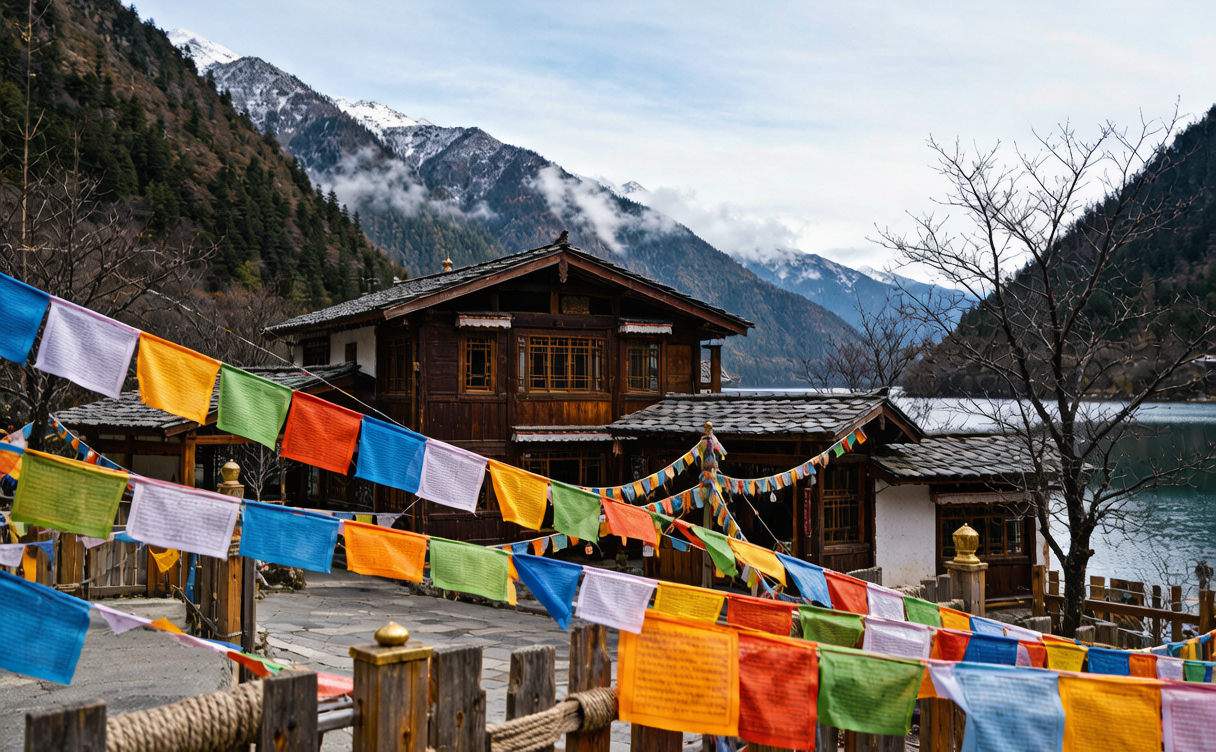
Accommodation clusters in Zhangzha town near the park gate: everything from RMB 150 hostels to full resorts (several international five-stars sit within 10 minutes of the entrance, RMB 900–2,000+). Tibetan-run guesthouses in the surrounding villages add character and home cooking for RMB 200–400. Staying within walking or short-taxi distance of the gate matters — you want to be in the first shuttle wave. There is no overnight accommodation inside the park.
What to Eat
Zhangzha’s dining is a mix of Sichuan standards and Tibetan plateau cooking: yak-meat hotpot, tsampa, butter tea, and hand-pulled beef noodles for cold mornings. Inside the park, food service concentrates around the Nuorilang center — functional, not memorable — so many walkers carry a packed lunch and eat at a lakeside rest deck. Evening options in town include decent Sichuan skewers and a few Tibetan dinner-show restaurants; skip the show, keep the momos.
Sample Itinerary
One day (fit but rushed): first shuttle to Long Lake and Five-Color Pond; bus down and up to Arrow Bamboo Lake by late morning; walk Rize’s lake sequence down past Five Flower Lake and Pearl Shoal to Mirror Lake; bus to Nuorilang Falls; walk or hop buses down Shuzheng’s lakes; exit by 5pm.
Two days (recommended pace): Day 1 — Rize branch thoroughly on foot, Primeval Forest to Nuorilang. Day 2 — Zechawa in the morning, Shuzheng in the afternoon, with a second dawn visit to whichever lake stole your heart. Second-day re-entry policies have varied since reopening; confirm current rules when buying your first ticket rather than assuming.
Practical Tips
- Altitude runs 2,000–3,100 m. Hydrate, skip alcohol the first night, and take Zechawa’s stairs slowly.
- Weather flips fast; carry layers and a rain shell even under blue morning skies.
- Buy entry tickets online in advance during October — daily caps do sell out.
- Boardwalk distances deceive: walking “just Rize” is a 15+ km day. Comfortable shoes, not sandals.
- Drones are prohibited inside the park.
- Mornings before 9am and the hour before closing deliver the reflections; wind ruffles the lakes from late morning.
FAQ
Which branch should I prioritize with limited time?
Rize, specifically Arrow Bamboo Lake down to Pearl Shoal. Add Five-Color Pond in Zechawa if you have two extra hours.
Is Jiuzhaigou fully open after the earthquake?
Yes — the park reopened fully in stages, with daily visitor caps and rebuilt boardwalks. A few minor viewpoints stay fenced; Sparkling Lake no longer exists in its old form.
Can I walk instead of using shuttles?
On Shuzheng and Rize, mostly yes — continuous boardwalks parallel the road. Zechawa’s stretch between Five-Color Pond and Long Lake is best bused.
How cold is late October?
Expect frosty dawns around −2 to 5°C and daytime 10–15°C. The color payoff justifies the gloves.
Is it manageable with kids or older travelers?
Yes — shuttles connect every major sight, and how much you walk is entirely elective, which is why this is one of the best things to do in Jiuzhaigou country for mixed-age groups; see our family travel guide to China for altitude notes with children.
Do I need a guide?
No. Signage is bilingual, the shuttle system is simple, and this guide plus the park map covers routing.
Written by Karl Huang, updated July 2026.