

Worried you will be lost without language skills? The good news is that learning a handful of Mandarin phrases for travelers will take you surprisingly far in mainland China. English signage is common in major hubs, and translation apps do heavy lifting, but a few spoken words earn smiles, smoother service, and easier negotiations. This guide gives you practical survival Chinese, explains how to say thank you in Chinese, covers taxi and restaurant phrases, and answers the big question: do people speak English in China?
Do People Speak English in China?
In Beijing, Shanghai, and Guangzhou, you will meet young people and hospitality staff with workable English, especially in hotels, airports, and chain stores. Outside those bubbles, English drops off sharply. In smaller cities, rural areas, and local restaurants, almost no one speaks English. Train station announcements, menus, and street signs are usually in Chinese only.
The practical takeaway: do not assume English will save you. Learn a core set of basic Chinese for tourists, pair it with a translation app, and you will navigate confidently. For broader context before you fly, read our things to know before visiting China.
Pronunciation Basics: Pinyin and Tones
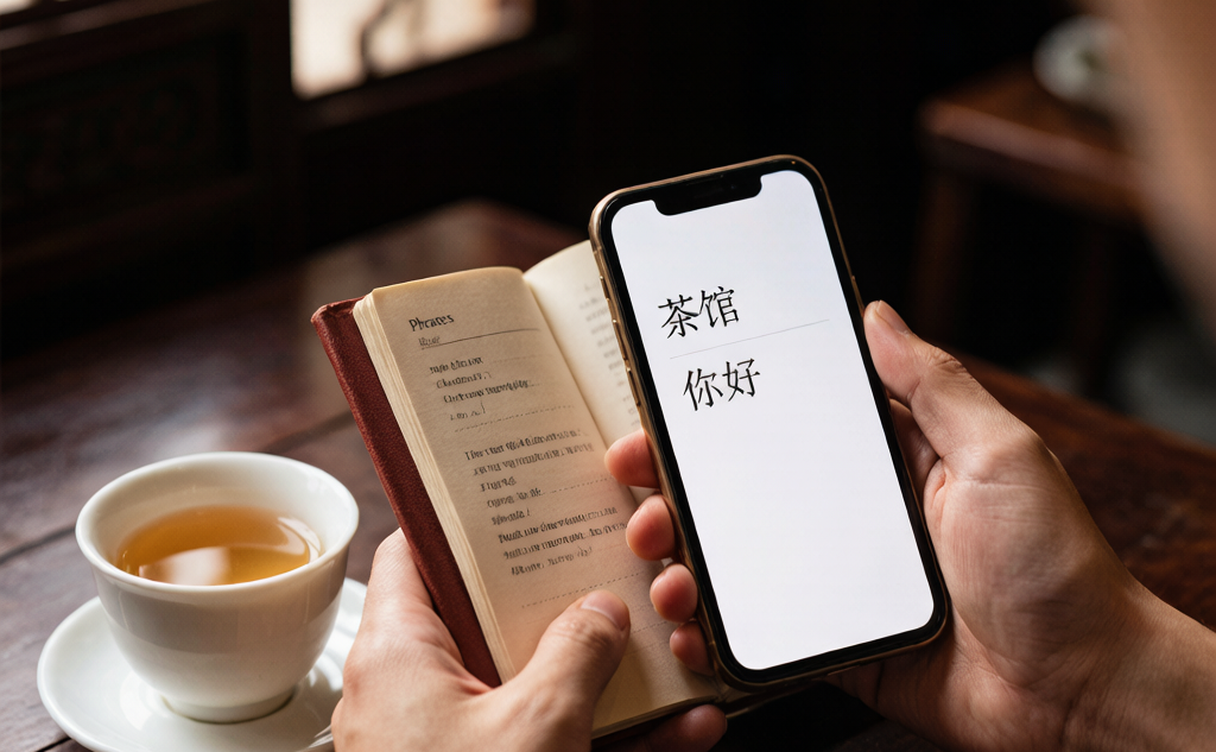
Mandarin uses pinyin (Romanized spelling) and four main tones. Tones change meaning, but travelers are forgiven for imperfect tone—locals usually understand from context. Speak slowly, and when stuck, show the Chinese characters on your phone. According to Wikipedia’s overview of Standard Chinese, Mandarin is the most spoken native language in the world, so even rough attempts are appreciated.
Must-Know Greetings and Politeness
These open nearly every interaction:
- Hello — 你好 (nǐ hǎo)
- Thank you — 谢谢 (xiè xie)
- You’re welcome — 不客气 (bú kè qi)
- Sorry / excuse me — 对不起 (duì bu qǐ)
- Goodbye — 再见 (zài jiàn)
- Please — 请 (qǐng)
Learning how to say thank you in Chinese (谢谢, xiè xie) is the single most useful habit. Pair it with a slight nod and you signal respect anywhere.
Getting Around: Taxi and Direction Phrases
Transport is where language gaps hurt most. Memorize these:
- Where is the subway? — 地铁在哪里? (dì tiě zài nǎ lǐ?)
- I want to go to… — 我要去… (wǒ yào qù…)
- How much is the fare? — 多少钱? (duō shao qián?)
- Please use the meter — 请打表 (qǐng dǎ biǎo)
- Left / right / straight — 左 / 右 / 直走 (zuǒ / yòu / zhí zǒu)
- Stop here — 在这里停 (zài zhè lǐ tíng)
For deeper city mobility, our China travel guide for first-timers covers apps and etiquette.
Eating Out: Restaurant and Food Phrases
Food is the heart of Chinese travel, and Chinese phrases for taxi and restaurant situations overlap heavily. Try these at the table:
- I want this (point) — 我要这个 (wǒ yào zhè ge)
- Is it spicy? — 辣不辣? (là bu là?)
- Not spicy, please — 不要辣 (bú yào là)
- The bill, please — 买单 (mǎi dān)
- Delicious — 好吃 (hǎo chī)
- I don’t eat… — 我不吃… (wǒ bú chī…)
Menus are often picture-based or QR-coded, which helps enormously. To order like a local without reading Chinese, see our how to order food in China with an app.
Shopping and Bargaining
- How much? — 多少钱? (duō shao qián?)
- Too expensive — 太贵了 (tài guì le)
- Can you lower the price? — 便宜一点? (pián yi yì diǎn?)
- I’ll take it — 我要了 (wǒ yào le)
Emergency and Safety Phrases
Keep these handy and store them offline:
- Help! — 救命! (jiù mìng!)
- Call the police — 报警 (bào jǐng)
- I need a doctor — 我要看医生 (wǒ yào kàn yī shēng)
- I lost my passport — 我的护照丢了 (wǒ de hù zhào diū le)
Our China travel safety tips explain what to do if something goes wrong.
Translation Apps That Actually Work in China
Even with survival Chinese, an app is your best friend. Top picks:
- Google Translate (download the Chinese offline pack before arrival; note it may be unreliable without a VPN—see how to use the internet in China).
- Pleco — excellent Chinese dictionary with camera lookup.
- Baidu Translate and Tencent Translate — work well inside China’s network.
- WeChat translate — built into the super-app many travelers already use.
Point your camera at a sign or menu and these apps render readable English in seconds.
Another useful habit is to save key Chinese characters as images in a notes app—your hotel name, the train station, and a phrase like “I am lost, please help.” When speech fails, simply showing the screen resolves most situations faster than gestures. Practice reading a few characters too: 出口 (exit), 入口 (entrance), 男 (men), 女 (women), and 卫生间 (restroom) appear constantly and save you from wandering. Combining spoken phrases, written characters, and a translation camera gives you three layers of backup, so a dead battery or noisy street never leaves you stranded.
Payment and Tech Phrases You’ll Need
Mobile payments dominate. You may hear “扫一下” (sǎo yí xià, “scan once”) when a vendor wants you to scan a QR code. Setting up Alipay or WeChat Pay in advance removes a major friction point—our Alipay and WeChat Pay guide for foreigners walks you through it.

A Simple Daily Practice Routine
You do not need fluency. Spend 15 minutes a day for a week before departure:
1. Learn greetings and thank-you.
2. Memorize directions and “how much.”
3. Practice restaurant phrases aloud.
4. Save emergency phrases as phone notes.
5. Install and test a translation app offline.
This modest effort delivers outsized confidence. Locals warm to visitors who try, and small phrases prevent big misunderstandings.
Common Phrase Mistakes to Avoid
Even with survival Chinese, learners trip on a few patterns. First, tone errors are usually forgiven, but confusing similar-sounding words is not—practice “shi” (yes/is) versus “si” carefully, since they sit near the edge of what ears catch. Second, avoid shouting; speaking louder does not make Mandarin clearer, it just stresses everyone. Slow down instead.
Another mistake is relying only on English place names. Locals use Chinese names, so save the characters for your hotel and key sights in your phone before you need them. Also, don’t over-apologize with “duibuqi” for tiny things; a simple “excuse me” gesture works better in a crowd. Finally, learn to recognize “mei you” (there isn’t / sold out) and “man le” (full), two phrases that will save you from walking into dead ends at busy venues.
Reading the Room Without Words
Body language carries far in China. A palm-up slight wave means “come here” or “a little,” while a quick shake of the hand with a smile softens a refusal. Nodding can mean “I hear you,” not always “yes,” so confirm important details by repeating them back. Pointing with a full open hand rather than a single finger is more polite. When a vendor laughs at your pronunciation, it is usually delight, not mockery—lean into it and the interaction turns warm.
Final Thoughts
Mastering Mandarin phrases for travelers is less about grammar and more about goodwill. A confident “谢谢” and a translation app will carry you through nearly any situation in China. Prepare a core vocabulary, lean on technology, and treat each interaction as part of the adventure. You will travel lighter—linguistically and mentally.