

I had seen photographs of Wulong Tiankeng before I ever set foot in Chongqing, and I told myself they had to be edited. No natural sinkhole could possibly swallow a cathedral whole. Then I stood at the rim of Tianlong Tiankeng, looked down into a circular abyss the size of a stadium, and felt my skepticism crumble like the limestone walls around me. This is the Wulong Karst — a UNESCO World Heritage GeoPark about two and a half hours southeast of downtown Chongqing, where the earth has folded itself into giant sinkholes (tiankeng) and thrown three colossal stone bridges across the gaps. If you only have time for one day trip out of the city, make it this one.
Getting There
Reaching Wulong from Chongqing is easier than you might expect, and that is half the reason I recommend it to first-time visitors. I took a high-speed train from Chongqing North Railway Station to Wulong Station; the ride takes about two hours and costs a fraction of what a private car would. From the station, local buses and taxis shuttle you the remaining 30–40 minutes to the Xiannüshan (Fairy Mountain) scenic area, where the karst sites are managed.
If you prefer comfort and flexibility, hiring a driver for the day is popular and lets you combine Wulong with nearby stops. Many travelers fold this trip into a broader itinerary — our Chongqing Travel Guide lays out how to balance city sightseeing with the surrounding countryside. Whatever you choose, arrive early: the first shuttles up the mountain beat both the crowds and the midday haze that can soften the views.
What to See
Wulong is not a single viewpoint; it is a cluster of karst wonders. The headline acts are the Three Natural Bridges and the Tiankeng (sinkhole) cluster, but the wider area also includes the Longshui Gorge (a narrow fissure you walk through on catwalks) and the rolling grasslands of Fairy Mountain. I spent most of my energy on the bridges and the sinkholes, because that is what makes Wulongunique (truly one-of-a-kind).
The moment that hooked me was descending the long stairway into Tianlong Tiankeng. The temperature dropped, the light turned green, and suddenly I was on the floor of a natural amphitheater with cliffs rising hundreds of meters on every side. A small wooden farmhouse sits at the bottom — the same one used as a set for the 2014 film Transformers: Age of Extinction. Standing there, tiny against the stone, I finally understood why directors choose this place: it looks like another planet.
The Three Natural Bridges
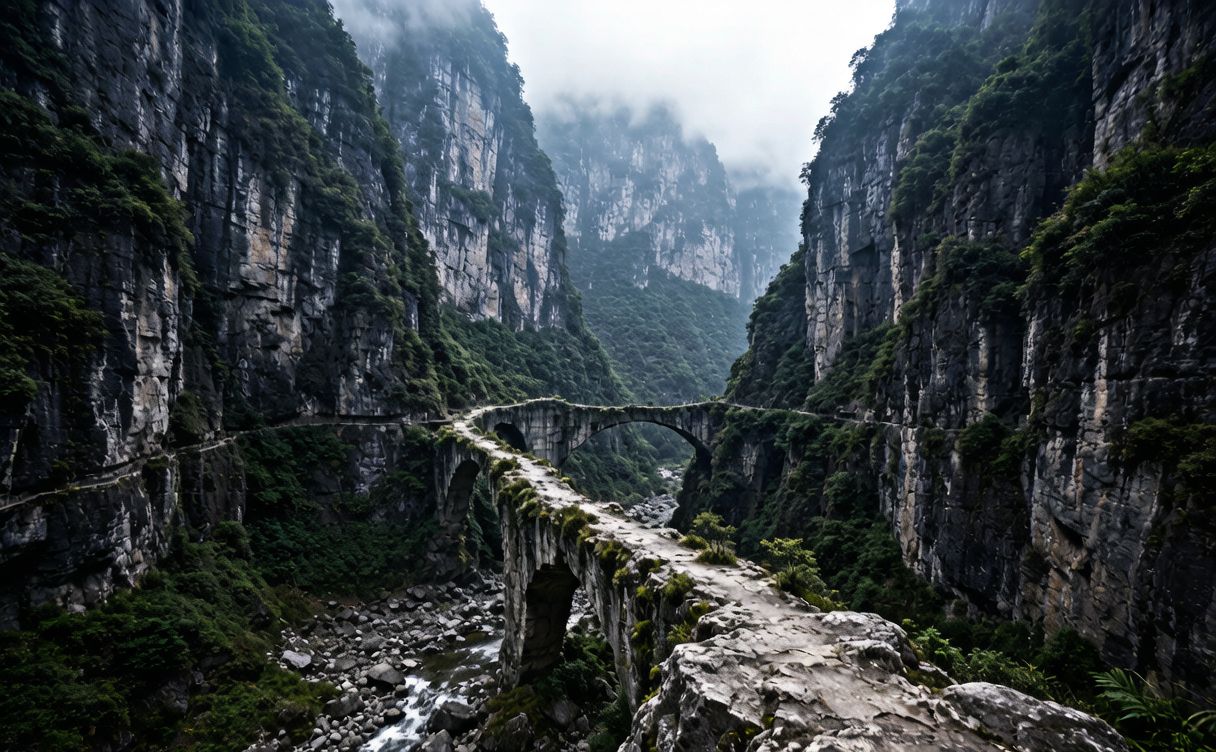
The Three Natural Bridges are the heart of Wulong, and they are exactly what the name promises: three enormous natural stone arches, formed where underground rivers collapsed the roofs of caves and left the spans standing. From top to bottom they are Tianlong Bridge (天龙桥), Qinglong Bridge (青龙桥), and Heilong Bridge (黑龙桥). Each is named for a dragon, and each has its own character.
I crossed them on the loop trail, walking from the rim down through Tianlong Tiankeng, beneath Tianlong Bridge, then past the others in turn. Qinglong Bridge is the tallest — its arch soars so high that sunlight only reaches the floor in thin shafts. Heilong (“Black Dragon”) Bridge lives up to its name: the gorge there stays cool and shadowed even at noon. Between the bridges, streams and waterfalls thread through the green, and the air smells of wet stone and moss.
What struck me most was the scale. The spans are not delicate arches you admire from a distance; you walk directly beneath them, and the rock overhead feels like the ceiling of a cathedral built by geology. Filmed or not, this is the kind of place that makes you quiet. If you enjoy this kind of dramatic terrain, our guide to Zhangjiajie National Forest Park covers another of China’s surreal stone landscapes worth the trip.
Tips (hiking)
Wulong is not a hard hike, but it is a long one on the legs. The standard route is mostly downhill first — you descend hundreds of stairs into the sinkholes — and then uphill on the way out, so the climb comes at the end when your thighs are already complaining. Wear proper shoes with grip; the stone steps can be slick after rain.
I paced myself by treating each bridge as a rest point. Carry water and a light snack, because the loop takes a solid two to three hours and the only food inside is overpriced noodles at the bottom. An umbrella or rain jacket is wise in summer, when afternoon showers roll in fast. The walk is stroller-unfriendly and not ideal for anyone with serious knee problems, given the stair count. Go early, keep left at the fork to follow the full bridge loop, and do not rush — the best photographs are in the shaded stretches where the light is soft. For more ideas on trails across the country, see our China Hiking Treks Guide.
Best Time
I visited in late spring and was rewarded with lush green sinkhole floors and comfortable temperatures, but Wulong changes with the seasons. Spring (March–May) and autumn (September–November) are the sweet spots: mild weather, clear air, and good light for photography. Summer brings the most vivid green and the fullest waterfalls, but also heat, humidity, and sudden rain — and the largest crowds, since it is school-holiday season.
Winter is quieter and occasionally dusted with frost or light snow that makes the bridges look ethereal, though some side paths may close. If you want the place nearly to yourself, aim for a weekday in the off-season and be on the first shuttle. Fog is common year-round in the early morning, which can hide the tops of the bridges — I actually liked the mystery of it, but if you want postcard clarity, plan your descent for late morning once the mist lifts.
Good to Know
Wulong Karst is a UNESCO World Heritage site, and entry is managed through the Xiannüshan scenic area with combined tickets covering the shuttle buses and the bridge loop. Bring your passport, as identity checks at the station and gate are routine for foreign visitors. English signage is limited, so download an offline map and a translation app before you go; the staff are helpful but may not speak English.
Allow a full day from Chongqing and back, and consider pairing Wulong with another regional highlight if you have extra days — our guides to Chengdu and the Dazu Rock Carvings near Chongqing are easy additions to a Sichuan-Chongqing route. For official logistics, opening hours, and transport updates, check the Chongqing Government site before you travel.
I left Wulong with a stiff neck from looking up too much and a phone full of photos I knew could not capture the scale. Some landscapes you simply have to stand inside to believe, and this is one of them. If you are building a Chongqing trip, do not let the city’s neon distract you from the stone giants waiting just beyond the hills — they are, without exaggeration, some of the most extraordinary geology I have ever walked through.