

I had spent two blissful but busy days circling West Lake before I finally listened to a friend who lives in Hangzhou. “You’ve seen the postcard,” she said. “Now come see the backyard.” She meant Xixi National Wetland Park (西溪湿地), and she was right. The first time I stepped off the busy ring road and onto a narrow wooden boardwalk, the noise of the city dissolved into the soft slap of water against reeds. Xixi is one of China’s first designated national wetland parks, and unlike the polished promenades around West Lake, it feels half-wild — a tangle of canals, lotus ponds, and old villages stitched together by boat routes. If you want a calmer, greener slice of Hangzhou, this is where I send people now.
Getting There
Xixi sits in the northwest of Hangzhou, roughly 15 kilometers from the city center and about 30 minutes by car from the lake district. The easiest option for most visitors is the metro: Line 3 stops at Xixi Wetland Station and connects cleanly with the rest of the network, so you can pair it with a day at West Lake without fighting traffic. I took a DiDi from my hotel near the lake, and it cost about the same as a long museum taxi ride — cheap by Western standards and far more relaxing than renting a car.
There are three main entrances, and they are not interchangeable. The East Gate (near the visitor center and most boat docks) is where I entered, and it is the most convenient for first-timers. The West Gate and Zijingang Gate feed into quieter corners if you want to skip the crowds. Pro tip from my own mistake: buy your ticket and boat combo online before you arrive. The on-site lines move, but the app queue is shorter, and you’ll want every minute for wandering.
What to See
What surprises most first-time visitors is the scale. Xixi covers around 11 square kilometers, of which roughly 70 percent is water — a maze of more than ten kilometers of waterways and six primary streams. You cannot see it all on foot, and you shouldn’t try. I treated it as a slow sampler: a boat ride, a couple of villages, and one long walk along the reeds.
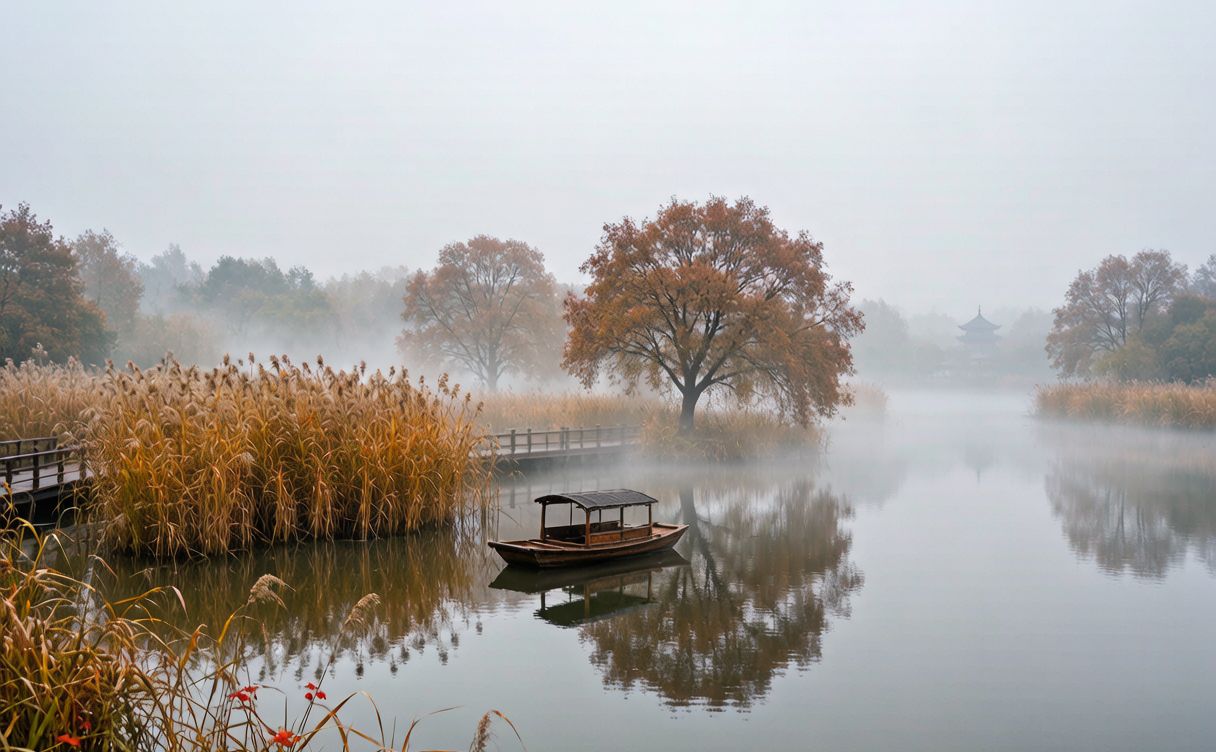
The reed beds are the soul of the place. In late autumn the tall sedges turn the color of wheat and rustle in sheets when the wind passes — locals call it the “Xixi red reed” season, and it’s genuinely photogenic without feeling staged. Scattered through the park are restored villages like Zhoujia Village and the Longyin Temple area, where low whitewashed houses sit right at the water’s edge. I spent an hour just watching an old man mend a fishing net outside a teahouse, a scene that feels centuries old and somehow still ordinary here.
Don’t miss the Chinese wetland museum near the edge of the park if you want context on why this ecosystem matters — it’s an easy, air-conditioned break on a hot afternoon. And if you enjoy temples, you can link Xixi with Lingyin Temple on the same trip; both reward a quiet, early start.
Boats & Birdlife
This is the section I’d underline if I could. Xixi is best understood from the water. The park runs several boat types: electric gondola-style boats that follow fixed routes (good value, narrated, and easy), and rowed wooden boats for smaller groups that slip into narrower channels where the big boats can’t go. I chose the rowed boat, and our oarsman quietly pointed out a kingfisher that froze on a reed stalk, electric blue, before flicking away.
Birdlife is the park’s quiet headline. More than 170 bird species have been recorded here, from egrets and herons stalking the shallows to winter visitors that arrive when northern China chills. Early morning is the honest best time for birding — I went once at noon and saw mostly dragonflies, which was lovely but not the point. Bring binoculars if you have them; the park loans basic ones but they’re not magic.
Xixi is also the birthplace of Hangzhou’s dragon-boat culture. During the Dragon Boat Festival the waterways fill with racing teams and drums, and even off-season you’ll find exhibits and the occasional practice run. It’s a living tradition rather than a museum piece, and that’s part of why I keep recommending Xixi over more performative attractions. If you want more of this water-town atmosphere, Wuzhen water town makes a great next stop, though it’s a manicured town rather than a wild wetland.
Tips
A few things I wish someone had told me before my first visit:
- Go early. Gates open around 7:30 a.m. in summer, and the first two hours are golden — few people, active birds, and soft light on the water.
- Wear real walking shoes. The boardwalks are even and fine, but the village paths can be damp and uneven.
- Pack water and a snack. There are teahouses and small cafés, but prices rise near the main docks and options thin out in the quiet corners.
- Download an offline map. Mobile signal is patchy in the reed maze, and the boat routes don’t always match your instincts.
- Combine, don’t cram. Xixi deserves a half-day. Pair it with a sunset at Leifeng Pagoda if you want a classic lake view to close the day, but don’t try to do both at full speed.
Best Time
Hangzhou has four real seasons, and Xixi shows all of them. Spring (March to May) brings fresh green reeds and lotus shoots pushing through the water — mild, breezy, and my personal favorite for a first visit. Summer is lush and hot; the lotus blooms are spectacular but midday is sticky, so favor early morning boats. Autumn (late October to November) is the famous red-reed season, and the park earns its postcard moment. Winter is the quietest and best for serious birding, with migratory flocks and almost no crowds.
I’ve been in both spring and late autumn, and I’d gently steer first-timers toward autumn for the visuals and spring for the calm. Avoid the National Day holiday week in early October if you can — like everywhere in China, the parks swell with domestic travelers then.
Good to Know
Xixi is open year-round with seasonal hours, and tickets are modest compared with Western attractions. The park is stroller- and wheelchair-accessible on its main boardwalks and boats, though the smaller village lanes are trickier. Photography is welcome (no drones without permits), and there are clean restrooms at regular intervals — a small mercy I learned to appreciate after a long reed walk.
For official hours, maps, and event schedules, the park’s own site is the most reliable source: Xixi Wetland. I check it before each trip because boat routes and festival dates shift with the seasons.