

I’ll be honest: before I visited the Du Fu Thatched Cottage, I thought it would be a quiet, slightly dusty shrine to a poet I only half-remembered from school. I was wrong. This is one of the most peaceful green spaces inside Chengdu, a place where Tang-dynasty poetry, elegant gardens, and slow-moving streams come together. If you like gardens, history, or just a calm escape from the city, put the Du Fu Cottage Chengdu on your list.
The site sits on the west side of Chengdu, near the Huanhua River. It honors Du Fu, the great Tang poet who lived here from 759 to 765 AD. What you walk through today is not a single hut but a sprawling garden-museum — pavilions, bamboo groves, lotus ponds, and reconstructed halls built around the spot where his simple thatched cottage once stood.
You don’t need to be a poetry scholar to enjoy it. I watched a group of students sketching bridges, an older couple practicing tai chi by the water, and a few travelers like me just sitting and reading. The place works on you slowly. Unlike the busy panda base or the crowded food streets, the Du Fu Cottage rewards a slower pace, and that’s exactly what makes it special for visitors who want a breather.
In this guide I’ll cover how to get there, what to see, a little about the poet’s life, practical tips, and the best time to visit. I’ve also linked a few related Chengdu and China guides at the end.
Getting There
The Du Fu Caotang (草堂), as locals call it, sits in the Qingyang district, west of Chengdu’s center. The address is 37 Qinghua Road. It’s an easy half-day trip from most central hotels.
I took the metro, which I recommend. Hop on Line 4 and get off at Caotang Road North (Caotang Beilu) station. From there it’s a short, well-signposted walk of about ten minutes to the main east gate. A taxi or rideshare from Tianfu Square takes roughly 25 minutes depending on traffic and costs very little by Western standards.
If you’re combining sights, the cottage pairs well with the nearby Sichuan Provincial Museum and Huanhuaxi Park. I did both in one relaxed morning and was glad I did. For a fuller plan of the city, see my Chengdu pandas & city guide.
One tip: arrive when the gates open. The early hours are wonderfully quiet, and you’ll hear birdsong instead of tour-group loudspeakers.
What to See
The Du Fu Museum is laid out as a series of courtyards and garden paths. You don’t need a fixed route — the joy is in wandering. Here are the spots I found most memorable.
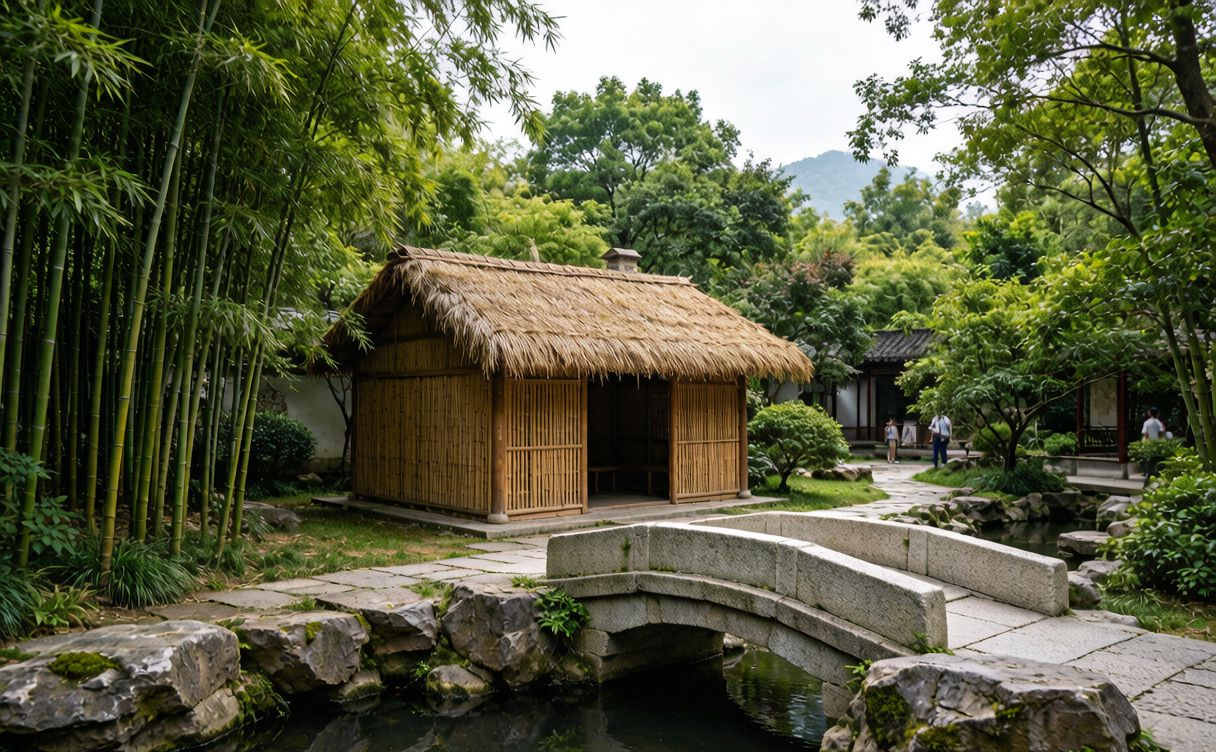
The Thatched Cottage itself. A small, humble reconstruction of Du Fu’s original dwelling stands near the heart of the grounds. It’s deliberately plain: mud walls, a thatched roof, a few simple furnishings. After the grand palaces elsewhere in China, this modest hut is a sharp and touching contrast.
The Hall of Odes (Dashi Hall). This is the main shrine hall, built to honor the poet. Inside, a statue of Du Fu looks out over offerings of calligraphy and stone inscriptions of his poems. The surrounding courtyard is shaded by old trees.
Streams and bamboo. What stays with me most is the water. Small streams thread through the gardens, crossed by stone bridges. Bamboo grows everywhere, rustling in the wind. On the day I visited, the light filtered through leaves onto the water and I sat on a bench for nearly half an hour doing nothing.
The poetry walls. Carved stelae and walls display Du Fu’s verses in beautiful calligraphy. Even if you can’t read Chinese, the brushwork is worth pausing for. I used a translation app to read a few poems aloud to myself, which made the place feel alive.
The reconstruction studies hall. A small exhibition explains how the site was rebuilt across the Song, Ming, and Qing dynasties, and how the present layout took shape. I found the maps and old photographs genuinely interesting.
The Poet’s Life
A little background made my visit far richer, so here’s the short version. Du Fu (712–770 AD) is often called the “Poet Sage” of China. He lived through the An Lushan Rebellion, a brutal civil war that shattered the Tang golden age. Fleeing the chaos, he came to Chengdu in 759 and built a thatched cottage with the help of friends.
He lived here for about six years. It was one of the few stable, happy periods of his life, and he wrote more than 240 poems during his stay — including some of his most beloved lines about everyday peace: watching spring rain, tending plants, missing friends. The cottage became a symbol of the simple, principled life.
After his death the site was preserved and expanded by later generations who revered him. That’s why today it’s part shrine, part garden, part museum. Standing in the hut, I thought about how rare it is that a writer’s home has been cared for, continuously, for over a thousand years.
If you enjoy this kind of literary landscape, you might also like the classical gardens of Suzhou. Our Suzhou Lion Grove Garden guide covers another tranquil spot built for wandering and reflection.
Tips
A few practical things I wish I’d known before going.
- Buy tickets online or at the gate. Entry is inexpensive. I scanned a QR code at the entrance and walked straight in. Keep your passport handy; some ticket systems ask for it.
- Wear comfortable shoes. The paths are flat but you’ll walk a lot. The gardens cover a large area, bigger than they look on the map.
- Go light on luggage. There’s limited storage. A small daypack is ideal.
- Hire a guide or use the audio app. The poetry means more with context. I rented the on-site audio guide; it was worth it.
- Toilets and water. Restrooms are clean and signed. Bring a water bottle — there are refill points.
- Photography. It’s allowed and the gardens are photogenic, but skip the flash inside the halls with statues and stelae. Early light through the bamboo is the best shot.
- Tea break. There are small tea spots near the exits where you can sit with a cup of Sichuan tea. I treated myself to one on the way out and it was the perfect close to the morning.
- Combine with nearby sights. The Sichuan Provincial Museum is a ten-minute walk and is free with reservation. I’d pair the two.
Best Time
Chengdu is mild, but the cottage is at its best in certain seasons. I visited in spring and the gardens were overflowing with new green and blooming flowers — Du Fu himself wrote famous poems about spring rain here, so the season feels right.
- Spring (March–May): My top pick. Mild weather, fresh bamboo, and the gardens at their lushest.
- Autumn (September–November): Crisp air and golden leaves. Also excellent and less crowded than spring weekends.
- Summer: Hot and humid, with afternoon rain. Go early. The shade helps, but it can feel sticky.
- Winter: Quiet and misty, with few tourists. If you like solitude, this is the time.
Weekdays beat weekends almost always. Mornings beat afternoons. That’s the whole strategy.
Good to Know
The Du Fu Thatched Cottage is managed as part of Chengdu’s cultural heritage, and the official city tourism site has up-to-date opening hours, ticket prices, and festival information. I checked Visit Chengdu before my trip and found the seasonal hours helpful. Allow at least two hours, or half a day if you want to linger, write in your notebook, or just sit by the water.
For foreign visitors, the cottage is an easy, low-stress introduction to Chinese literary culture — no prior knowledge needed, and English signage is decent in the main halls. Pair it with pandas in the morning and old streets in the evening, and you’ll have a very satisfying Chengdu day.