

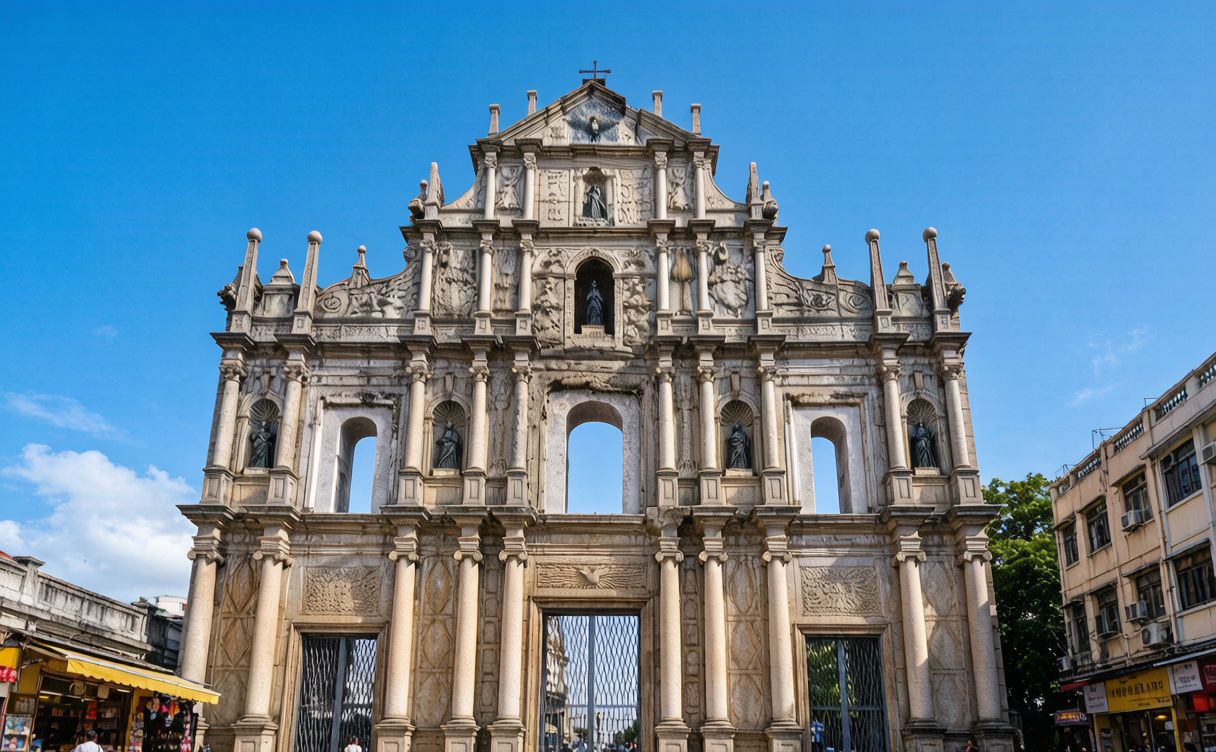
The first time I climbed the weathered stone steps toward the Ruins of St. Paul in Macau, China, I honestly expected a postage-stamp monument buried in tour groups. What stopped me was the façade itself — a 26-meter wall of carved granite and limestone rising out of a quiet hillside, detailed enough that I spent a full twenty minutes just reading its statues with my neck craned. If you are planning a trip to Macau, China, this is the one sight you cannot skip, and the good news is that it is free, central, and easy to pair with half a day of walking.
I have now returned three times, once at dawn before the crowds and once during a weekend festival when the surrounding lanes were packed. This guide is built from those visits — practical, first-person, and focused on helping you actually enjoy the Ruins of St. Paul Macau rather than just ticking it off a list.
Getting There
The Ruins of St. Paul Macau sit on the northern edge of the Macau Peninsula, in the Santo António parish, about a ten-minute walk inland from the waterfront. Most visitors arrive through Senado Square, the large wave-patterned paved plaza that is itself a UNESCO World Heritage sight. From there, follow Rua de São Paulo — the pedestrian street lined with shops and snack stalls — uphill until the staircase appears.
If you are coming from the border or the ferry terminal, the simplest option is a taxi to “Ruinas de São Paulo” (the Portuguese name locals use) or a public bus to the nearby Senado stop. I usually walk: Macau, China is compact, and the walk from the historic center lets you absorb the blend of Portuguese and Chinese architecture that makes the city unique. Budget 15–20 minutes on foot from most central hotels.
One honest tip: the approach street gets crowded by mid-morning. If you want the classic empty-shot of the steps, aim for before 9 a.m. or after 6 p.m.
What to See
The Ruins of St. Paul Macau are what remain of the Church of St. Paul, begun in 1602 by Jesuit missionaries and destroyed by fire in 1835. Only the front façade and a portion of the stone staircase survived — but that façade is the draw, and it is far richer than a photo suggests.
Walk slowly up the steps and look at the carvings. From bottom to top, the façade is divided into sections showing the Virgin Mary, Jesus, and the saints, with a window of “the nave of the church” in the center. On the third level you will find a bronze statue of the “Virgin Mary stepping on a dragon,” a detail that fuses Christian and East Asian imagery. I found the small statues of Japanese martyrs especially moving — a reminder that this was once a gateway for Christianity in Asia.
Beyond the wall, the site includes the Crypt and the Museum of Sacred Art, housed in the foundations behind the façade. The crypt holds the tombs of some early bishops of Macau, China, while the museum displays wooden and ivory crucifixes, oil paintings, and liturgical objects salvaged from the original church. Entry is free, and I recommend it on a hot afternoon as much for the air-conditioning as the artifacts.
A short detour worth your time: behind the Ruins, Mount Fortress (Fortaleza do Monte) offers a free small museum and a green hilltop with the best panoramic view of the Ruins of St. Paul Macau from above. I spent forty minutes there on my last trip just watching the light move across the city rooftops.
The Façade & Museum
Stand directly in front of the wall and you will notice the symmetry: four columns frame the central window, and a stone pediment crowns the top with a cross and a dove representing the Holy Spirit. The craftsmanship is a mix of European Baroque with Chinese and Japanese motifs — the kind of cultural layering you only find in Macau, China.
Inside the Museum of Sacred Art, my favorite piece is a tiny 17th-century painting of the Madonna, its colors still vivid. Photographs are allowed without flash. The crypt is small and cool, a quiet contrast to the busy square outside.
If you are a history lover, pair this stop with the Macau, China travel guide, which maps the rest of the city’s UNESCO sites within easy walking distance.
Tips
Here is what I wish I had known before my first visit:
- Go early or late. Midday is the worst for both crowds and harsh shadows on the wall.
- Combine with Senado Square and St. Dominic’s Church. All three are within a five-minute walk and make a natural half-day loop.
- Try the peanut candy and beef jerky on Rua de São Paulo — vendors hand you free samples, and the almond cookies make good gifts.
- Wear comfortable shoes. The approach is a real uphill climb on uneven stone.
- No drone flying near the monument, and the front steps are a pedestrian zone, so leave the scooter at the hotel.
- Free Wi-Fi is available in the square, which helped me pull up the map when my roaming data stalled.
For a bigger-picture plan, the China bucket-list attractions list shows how the Ruins of St. Paul Macau fit alongside the Great Wall, the Terracotta Army, and other icons.
Best Time
Macau, China has a humid subtropical climate. I have been in both cool winter and sticky summer, and my pick is October to December, when the air is dry and the temperatures sit comfortably in the low 20s °C. Spring (March–May) is pleasant too, though April can bring occasional rain.
Avoid the week of Chinese New Year and the October National Day holiday if you dislike crowds — the Ruins of St. Paul Macau can be shoulder-to-shoulder then. Summer is hot andtyphoon season; if you visit then, do the outdoor parts in the early morning and save the museum for midday.
If your trip also covers Hong Kong, the Victoria Harbour Hong Kong guide pairs naturally with a Macau stop — the two cities are linked by a one-hour ferry or the Hong Kong–Zhuhai–Macau Bridge.
Good to Know
The Ruins of St. Paul Macau are open daily, with the façade accessible around the clock and the Museum of Sacred Art typically open 9 a.m. to 6 p.m. (last entry 5:30 p.m.). Admission to both is free. For official opening hours, conservation notices, and event information, check the Macao Government Tourism Office.