

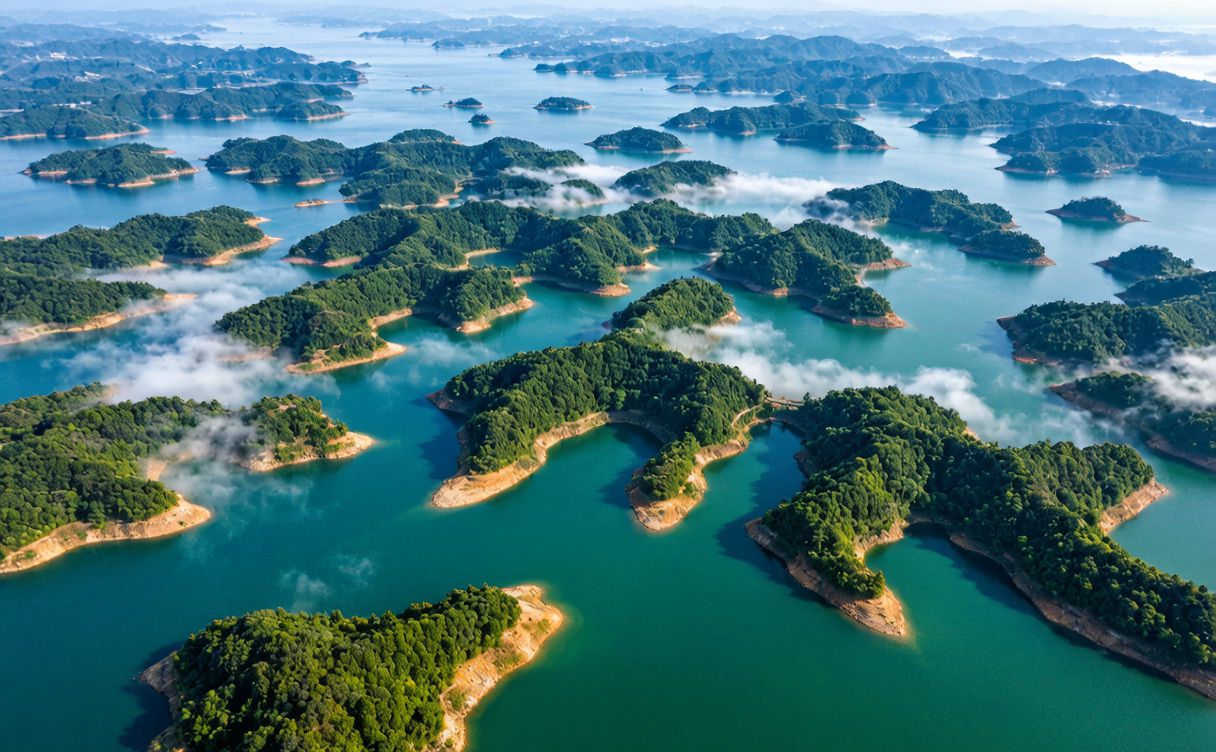
The first time I heard about Qiandao Lake, I assumed it was another one of those poetic Chinese place names that sounds better than the reality. It is not. This is a genuine, 573-square-kilometer artificial reservoir that swallowed an entire county and now floats more than a thousand islands on its green surface. I drove up from Hangzhou one April morning expecting a pleasant half-day detour and instead lost two full days to it. If you are building a Zhejiang itinerary and only have time for one trip outside the city, this is the one I would keep.
Before we go further, get the name straight: locals say “qiandaohu,” the pinyin for “thousand-island lake.” You will also see it written as thousand island lake china on older travel brochures, and as qiandao lake hangzhou on booking sites that want you to know how close it is to the provincial capital. They all mean the same stretch of water, about 130 kilometers southwest of Hangzhou in Chun’an County, Zhejiang.
How Qiandao Lake Was Made (and What It Drowned)
Here is the part that hooked me more than any postcard view. Qiandao Lake is not natural. It was created in 1959 when the Xin’an River Dam was built to generate hydroelectric power. The valley flooded, and with it went two ancient counties — Hecheng and the better-known Shi Cheng, the “Lion City” — along with dozens of villages, temples, and stone archways. Roughly 290,000 people were relocated. For nearly fifty years the submerged city sat silently under 26 to 40 meters of water.
I find that history genuinely eerie, and it is also the lake’s best story. In 2001 divers rediscovered Shi Cheng intact: streets, gates, and carved stone lions still standing on the lakebed, preserved by the cool, low-oxygen water that stopped wood rot. You can now dive to it, or — easier for most of us — peek through the windows of a semi-submersible boat. When I did the glass-boat viewing, the guide switched off the engine and the silence down there was the kind you feel in your chest.
Getting to Qiandao Lake from Hangzhou
The logistics are painless, which is half the reason I keep sending friends here. From Hangzhou, the fastest option is the high-speed train to Qiandaohu Station, which takes about 45 to 70 minutes from Hangzhou East. A taxi or shuttle bus from the station to the main dock (Xiushui Avenue area) is another 20 minutes. If you would rather drive, the expressway run is under two hours and the final stretch along the lakeshore is pretty.
I have done it both ways. The train wins for a day trip; driving wins if you want to hop between the scattered scenic zones without begging for rides. Either way, book your cruise ticket online before you leave the city, because the central wharf gets slammed on weekends. For the wider rail picture, my China high-speed train guide for foreigners covers how to buy tickets without a Chinese ID.
The Boat Cruises: Counting Islands You Will Never Finish
A boat cruise is not optional here; it is the whole point. The standard loop from the central wharf visits Meifeng Island, where a cable car or 300-odd steps lift you to the best panorama on the lake — the classic shot of islands scattered like fallen leaves across jade water. I counted eleven islands before giving up and admitting the brochure’s “1,078” was probably right.
Most cruises also stop at Longshan Island, home to a rebuilt Hai Rui Shrine and a decent climb, and at a few leisure islands with fish-feeding platforms and tea stalls. The boats are big, comfortable, and run on a fixed schedule, so you are locked into a half-day block. My tip: take the morning departure. The water is calmer, the light is softer, and you beat the tour buses that roll in around 10 a.m.
If you want the lake without the conveyor-belt feeling, skip the central wharf and base yourself near Huangshan Island or rent a small electric boat in one of the quieter bays. That is how I found my favorite hour — drifting past half-sunken tree stumps with a thermos of Longjing tea someone at the guesthouse pressed into my hands.
Shi Cheng and the Underwater City Experience
Back to the drowned city, because this deserves its own section. The full scuba dive to Shi Cheng is a proper expedition: cold, dark, and limited to certified divers on organized trips, usually from May to October when visibility is best. I am not a diver, so I took the tourist submersible-style boat, which dips its viewing cabin below the surface and glides past the stone gates. It is touristy, yes, but watching a 600-year-old lion carving hover in the green gloom is the kind of thing that justifies the ticket.
There is also an above-water stand-in: the nearby Qiandao Lake Forest Oxygen Bar and a reconstructed “underwater city” exhibition hall that shows sonar maps and relics pulled from the site. Good for kids and for the rain day you hope you do not have.
What to Eat: The Famous Fish Head
You cannot leave without the lake’s signature dish — qiandaohu organic fish head hotpot (鱼头煲). The water is clean enough that the carp here taste sweet rather than muddy, and the local fishery is certified organic. I ate mine at a lakeside restaurant in Qiandaohu Town, the broth milky white, the flesh flaking off the bone, a bottle of local rice wine on the side. It was one of those meals where you stop talking and just eat. Pair it with fresh river greens and you have a dinner worth the trip on its own.
The town center is also where the night market wakes up after dark, all sizzling skewers and stinky tofu for the brave. I tried the tofu. I regret nothing and admit nothing.
Best Season to Visit
I get asked this constantly, so here is my straight answer. Spring (April to May) and autumn (September to November) are the sweet spots: mild weather, clear water, and the islands glowing green or gold. Summer is hot and crowded but great for water sports and swimming beaches. Winter is cold, quiet, and occasionally misty in a way that photographs like a scroll painting — my favorite for solitude, worst for cruising comfort.
Avoid the first week of May (Labor Day) and the first week of October (National Day) unless you enjoy shoulder-to-shoulder photography. For a deeper read on timing across the province, my Hangzhou travel guide lines up the seasons and festivals.
Where to Stay
You have two sensible bases. Qiandaohu Town, by the central wharf, has the most hotels, from budget chains to lakeside resorts, plus all the food. It is the easy choice. The more memorable option is one of the resort clusters on the lake’s quieter arms — places like the Sheraton or local boutique guesthouses on their own little peninsula, where you wake up to water on three sides. I stayed once in a family-run guesthouse near a fishing village; the owner lent me a bike, pointed at a dirt path, and said “go.” I went, and found a cove with no name and no people. That is the version of Qiandao Lake I tell people to chase.
If you are combining this with the classic Hangzhou sights, note that the lake pairs beautifully with a day on West Lake in Hangzhou — one is a manicured imperial garden, the other a wild flooded valley, and together they show you two completely different Chinas within an hour of each other.
A Suggested Side Trip: Wuzhen
If you have an extra day and want a contrast to all this water-and-mountain emptiness, the ancient water town of Wuzhen is reachable as a longer loop through the region. It is a different kind of pretty — stone canals, lantern-lit alleys, and theatrical evening light shows. I treated it as the “settlement” half of my Zhejiang trip after the “wilderness” half at Qiandao Lake, and the rhythm worked. My full notes are in the Hangzhou and Wuzhen water town guide.
Practical Tips I Wish I Had Known
- Buy cruise and train tickets in advance; the wharf sells out on good-weather weekends.
- Bring a light jacket even in summer — the boat deck gets windy and the lake sits in a valley.
- Carry cash for small village stalls; the town takes Alipay, but the fishing hamlets do not. My guide to paying with Alipay and WeChat as a foreigner explains how to set that up before you arrive.
- Rent a bike at the lakeside path if you have two days; the flat 10-kilometer ribbon road is the best free view in town.
Why I Keep Coming Back
I have now been to Qiandao Lake four times, in three seasons, by train and by car, alone and with friends, and it has never given me the same day twice. That is the mark of a real place rather than a checklist attraction. One visit it was the drowned city that got me; another it was a nameless cove and a borrowed bike. The lake is big enough — over a thousand islands big — that you can keep finding new corners long after the postcards run out.
For authoritative background, opening hours, and the latest official notices, the Zhejiang Provincial Department of Culture, Radio, Tourism and Sport is the government source I check before each trip.
If you take one thing from this: do not treat qiandao lake hangzhou as a box to tick on a China highlight reel. Give it a night. Let the ferry be slow. Eat the fish head. And if you are lucky enough to catch the morning mist burning off those thousand islands, you will understand why I keep the photo from that April morning on my desk.