

The first time I stood among the shattered marble arches of the Old Summer Palace, the only sound was a crow flapping somewhere over the lotus ponds. I had just come from the crowded Forbidden City and the polished (New) Summer Palace, so the silence here hit me like a slap. The Old Summer Palace — known to locals as Yuanmingyuan — is not a palace you walk through. It is a palace you walk through after it stopped existing. Built over 150 years and torched in 1860, what remains is a vast park of water, willows, and the ghostly European stone ruins that have become its signature. If you want to understand both the splendor and the scar of imperial China in a single afternoon, this is the place.
What the Old Summer Palace actually was
Before you picture ruins, picture this: by the late 1700s, Yuanmingyuan was the personal playground of the Qing emperors — a sprawling complex of three gardens covering roughly 350 hectares, larger than any European royal estate of the era. It wasn’t one building. It was thousands of pavilions, temples, libraries, and artificial lakes stitched together with the finest craftsmanship in Asia. European visitors, including the Jesuit missionaries who helped design parts of it, called it the “Garden of Gardens” and admitted they had nothing like it back home.
The original splendor is almost impossible to grasp now, because almost none of it is standing. The Chinese garden sections were mostly wooden and burnable. The emperors kept a famous collection of art and books here — the kind of stuff that would make a museum curator weep today. When I walked the ruins early on a Tuesday morning, an elderly man doing tai chi near the West Gate pointed at a flat stretch of grass and said, “Under there, a whole library once stood.” Then he shrugged. “Now we just walk the dogs.”
That casual acceptance is part of what makes Yuanmingyuan different from a normal tourist site. There is no gift-shop gloss. There is loss, and then there is a very pleasant park built on top of it.
The 1860 destruction — and why the stones survived
Here is the part the guidebooks sometimes soften. In October 1860, during the Second Opium War, Anglo-French forces looted Yuanmingyuan and then burned it. The wooden Chinese pavilions went up in flames within days. The stone European section — the Western Mansions (Xiyang Lou) — survived the fire but was later vandalized and toppled, and its marble columns were carted off or simply left to fall.
I’m not going to pretend this is a neutral history lesson. Standing in front of the broken fountains, you feel the weight of it. A French diplomat at the time called the looting “a deed of barbarism.” The British commander ordered the burn to punish the Qing court for torturing captured envoys. History is messy; the stones just sit there and let you decide.
What survives today are the European-style stone ruins — and they are the reason most foreign visitors come. Unlike the rest of the park, these were built of imported marble and lime, so even after being knocked down, they stayed down as ruins rather than ashes.
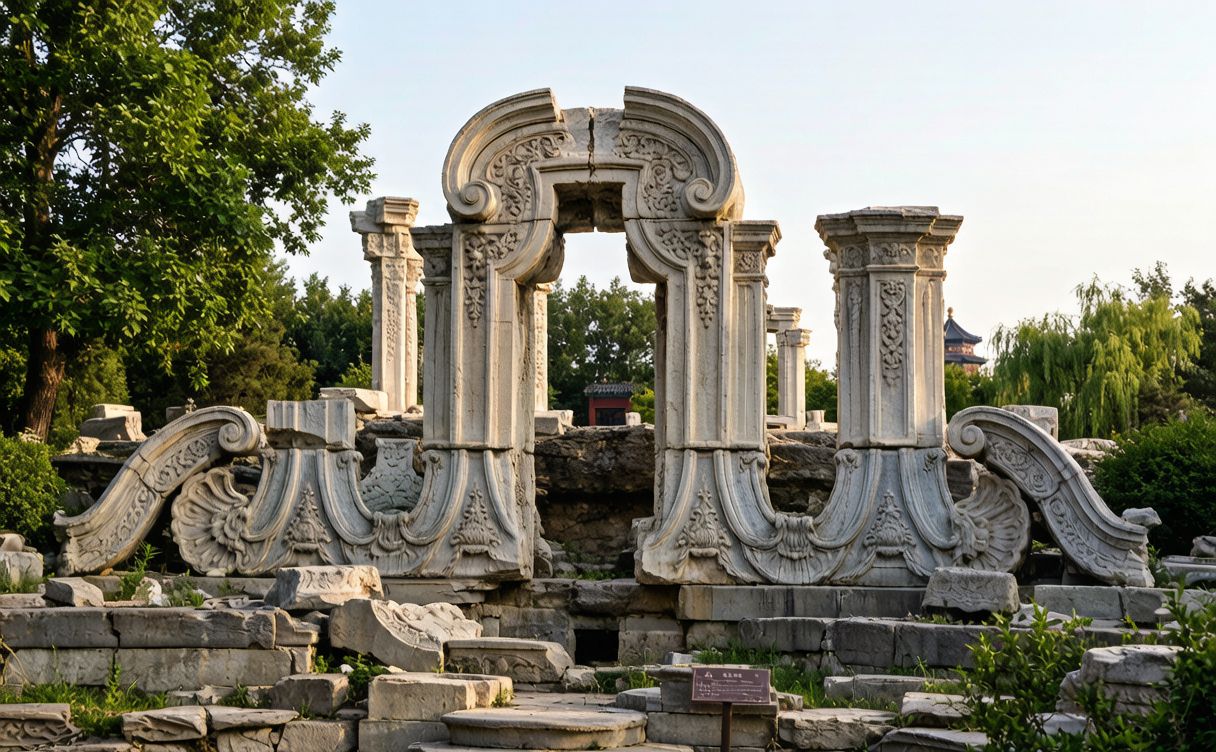
The European-style stone ruins that remain
The Western Mansions are the postcard image of the Old Summer Palace, and they earn it. This was a bizarre, wonderful experiment: a handful of European baroque buildings and waterworks dropped into the middle of a Chinese imperial garden, designed with help from Jesuit priests like Giuseppe Castiglione. Imagine Versailles reimagined by people who had never seen Versailles but had seen etchings of it.
The highlights you should not miss:
- The Great Fountain (Dashuifa): a tiered stone fountain platform where water once danced for the emperor. Today it is a skeleton of carved marble, and it is the single most photographed spot in the park.
- The Labyrinth (Huanghuazhen): a low hedge maze the imperial family used for games. It is one of the few structures you can still walk inside.
- The Stone Gate and broken arches: row after row of toppled columns that look like they belong in a Roman forum rather than Beijing.
When I walked the ruins at golden hour, the light turned the marble honey-gold and a small group of art students sat sketching in silence. One of them told me she comes every month “because the light is never the same twice.” That’s the thing about this place — it rewards slowness.
The reconstructed fountains and what’s been rebuilt
You’ll notice something slightly confusing: some of the fountains look suspiciously intact. That’s because parts have been reconstructed. The most visible rebuild is the fountain mechanism display near the Western Mansions, where a small museum shows how the original waterworks actually ran — bronze plumbing, hidden pumps, and a clockwork system that sprayed water in patterns. There is also a 3D model and a restored section demonstrating the hydraulic tricks that so amazed 18th-century visitors.
Be clear about what is real and what isrestored: the ruins are authentic 1860-era stones. The functional fountain demonstrations are modern reconstructions built to explain, not to deceive. I actually appreciated this. The reconstructed models answered a question the bare ruins left hanging: “What on earth was this for?” A local told me the rebuilt water clock “makes the kids understand why the emperor liked it here.” Fair enough.
How to visit from central Beijing
Yuanmingyuan sits in the Haidian district, northwest of the old city, right next to Tsinghua and Peking universities. It is easy to reach and — crucially — rarely as packed as the Forbidden City.
- Subway: Take Line 4 to Yuanmingyuan Park Station (圆明园站). Exit B walks you straight to the South Gate in about five minutes. This is the simplest route.
- From the (New) Summer Palace: they are a 15-minute walk apart. I did both in one day and it worked beautifully — more on that below.
- By taxi/rideshare: Alipay with a tourist account makes this painless; see our guide on payments before you arrive.
- Tickets: entry is cheap (around 10 RMB for the park, plus a small fee for the Western Mansions ruin zone and the museum). Buy at the gate or scan the QR.
The best route through the park
Yuanmingyuan is huge and flat, and the paths are confusing. Without a plan you’ll wander for hours and see mostly reeds. Here is the route I’d give a friend:
- Enter at the South Gate (subway exit).
- Rent a bike or take the electric cart — the park is too big to enjoy on foot alone.
- Head northwest to the Western Mansions ruin zone first, when the light is best.
- Loop through the lotus ponds (summer only — they are spectacular in July and August).
- Detour to the fountain museum before you tire out.
- Exit via the East Gate, which drops you a short walk from the New Summer Palace.
When I walked the ruins that first time I made the rookie error of entering at the East Gate and backtracking — cost me an extra hour and a blister. Enter south, exit east. Trust me.
Combining the Old and New Summer Palace
A lot of tourists skip Yuanmingyuan because they’ve already booked the (New) Summer Palace — Yiheyuan — down the road. Big mistake. They are completely different experiences, and doing both in one day is the smart play.
The (New) Summer Palace is the survivor: a fully restored, gorgeous lakeside retreat with the marble Boat of Purity and the Long Corridor. It shows you what imperial leisure looked like when it wasn’t destroyed. The Old Summer Palace shows you what happened when it was. Together they tell the full story — glory and ruin in a single afternoon.
I usually do Yuanmingyuan in the morning (cooler, fewer tour groups at the ruins) and the New Summer Palace after lunch. The walk between the East Gate of Yuanmingyuan and the North Gate of Yiheyuan is about 15 minutes and takes you past university cafés where you can grab a coffee.
Practical tips I wish I’d known
- Go early. The ruins are exposed and there is little shade. Mornings are cooler and the light is kinder on the marble.
- Wear real shoes. It is flat but enormous; my “comfortable” sandals lied to me.
- Bring water. Vendors are sparse once you leave the gates.
- Don’t expect signage in English everywhere. The ruin zone has decent plaques; the rest assumes you know why you’re there.
- July–August = lotus season. Our best time to visit Beijing breakdown helps you dodge the worst crowds and smog.
Why the Old Summer Palace matters
I’ll be honest — if you only have one day in Beijing, the Forbidden City probably wins. But if you have three or more, Yuanmingyuan is the site that will sit with you longest. The (New) Summer Palace is prettier. The Forbidden City is grander. The Old Summer Palace is haunting, and haunting is its own kind of worth.
It is also a genuinely pleasant park. On any given afternoon you’ll see families picnicking by the water, students reading under the willows, and old men flying kites where marble palaces once stood. The Chinese have a phrase for this — 废墟上的花园, “a garden on the ruins” — and they’ve made peace with it in a way that turns grief into a public green space. That duality is the whole point.
Official visitor information, including seasonal opening hours and the latest ticket policies, is maintained by the Beijing Municipal Culture and Tourism Bureau at https://www.visitbeijing.com.cn/.
So go. Bring comfortable shoes, arrive before the crowds, and let the broken arches do the talking. The Old Summer Palace won’t shout at you like the big ticket sights — but weeks later, it’s the one you’ll still be thinking about.