

The first time I saw them from the back of a scooter bumping along a muddy Fujian lane, I thought I had stumbled onto a set of giant prehistoric doughnuts half-buried in the rice paddies. They were not doughnuts. They were houses — and not just any houses. Fujian Tulou are massive circular and square earthen fortresses built by the Hakka people, some of them holding three hundred relatives under one baked-mud roof. I had come expecting a tourist stop and left genuinely stunned that so few Western travelers have heard of them. If you want one genuinely off-the-beaten-path wonder in China, the Fujian Tulou are it.
What Exactly Are Fujian Tulou?
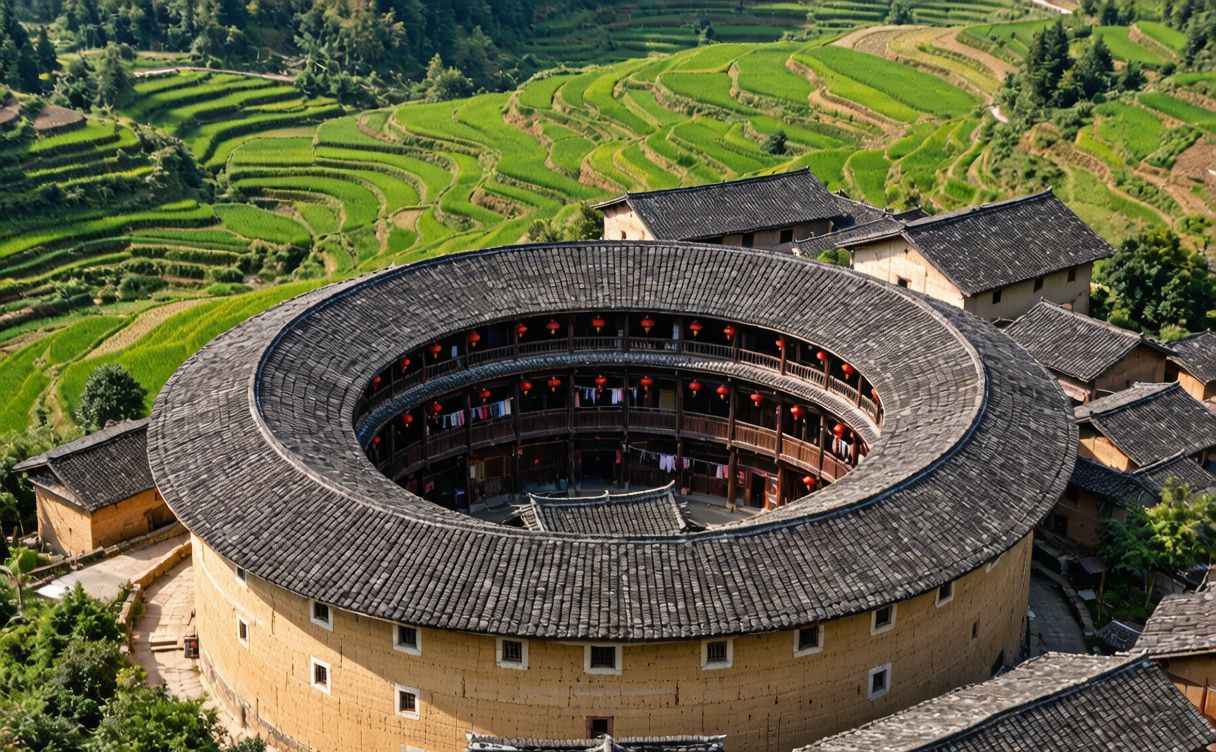
Fujian Tulou are traditional communal residences of the Hakka and Minnan peoples in the mountainous southwest of Fujian Province. The word tulou literally means “earthen building,” and that is not poetry — the outer walls are rammed earth: a dense paste of clay, sand, lime, and sticky rice mixed with egg whites, pounded layer by layer into walls up to six feet thick. Step back and the result looks like a fortress, because that is exactly what it was designed to be.
In 2008, UNESCO inscribed 46 of these structures as a World Heritage Site, calling them “exceptional examples of a building tradition and function exemplifying a particular type of communal living and defensive organization.” You can read the official listing here: https://whc.unesco.org/en/list/1113/. The recognition was overdue. These are not reconstructed theme-park curiosities; many are still lived in by the descendants of the families who raised them four or five centuries ago.
The Fujian Tulou houses I visited were alive in every sense — laundry flapped from balconies, a grandmother sunned radishes on the roof, and a rooster strutted across the central courtyard as if he owned the place. Inside the ring, the world outside faded to a warm, earthen hush.
A First Look: Stepping Inside the Ring
When I stepped inside the ring of my first tulou, the noise of the countryside simply stopped. The thick earthen walls swallowed sound, and I found myself standing in a circular courtyard maybe thirty meters across, surrounded by four stories of wooden galleries where every door and window seemed to point inward, toward the communal heart. A single well sat in the middle. Above it, an ancestral shrine glowed with red lanterns. For a moment I understood the whole logic of the place: everyone faces the family, and the family faces the ancestors. No one is anonymous here.
A Hakka elder told me, as he polished a brass lock by the entrance, that his branch of the clan had lived in this same building for eleven generations. “The walls keep the wind out,” he said, “and the courtyard keeps us together.” He was in his eighties and had never once slept in a house with a straight outside wall. To him, a normal home would feel exposed, almost indecent.
How the Hakka Built Their Fortresses
The Hakka (“guest people”) migrated south from the Central Plains over a thousand years ago, often arriving in unfamiliar territory where they were outnumbered and sometimes unwelcome. They needed shelter that was also a stronghold. The hakka tulou answered that need: a self-contained clan citadel with one heavily barred gate, no windows on the lower floors, and staircases that could be dismantled to seal off the upper rings during a raid.
Building a Fujian Tulou was a community act. Entire villages would tramp the earth mixture into timber molds, raising the walls a hand’s width at a time, then drying each course before adding the next. The tulou earthen buildings were engineered for earthquake resistance too — the flexible timber skeleton lets the structure sway rather than crack, which is why some have survived four hundred years of seismic shaking. The central courtyard usually held a well, grain stores, and livestock, so a besieged clan could wait out trouble for months without leaving.
What surprises most visitors is the elegance hiding inside the raw mud. The upper galleries are finely joineryworked timber, the shrines are carved and gilded, and the proportions are tuned by feng shui. These were not hovels. They were fortified palaces for extended families.
The Best Tulou to Visit
There are thousands of Fujian Tulou scattered across Nanjing, Yongding, and Hua’an counties, but a handful are unmissable.
Chengqi Lou — The “Prince of Tulou”
Near Yongding, Chengqi Lou is the one that will break your camera. Four concentric rings nest inside one another, the outermost alone carrying some four hundred rooms across four floors, home at its peak to more than eight hundred people. Standing in its center, looking up through the layered rings to a slice of sky, is one of those travel moments you do not forget. It is the largest and most symmetrical of the circular tulou, and the crowds know it — go early.
Tianluokeng — “Four Dishes and One Soup”
The postcard image everyone recognizes is Tianluokeng, a cluster of five tulou viewed from a hillside lookout: three round, one square, one oval, arranged so a witty local nicknamed them “four dishes and one bowl of soup.” Arrive at golden hour and the earthen walls turn the color of toasted bread against the green valley. This is the single best photo stop in the region, and the viewing platform was built precisely so you can see why.
Other Worthwhile Stops
- Hegui Lou, a square tulou oddly built on a swamp, still stands level after three centuries.
- Huaiyuan Lou, a model of preservation with intact carved gates and a small tulou museum.
- Yuchang Lou, the “wobbly building,” whose leaning pillars have defied gravity for six hundred years.
How to Reach Fujian Tulou from Xiamen
Most foreign travelers base themselves in coastal Xiamen and do Fujian Tulou as a long day trip or an overnight. Xiamen is the nearest major hub with an international airport and high-speed rail, and it is a delightful city in its own right. If you are building a Fujian itinerary, start with our full Xiamen travel guide before heading inland.
The practical options:
- Bus or hired car from Xiamen — The Nanjing tulou cluster (including Tianluokeng) is about 2.5 to 3 hours by road. Many hostels in Xiamen sell packaged day tours that handle the confusing last-mile transfers for you.
- Train to Nanjing County — Take a high-speed train from Xiamen North to Nanjing station, then a local bus or taxi to the tulou villages. This is cheaper and avoids a long coach slog, though you will still need a local ride for the final stretch.
- Overnight in the village — Strongly recommended. The tulou are magical at dawn when the tour buses have not yet arrived, and staying inside one (yes, some rent rooms) is unforgettable.
For first-timers managing China’s rail system, our high-speed train guide for foreigners walks you through booking 12306 without the usual headaches.
Where to Stay
You have two sensible choices. Stay in Xiamen and do a day trip — comfortable, with cold beer and hot showers waiting — or sleep inside a tulou. I chose the latter and spent the night inside a Fujian Tulou, in a converted ring-house room: thin walls, a hard bed, and the strangest, most soothing silence I have ever slept inside. A Hakka family cooked me sweet-potato porridge for breakfast and refused payment beyond a few yuan.
If you prefer a proper hotel after a long travel day, base in Nanjing County town or Xiamen and commute in. Either way, book ahead during Chinese holidays, when domestic tourists flood the valleys. For a broader sweep of atmospheric places to sleep across the country, see our roundup of China’s best ancient towns.
Etiquette and Practical Tips
These are homes, not museums, and a little respect goes a long way. Before you set out for the Fujian Tulou, keep a few rules in mind:
- Ask before photographing people. Elders in particular may not want a lens in their face. A smile and a gesture works better than pointing a camera.
- Don’t bring pork into the shrine areas or step on the threshold of the ancestral altar. Remove hats indoors.
- Buy something. Many families sell tea, dried fruit, or handmade goods. A small purchase supports the people keeping these buildings alive.
- Wear sturdy shoes. The lanes are uneven and the gallery stairs are steep and worn.
- Go midweek and arrive at opening. The difference between a packed courtyard and a private one is often ninety minutes.
The tulou earthen buildings taught me something I did not expect to learn on a architecture trip: that defense and warmth can be the same thing. A wall thick enough to stop an arrow also stops the cold and the noise, and turns a cluster of strangers into a clan.
Why Fujian Tulou Belong on Your Itinerary
I have now dragged a lot of skeptical friends to see Fujian Tulou, and not one has come back unimpressed. There is a reason UNESCO called them unique. In an age of glass towers and gated suburbs, these earthen rings are a quiet argument for living close, building to last, and letting the family — not the fortress wall — be the point.
If you are the kind of traveler who collects places your friends have never heard of, this is your spot. Pack light, bring an open mind and a respectful lens, and let the Hakka elders show you how a “house” can be a whole world.
And if you only remember one thing: the Fujian Tulou are not a relic. They are a way of life that has outlasted empires, and for a few yuan and a few hours, it will let you stand inside it.