

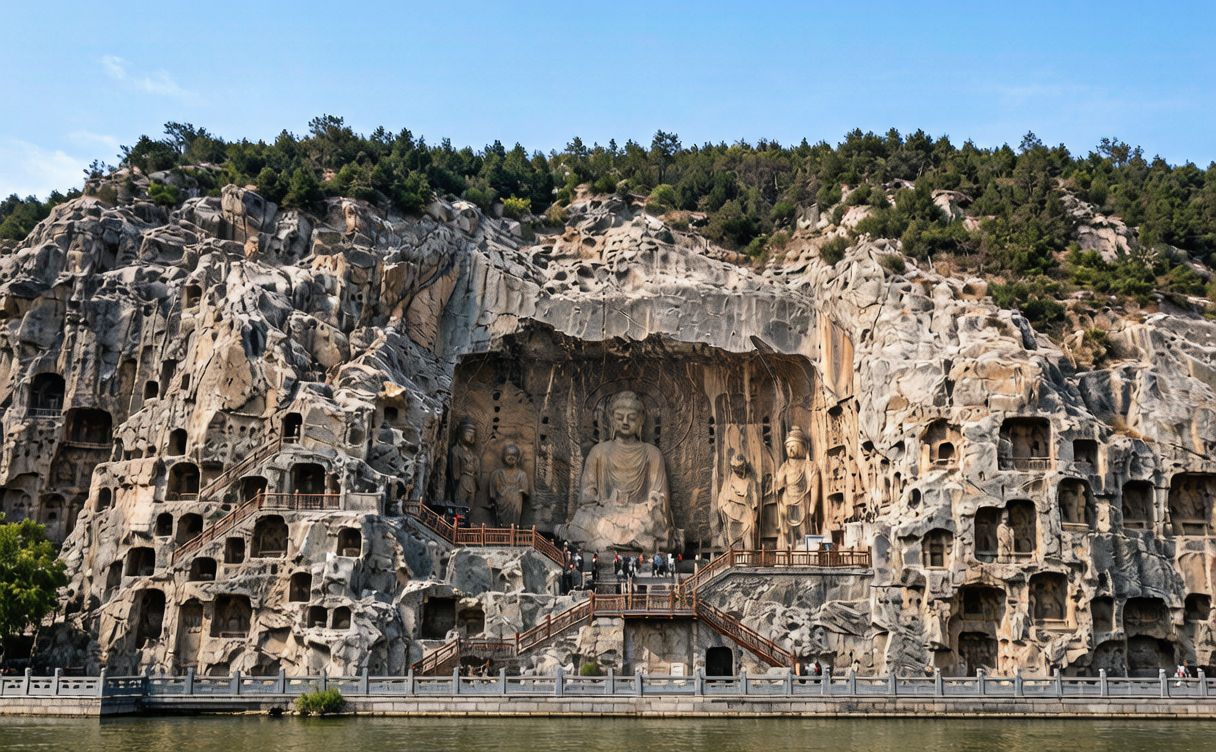
I’ll never forget the moment I stepped off the shuttle bus and turned the corner onto the riverside path. There it was: a sheer limestone cliff, honeycombed with tens of thousands of carved niches, each one holding a serene Buddha staring calmly across the Yi River. The Longmen Grottoes are not a single monument you admire from a distance — they are a mile of mountain that someone spent 1,500 years hollowing out, one prayer at a time. I’d read the numbers before I came (over 2,300 caves, 110,000 statues, 60 pagodas), but numbers lie about scale. Standing in front of that first cliff at golden hour, with the river whispering below and the smell of roasted chestnuts drifting up from a nearby cart, I finally understood why UNESCO calls this one of the finest examples of Chinese Buddhist art on Earth.
What the Longmen Grottoes Actually Are
To call them a “grotto” undersells it. The Longmen Grottoes are a chain of cave temples carved into the east and west cliffs of the Yi River, about 12 kilometers south of Luoyang in Henan Province. Two ridges face each other across the water like a stone gate — in fact, “Longmen” means “Dragon Gate.” The carving began in the year 493, when the Northern Wei dynasty moved its capital to Luoyang, and continued off and on for the next five centuries under the Tang. That timeline matters: you are not looking at one style but at the evolution of Chinese sculpture itself, from the thin, severe, almost otherworldly Wei Buddhas to the round, plump, unmistakably Chinese faces of the Tang.
The Longmen Grottoes split naturally into three zones. The West Hill (Xishan) is the headliner — it holds roughly 90 percent of the statuary and nearly all the famous caves. The East Hill (Dongshan) is quieter, with more rock-cut inscriptions than statues, and a lovely tea terrace where I sat and watched the light move. Between them runs the river, crossed by a modern bridge that frames the West Hill perfectly for photos. When you visit the Longmen Grottoes, do West Hill first, then cross to East Hill for the quieter second act.
Meeting the Vairocana Buddha
If you remember one statue from the Longmen Grottoes, it will be the Vairocana Buddha. She — the face is traditionally read as feminine, modeled, legend says, on Empress Wu Zetian — sits 17 meters tall in the Fengxian Temple, the last and grandest cave, completed in 675 AD. When I faced the Vairocana for the first time, I expected to feel small. I didn’t. The carving is so generous, the expression so unhurried, that the giant longmen buddha seemed to be leaning down to meet me rather than looming over me. Her hands rest in her lap, her robe folds fall in clean rivers of stone, and her slight smile has outlasted fourteen centuries of wind, flood, and the occasional idle bullet from a wartime marksman.
A local told me to come back at 4 p.m. “The face catches the low sun,” he said, “and the stone turns the color of warm tea.” He was right. By late afternoon the limestone glows, and for twenty minutes the Vairocana looks lit from inside. That’s the single best photo window at the whole site, and it’s free — no filter, no tripod gymnastics required.
How the Longmen Caves Were Made (and Looted)
Walking the path, you’ll notice something unsettling: many of the smaller Buddhas have empty eye-sockets, or are missing entirely, replaced by raw square holes. The luoyang grottoes suffered badly in the early 20th century, when foreign collectors and dealers chiseled out entire reliefs and shipped them abroad. Several of the finest Tang sculptures now sit in museums in New York, Boston, and Paris. China has spent decades repatriating what it can, and the on-site museum displays both rescued pieces and the sobering story of the looting. It’s a reminder that this is not just art — it’s a wound that’s still healing.
What survives, though, is staggering. The Binyang Middle Cave took the Wei court twenty-four years to carve, and it remains one of the Longmen Grottoes’ most complete Wei-era interiors. The Ten Thousand Buddha Cave (Wanfo Dong) packs precisely that many tiny figures into its walls, each no bigger than my thumb. And the Guyang Cave, the oldest at the site, preserves early “calligraphy cliffs” — stone slabs of classical Chinese script that scholars still pilgrimage to see. For a traveler, the takeaway is simple: pace yourself. There is more here than any single visit can absorb, and the magic is in the details, not the headline statues.
Getting to Longmen Grottoes from Luoyang and Xi’an
Logistics are refreshingly easy. From central Luoyang, Bus 81, 53, or 60 drops you at the entrance in about 40 minutes and costs a couple of yuan. A Didi ride runs 30–50 yuan depending on traffic. If you’re basing yourself in Luoyang for a few days, the Longmen Grottoes are a half-day outing you can pair with the White Horse Temple (see below). Luoyang itself is a criminally underrated city — the ancient capital of thirteen dynasties — and pairs beautifully with the grottoes as a two-night stop.
Coming from Xi’an, it’s a short hop on the high-speed train: roughly 1.5 hours, with departures every half hour during the day. I did exactly this — a morning train from Xi’an, a taxi to the site, four hours among the caves, and back to Xi’an for dinner. It’s the most efficient way to see two of China’s heavyweight historical cities in one trip. Plan your rail leg with our Xi’an travel guide and the high-speed train guide for foreigners before you book.
Tickets, Timing, and Photo Light
Entry runs about 90 yuan in peak season (March–November) and 60 yuan off-season, with the Longmen Grottoes open 8 a.m. to 6 p.m. in summer, closing earlier in winter. Buy at the gate or, better, through the official WeChat mini-program to skip the worst of the queue. Two tips I wish I’d known: first, the ticket includes the East Hill, so don’t treat it as an optional add-on. Second, the electric cart from the parking lot to the entrance is worth the few yuan if it’s hot — the walk is longer than it looks.
For light, the West Hill faces east, so it’s best shot in the morning and again at late afternoon; midday is flat and harsh. The East Hill, facing west, is your golden-hour spot for a silhouette of the whole cliff line. Bring a polarizing filter if you’re serious about photos — the river glare is real. And wear real shoes: the path is paved but long, with many stairs.
Pairing Longmen with White Horse Temple
Sixteen kilometers away sits the White Horse Temple, traditionally regarded as the first Buddhist temple in China, founded in 68 AD. The two sites together tell the whole story of how Buddhism arrived, took root, and then exploded into stone at Longmen. I made the mistake of doing both in one day on my first visit and felt rushed at both. On my second trip I gave the Longmen Grottoes a full morning and the temple a lazy afternoon, and it was the right call. A local told me the temple’s international quarter — with replica pagodas gifted by India, Thailand, and Myanmar — is best at opening time before the tour buses roll in. Trust the locals on this one.
How Longmen Stacks Up Against China’s Other Cave Art
If rock-cut Buddhism is your thing, China delivers three masterpieces, and the Longmen Grottoes are the most accessible of them. The Datong Yungang Grottoes are older, more Central-Asian in flavor, and less crowded. The Mogao Caves at Dunhuang are painted rather than carved, a desert library of murals. Longmen sits between them in age and beats both for ease of reach. For me, the Vairocana alone justifies the trip, but seeing all three turns a checklist into a real education in how a religion became Chinese.
And if you’re building a China itinerary around must-see sights, the grottoes absolutely earn a spot on any serious China bucket list of attractions — right alongside the Terracotta Army and the Great Wall.
Practical Wrap-Up
The Longmen Grottoes reward the curious and punish the rushed. Go early, walk slowly, cross the river, and stay for the last light on the Vairocana. Bring water, comfortable shoes, and a willingness to let 1,500 years of devotion sink in. I left feeling smaller in the best way — like I’d been let in on a secret the cliffs had been keeping since the year 493.
For authoritative background on the site’s inscription and preservation, see the UNESCO World Heritage listing for the Longmen Grottoes.